Showing posts with label Serial Killers. Show all posts

Wednesday, July 9, 2025

Mr. Right


Mr. Right, by Carolyn Banks
May, 1980  Warner Books

I recently discovered this one at a Half Price Books. Apparently making a bit of a splash upon its original 1979 hardcover publication – the back cover quotes a glowing review from CosmoMr. Right was republished in 1999 under much “parafeminist” ballyhoo. Curiously this 1980 paperback doesn’t mention that at all, and indeed does a better job of describing the book. 

To be honest, I didn’t get any “feminist” angle from the novel. Sure, protagonist Lida is a sexually-liberated young woman who keeps a list of the 30-some men she’s been with, but at no point does she use this as a proclamation that “a woman needs a man like a fish needs a bicycle.” Indeed, in another of those unintentionall “tells” that I love so much, Lida thinks something is wrong with her and wonders if she’ll ever find true love. Lol, there goes the “feminism” thing; Lida needs a man, after all. 

Another humorous thing is how much the sex angle is exploited on the back cover. Folks, I have to report that again we have that curious ‘70s phenonmenon of a “sexy book” that hardly has any sex in it, and indeed the vast majority of the sex occurrs off-page. There is nothing in this book to the sleazy length of, say, The Baroness, or even of contemporary popular fiction like Harold Robbins. Rather, the sex scenes we do get to read about are over and done with in a few sentences, and seldom if ever dwell on any juicy details. 

I also found it interesting that there’s nothing different about Lida, at least when compared to the average female protagonist of the day – in Robbins, in Hirschfeld, in Susann. Those authors, and innumerable others, gave us female characters who were both strong and promiscuous, who were literate and witty. All told, the only thing different about Lida is her self-doubt (she’s certain something is “wrong” with her), and also she has small boobs – though, again demonstrating the lack of focus on anything risque, we aren’t even told this until rather late in the game. 

Well anyway, Mr. Right is really more of a mystery, anyway, one that just happens to feature a promiscuous single woman in her 30s who fears that the man she is falling in love with might be a murderer. This is Duvivier, a famous mystery author who writes under other pseudonyms and who might have murdered a woman back in the early ‘60s, though Lida only learns this through coincdental plotting – her friend, Diana, happens to sleep with a guy who knew of a murderous colleage, years before, and Diana fears this man might have gone on to become Duvivier. 

A big problem with Mr. Right is that Duvivier is not built up enough. Lida reads one novel by the guy, brought to her in the hospital by Diana (Lida’s there to have an abortion!), and Lida likes it so much that she writes Duvivier a fan latter. It would have helped tremendously if we had been told more about the man’s novels, or maybe even gotten to read snatches of them; author Carolyn Banks could have had a lot of fun spoofing the mystery thrillers of the day, but apparently this thought did not occur to her. 

So, as with so much of the novel, we are only told of how great Duvivier’s books are, particularly his murders. Lida also responds to the fact that Duvivier clearly enjoys writing his books – Lida is an English teacher at an all-black college in Washington, D.C., and thus responds to what she sees as Duvivier’s gifted mocking of literary conventions. 

We also have a lot of scenes from Duvivier’s point of view; the novel hopscotches a lot, and I’m happy to report that Banks either gives us white space to denote this or just starts a new chapter. In fact there are a lot of chapters in Mr. Right, some of them as short as those in the average Richard Brautigan novel. Anyway, Duvivier is droll, elitist, and condescending – and also enjoys masturbating when devising the murder scenes in his novels. 

The gist of the novel is that Lida belives she’s found “Mr. Right” in Duvivier, due to that one novel of his she’s read; again, it would have been so much better if we’d learned more about his books. It would have helped explain why Lida, a woman who is having sex with one guy on the very first page and will with another not many pages later – and who chastizes herself for being screwed up and whatnot – would fall in love with Duvivier in the first place. 

There’s some cool stuff that resonated with me where Lida tracks down Duvivier’s real name. Showing how this sort of thing was done before the internet, Lida calls the Library of Congress and has them root through varous files; it’s a nice bit of investigative work that impresses even Duvivier, when he learns of it late in the novel. This “uncovering an author’s real identity” was right up my alley, and I’m also happy to report that Mr. Right even refers to Jimi Hendrix, not just once but a few times. 

The pseudonym stuff might have seemed revelatory in the day, but is altogether quaint n our internet/AI world. But it was cool to see the work one had to do to find the real name of an author – and, as Duvivier is told by a librarian who takes his job very seriously, there’s nothing to be found if the author specifically tells the publisher not to share his real name, something Duvivier never thought to do. 

Banks drops more ‘70s topical details here, like mentions of the pseudonymous bestsellers The Sensuous Woman and The Sensuous Man; she also references The Sensuous Dirty Old Man, another real book, but the librarian states that it was by “Mr. X;” in reality it was by Dr. A. This same librarian claims to know who “Mr. X” really is, and tells Duvivier that he’d never believe it; one wonders if Carolyn Banks herself knew that Dr. A was really Isaac Asimov. 

All these things are up my alley, but unfotunately a big problem with the novel is Lida. In another “tell,” instead of coming off as the strong and independent woman the author and publisher(s) intend, she instead comes off like a self-involved whore. Perhaps this is another “tell,” or self-own. Lida sleeps with a married man and even visits him for more sex while he’s in the hospital, all while wondering why she can’t meet a real man – we even learn she had sex with one of the students in her class, a black kid named “George Washington,” just so she could write that particular name down on her list of conquests. Or, as the kid told her – all of this relayed to us via dialog, as a lot of the story is – Lida would be able to put up a sign over her bed that stated, “George Washington slept here.” 

There is a lot of pre-PC humor here that had me laughing at times, but I’m sure it would be forbidden today, as a lot of it has to do with Lida’s comments about her black students, the majority of whom are not intelligent. When Lida and Duvivier meet, there’s also a lot of witty repartee between the two; Banks capably demonstrates how the two were made for each other. There’s also a very funny part where Diana tries to come to Lida’s rescue during a play and starts yelling that she can’t see when the house lights go down, much to the annoyance of the audience. 

But a lot of Mr. Right is made up of incidental scenes that have little bearing on the plot. Also, Banks has a tendency to write in short, punchy sentences, not much setting up scenes or giving us an idea why they are important to the story. In a lot of ways – from plotting to writing – the novel reminded me of another contemporary “spoof” of popular fiction, The Serial

Also, a lot of the book occurs in the early 1960s, right after the JFK assassination. This part is very much out of a mystery novel, concerning a nebbish and possibly homosexual young man who might or might not have murdered a woman, and who might or might not have become Duvivier. Banks hopscotches from the ‘60s to Lida in the ‘70s and also Diana (who has her own share of the narrative), so there really is a lot of jumping around in the novel. 

What puzzles me is why contemporary reviewers would think this novel was so different. I mean, this was an era in which a mainstream bestseller featured characters giving each other golden showers, so how in the hell could anything in Mr. Right have been considered risque or boundary-pushing? It’s altogether tame in comparison. And Lida, despite her sparkling wit, isn’t too different from sundry other female protagonists of the time. Only in her previously-mentioned self-doubt is she different, and that begins to wear thin quickly. 

Overall I’m glad I came across Mr. Right in the bookstore, as I doubt I would’ve have learned of it otherwise. Carolyn Banks proves she can deliver witty dialog and memorable situations, but all told I didn’t feel that the actual novel lived up to the sordid spectacle promised by the back cover. But then, do they ever?

Wednesday, April 17, 2024

The Ripper


The Ripper, by William Dobson
December, 1981  Signet Books

I’d never heard of this obscure and apparently scarce Signet PBO until I recently came across it at the Frisco Half Price Books, of all places – I’ve been going there off and on for the past 20 years, and it’s certainly not a bookstore where you can expect to find rare books. Of course they wanted four bucks for it, but I saw copies went for much higher online, and in my usual high spirits I figured what the hell and bought the damn thing. 

A big thanks to Will Errickson, who did a post on author Michael Butterworth, credited as “William Dobson” here on The Ripper and his other Signet PBOs. Curiously though the book is copyright under Butterworth’s real name, despite there being a bio at the end of the book for William Dobson! There must have been an interesting story with Butterworth, as he was a British author who lived in London, but it looks like The Ripper and his other Signet books were only published in the United States. Curious why the novels weren’t published in his home country, as The Ripper is so British it hurts – written in that same haughty, patronizing tone typical of British pulp. 

But then, the novel’s really more of a Mystery, just wrapped up in the sleazy trappings familiar from many Signet PBO thrillers of the era. In fact the back cover copy and the first page preview go out of their way to hype the kinkiness of the book, calling out the sleazy proclivities of several of the characters. But, as you’ll no doubt be unsurprised to learn given the British origin of the novel, such material turns out to be scant at best in the narrative itself. The very few sex scenes are all off-page, and those sleazy proclivities are essentially info-dumped to us in bald narratorial exposition. Even the murders, which essentially would be the biggest draw of the book, are for the most with over and done with in a jiffy, Butterworth only vaguely describing the gore. 

That said, there is a very nice (and British) dark comic vibe to the novel; Butterworth basically just has fun spoofing various upper-crust English people and then killing them off; the humor is especially dark in a ghoulish sequence in which a particular character is murdered while sitting in a car, but the body is not discovered until after the novel’s events have concluded – and Butterworth occasionally cuts back to the corpse, avidly detailing its latest state of vomit-inducing decay. But man that “British” vibe really just kills the book…I mean speaking of “upper crust,” that’s really how the book is written, that sort of “I’m not taking this seriously, dear reader, so I hope you don’t, either!” vibe that I’ve found is so common in British pulp novels. 

So, The Ripper is a murder mystery, with the mystery of course being who the Ripper is. A serial killer operating in Soho and environs, the Ripper is known for slashing wide open the mouths and throats of his victims and then stabbing them until their eviscera is spilled out everywhere; he kills men and women, and the novel opens with the Ripper in the act, chasing a young woman named Eunice through the darkened, early-morning streets of Soho. An effective scene, very much on the horror side, with the Ripper almost superhuman, but here we get a taste of what Butterworth will do throughout the majority of the novel: lots of pages focused on the thoughts of the soon-to-be victim, followed by a quick chase, followed by an even quicker death. 

Essentially, The Ripper is comprised of various one-off characters going about this or that, or thinking about this or that, and then the Ripper comes out of nowhere and slashes them and they’re dead. So in a way it’s basically the usual horror novel template. Our hero, such as he is, turns out to be a private investigator named Jack Shepherd, who apparently looks like Clint Eastwood despite being an alcoholic who spends most of his days drinking, avoiding bill collectors, and sleeping in his office. This being England and all, Shepherd cannot be confused with an American P.I., meaning he doesn’t have a gun. And nor do the police Shepherd occasionally runs afoul of carry guns. Like Jay Leno would say in his stand-up act back in the ‘80s when he guest-hosted on Carson, all the cops can do over there is yell, “Stop! Or I’ll yell ‘Stop’ again!” 

But then, Shepherd’s too much of a lush to even carry a gun. In his sequences he’s desperately counting the hours until he can have a drink, and when he does drink he gets so smashed he passes out in his office – even leaving the downstairs door unlocked at one point, despite being in the midst of the Ripper case. What I mean to say is, he doesn’t acquit himself well, at least in the capacity of a bad-ass hero, but then Butterworth’s intent here seems to be how Shepherd becomes a new man in the course of the case; in that regard, The Ripper is more than just a bloody thriller, with actual character content. 

Shepherd’s brought onto the case by the elderly parents of the first Ripper victim, a pastor and his grim-faced wife. They don’t show much actual sadness over their daughter’s murder, truth be told, more concerned with how she “lost her way” and went down the wrong path and etc. At length we’ll learn that Eunice, their daughter, was a “cigarette girl,” a sort of topless hostess in a Soho bar where guys would pay extra to squeeze her boobs. Shepherd in the course of his investigation will go to this place, the Spooky Club, fairly often, but Butterworth does little to bring the sleazy environs to life; even here the “I’m not taking this seriously” vibe rules supreme, with Shepherd usually more embarrassed for the girls and their topless states. 

But as mentioned the author does have tongue in cheek; one of the Ripper’s earliest victims is a cad of the first order, an art teacher named Dawlish who is a notorious ladykiller (we even learn that he banged both bridesmaids on the day of his wedding…and his mother-in-law!). We meet Dawlish in the act, getting it on with a horny babe who poses nude for his class, and here we see in another horror-esque setpiece in the darkened university building that the Ripper is very inclusive in his kills – this isn’t a serial killer who only does in defenseless women. 

Butterworth periodically delivers short chapters in italics on the thoughts of “a death-dealer,” and these are the first-person recountings of the Ripper, who we learn enjoys his work. The “Ripper” tag comes from the press, which begins to suspect that this serial killer is the 1980s version of Jack the Ripper. But whereas Jack the Ripper killed prostitutes, this Ripper seems to kill people willy-nilly. While authorities don’t believe anything links the victims, Jack Shepherd will of course learn there’s more to the story in the course of his investigation. 

It's not an action-packed novel by any means. We’ll have various one-off characters show up for a few pages, be quickly dispatched, and then we’ll go back to Shepherd as he drinks his way through the case. He manages to get laid, at least; Dawlish’s widow, Moira, takes an immediate shine to Shepherd – indeed, it is she who claims he looks like Clint Eastwood – and beds him soon after meeting. But to give an indication of how prissily “British” this novel is…well, we get dialog like this: “If you wouldn’t very much mind, I would like you to take me again.” I mean folks if I only had a dime… Seriously, though, the book’s so British it hurts – and that’s pretty much all we get in the sleaze and exploitation departments. 

The Shepherd-Moira romance organically develops, and is one of the better parts of the novel. It starts hot, gets cool, then gets hot again, developing into something more lasting. I liked how Butterworth handled it, and while Moira doesn’t have much to do in the novel, she at least comes off as a believable character, one the reader worries about along with Shepherd when Moira expectedly runs into trouble. This is due to Shepherd doggedly pursuing his leads…actually, that’s overselling what Shepherd does in the novel. He basically calls people and drives places on occasion. There’s absolutely nothing in the way of a physical confrontation or any kind of action on his part. 

I guess the only thing that separates The Ripper from a murder mystery of decades before is the increased focus on kink and gore, but as mentioned neither are dwelled on much at all. In fact this is one of those novels where I wondered why the author even wrote it, as there’s nothing particularly memorable or novel on display. The outing of the Ripper’s identity might be it, but it’s such a curveball – though believable, given the small cast of characters we’ve been given – that it more so leaves the reader scratching his head; this is another one of those mysteries that climax with characters expositing on why this or that happened, explaining everything to the reader, like the end of just about every episode of Scooby-Doo

Another thing marking this mystery as a bit more risque is the development, late in the book, that one of the female victims was not only a junkie but also in the midst of a lesbian affair; this entails a nicely-done scene where Shepherd talks to an older cabaret singer who was in a relationship with the victim – a scene that has a surprising climax, if a bit unbelievable. Actually, a lot of The Ripper turns out to be unbelievable in retrospect, given the surprise outing of the Ripper’s identity at book’s end. 

All told I was kind of “blah” about The Ripper. It was just a bit too stuffy, and some of the prose was too ornate. I did enjoy the dark humor of it, though, and Shepherd’s blossoming relationship with Moira was nicely handled. And, at 188 big-print pages, it really wasn’t much of a time commitment. I wouldn’t recommend paying for one of the exorbitantly-priced copies currently listed on the web, but if you too someday happen to come across a copy for a couple bucks at a used bookstore, you might as well pick it up. I mean what the hell, right?

Thursday, March 21, 2024

Vice Row


Vice Row, by Fletcher Bennett
April, 1963  Playtime Books

My friends, there are covers and then there are covers, and this obscure early ‘60s “adult” novel has a cover. It fills my head with so many thoughts, all of them depraved. In fact the cover art is so good I’m sure it will be censored by the prudish AI bots that now patrol Blogger. As is typical the art is uncredited, but I’m sure someone out there might have an idea who it’s by. Also, it doesn’t really illustrate a scene in the actual novel, but it certainly captures the vibe of the book – which, as one might expect, really isn’t even very “adult” at all in today’s world. I mean the book would be considered PG-13 at best today…either an indication of how things were just too conservative and sutffy back in the early ‘60s, or an indication of how morally bankrupt we have become in our modern era. (Prudish AI bots notwithstanding.) 

I picked this one up several years ago and I’m not sure why I took so long to read it. What I was not prepared for was how good of a book Vice Row turned out to be. Actually the cover, despite being so great, is detrimental to the actual quality of the novel itself, but I’m sure that’s typical for a lot of the so-called “sleaze” paperbacks of the era. For example The Devil’s Lash, another “racy” paperback that had quality writing throughout, or even the work of Ennis Willie; with the caveat that Fletcher Bennett is more risque here than either of those examples, though even Bennett’s actual sex scenes are either vaguely described or fade to black. No idea who Bennett was, but a few paperbacks were published under his name by Playtime Books; also no idea if it was the same author for all of them or if “Fletcher Bennett” was a house name. 

Whoever Bennett was, he proves himself quite familiar with the mindsets of whores – or “girls,” as one of them requests she be called in Vice Row. I like to imagine that Bennett just carried out a lot of field research. Seriously though, he brings more to the story than the sleaze one might reasonably expect; the “girls” here are all fairly three-dimensional (so to speak!), and Bennett invests the tale with a sentimental touch that never descends into maudlin sappiness. Even the finale, in which the killer’s identity is exposed, packs an unexpected emotional punch. 

I love the coarse cover copy, which calls out that “the new girl becomes the most popular whore on vice row.” This would be Laurie, a ravishing auburn-haired young woman fresh on Vice Row who is so gobsmacking beautiful that most people can’t believe she even is a whore. We get our first indication that Vice Row is slightly more risque than other “adult” novels of the era when Bennett describes Laurie’s ample charms: 

Her face was smooth and sweet as that of a schoolgirl. Her mouth was soft, her nose was narrow and upturned, her cheeks were rosy as spring flowers. Only her eyes betrayed the knowing mind hiding behind that innocent face. Beneath the long black sweep of her lashes, the dark pools of her gaze flashed a signal as old as time, and it was a signal the regulars of the Row knew very well indeed. 

The eyes of passersby didn’t linger on her face, however. There were far more interesting things to look at. 

Such as her breasts. 

They were as round and sweetly-shaped as autumn apples, and rode proudly on her torso with a firmness that did not need the enhancement of a bra. A moment’s close study told the simple truth – the girl wasn’t wearing a bra. At the tips of her round breasts, the tiny protrusions of her nipples made buttons in the material of her dress. The girl’s breasts belonged to her entirely, and they were obviously a pair to be conjured with. 

Among other things. 

The girl’s bottom was just as beautifully-fleshed as her bust. As she walked, twin tense cheeks worked in a rhythmic flexing against the seat of her dress. The curves were smooth and taut, of a size and shape to fit the curl of a man’s fingers neatly. 

Her legs were long. The roundness of her thighs could be glimpsed in the way the cloth of her skirt clung to their contours, and her shapely calves shifted with subtle muscle as she walked. She wore simple sandals on her feet; her ankles were finely-boned, her toes were slender and straight, the toenails were painted red. 

Now that my friends is how you exploit a female character! 

I forgot to mention, but “Vice Row” is really named Water Street, an area well-known for prostitution in some never-stated city. Bennett keeps the entire 224-page novel focused on this area, and populates it with a small but memorable cast. Surprisingly, “new whore” Laurie will not turn out to be one of the main characters; rather, she is a source of much discussion among the Vice Row regulars, and Laurie herself only appears in a handful of scenes – none of them, I should specify, being a sex scene! Rather, the majority of the heavy sexual lifting will be carried out by a blonde pro named Bunny, one who – we are copiously informed – has big boobs and a big butt and, unlike most pros, really enjoys having sex. 

The novel features a memorable intro of Laurie arriving on Vice Row, looking like some goddess among the riff-raff; she’s carrying luggage with her, which everyone finds hard to understand – surely she isn’t a new girl on the Row? Immediately she is accosted by a youth who drums up the courage to ask Laurie for her going rate, but Laurie shuts him down cold, even threatening to slam him in the jewels with her suitcase. Surprisingly, this affronted youth will become one of the novel’s many characters, simmering with rage that Laurie spurned him and trying to find her so he can get revenge – while taking out his anger on other hapless hookers. 

Another main character is soon introduced: Pop, elderly proprietor of the Double Eagle, a bar on Vice Row that is frequented by the girls, though Pop himself has no involvement in the business. This greatly puzzles sleazy Sergeant Polowski, a corrupt cop who allows Vice Row to operate because he’s paid off by Pop and the brothel owners and whatnot. However the main madam on the Row is Nell, a heavyset lady who “offices” out of a diner – which she owns, as well as the building it’s in. Bennett shows some foresight here with Nell being a successful businesswoman, owning quite a chunk of Vice Row and keeping her affairs in order. 

But then, throughout Vice Row Fletcher Bennett shows an understanding of character well beyond what one might expect of a vintage sleaze paperback. Pop in particular is prone to philosophical ruminations, and there’s a nice running theme about his “dream” to one day retire from Vice Row and live on a farm out in the country. There’s also a nicely-developed rapport between new girl Laurie and Pop, who immediately takes a paternal interest in her, sensing that there is something special about this girl – however, I was a little surprised that Laurie soon after essentially faded into the narrative woodwork, only appearing in passing. 

Much more focus is placed on Bunny, Bennett again expanding on his theme with the sentimental storyline of a prostitute falling in love with her john – a story Bennett handles so successfully that it’s actually a moving storyline. This would be Louie, an unhappily-married dude who, when we meet him, has just engaged Bunny for an hour’s work. This is how the two meet, and also where we get an indication of the type of sex scene Bennett will write in Vice Row

She rubbed against his belly, positioned herself, then thrust her body upward in an expert lunge. 

Their flesh blended. 

His mouth continued to kiss her breast as she began the tingling rhythm, moving her hips in time with the ticking of timeless mechanisms. Instinctively, he took up her beat, measuring his own plunge downward so that it corresponded with her lunge updward, slapping bellies with her, then pulling apart so that their deep sweet connection was almost lost. 

Almost, but not quite. 

Bunny felt the thrill coiling inside her. This, she decided, was going to be a real man. This one was going to be a blast. 

“The ticking of timeless mechanisms” – almost sounds like the title of a Pink Floyd song. So as you can see, the topical details are mostly relegated to the bodies of the women, but the actual “dirty stuff” is more intimated, or happens off-page. The above is actually the most explicit sex scene in the novel. So I guess even sleaze books could only go so far in the early ‘60s. I find this stuff so interesting; ten years later Harold Robbins would have best-sellers that featured not only super-explicit sex but even had characters pissing on each other

I also found it interesting how the meanings of words have changed over the decades. For example, that “hunk” was once used to describe an attractive woman! “You’re some hunk of woman,” etc. But then “hunk” is also used to describe a good-looking man in the book, so I guess once upon a time “hunk” was a unisex description. Even stranger is that the same, apparently, could be said about the phrase “well hung!” Judging from Vice Row, “hung” was once also used to describe a woman’s ample charms – “The way you’re hung” and etc, referring to a lady. And no it’s not a transvestite being discussed! 

There’s also a thriller element at play with the gradual reveal that a killer’s on the Row, one who specifically targets hookers. Bennett periodically cuts over to the perspective of the killer, never divulging his identity; we only know he wears a “disguise” when in public and also that he uses a straight razor – and has killed 30-some hookers in his career, slashing their throats and then mutilating them. Bennett well handles the mystery of the killer’s identity, but I must confess it soon became apparent who the killer really was; the revelation is another indication of how things have changed since 1963. What might have been shocking then is “I figured that out a hundred pages ago” today. But I won’t divulge it here so as not to spoil the surprise for those who decide to read Vice Row

That said, Bennett really handles the story with skill, jumping often from character to character to keep the story moving. Even Sgt. Polowski comes off as a realized character, and not the cliched corrupt cop one might expect. Though he does prove himself an unlikable character, taking “payment” from hookers at his whim, leading to a bit where slim pro Fay must keep her gorge down while taking care of the “thoroughly unpleasant” Polowski. Fay is mistreated throughout the narrative, and again not to go into spoilers but Fletcher Bennett sufficiently develops his prostitute characters so that it resonates with the reader when some of them are killed – and one becomes especially concerned that others in particular might also be killed. 

There’s almost a vibe of Herbert Kastle in the murder sequences; not in the style of the prose but in how the killer realizes he can basically get away with anything, given that he’s killing off the scum of society. And Bennett again shows the plight of these hookers when one of them is murdered, and we’re told that “by the end of the week” most people on Vice Row can’t even recall what she looked like. But as mentioned the reader does care for them, especially Bunny, who as it develops is essentially the main female character in the novel; Bennett skillfully dovetails her growing love with Louie alongside the imminent threat that the killer will slash Bunny’s throat. Speaking of which Bennett doesn’t much dwell on the gore, though we’re told the bodies are so disfigured that characters puke when they see them – most notably Polowski, who discovers the first corpse. 

But there’s also quite a bit of genuine humor in Vice Row. To be sure, there’s nothing satirical nor spoofy about the book – everything is on the level. But some of the character interactions are humorous, especially a conversation between Bunny and a hooker named Jan, who suspects every other hooker of being a “dyke.” But when Bunny questions Jan on why she suspects this – namely how those “dykes” will refer to other girls’s bodies so adoringly – Bunny exposes how Jan talks the very same way about the other girls. Hence, one might reasonably suspect that Jan herself is a “dyke.” There’s also some darker comedy – and another indication of changing sentiments – when Louie decides between Bunny and his cold fish of a wife. Louie’s wife refuses to have sex with him, so an angered Louie goes home, “belts” his wife a few times to snap her out of it, then forces her to go down on him – and when he realizes she’s just faking her excitement, he tells her “Goodbye, bitch!” and heads back to Bunny! 

There really isn’t much wasted space in the book, and Bennett really keeps the story moving. He also successfully weaves together the connecting dynamics of the various characters, from Bunny and Louie to the punk kid who likes to beat up Vice Row hookers. Also the unmasking of the killer is very well handled, and despite being a bit harried – one gets the impression Bennett was quickly approaching his contracted word count and thus wrapped it up – it still packs an emotional wallop. What could have been a bonkers, sleazy reveal is instead cast in a more somber glow, given that it’s elderly Pop who ruminates on it all – in fact I got the impression Fletcher Bennett himself might have been older, as there’s more of an introspective and reflective vibe to things than the primal rush one would expect from a younger, hornier author.  Then again, I did find it curious that the majority of the sex scenes were relayed through the perspective of Bunny, which almost led me to suspect that “Fletcher Bennett” might have been the pseudonym of a female author.

Overall I very much enjoyed Vice Row, and it’s inspired me to read some more of those vintage “adult” crime paperbacks I picked up several years ago.

Thursday, May 11, 2023

New title from Tocsin Press

Just wanted to let you all know that there’s a new book out from Tocsin PressSuper Cop Joe Blitz: The Maimer, by Nelson T. Novak. Here’s the cover: 

Sgt. Joe Blitz, that tough 1970s New York cop who featured in The Psycho Killers, is back in another sordid tale which sees him up against a Satanic snuff-flick cult. 

You can check out the back cover copy and read the first few pages of the book here

And let’s not forget the other books currently available at Tocsin Press… 


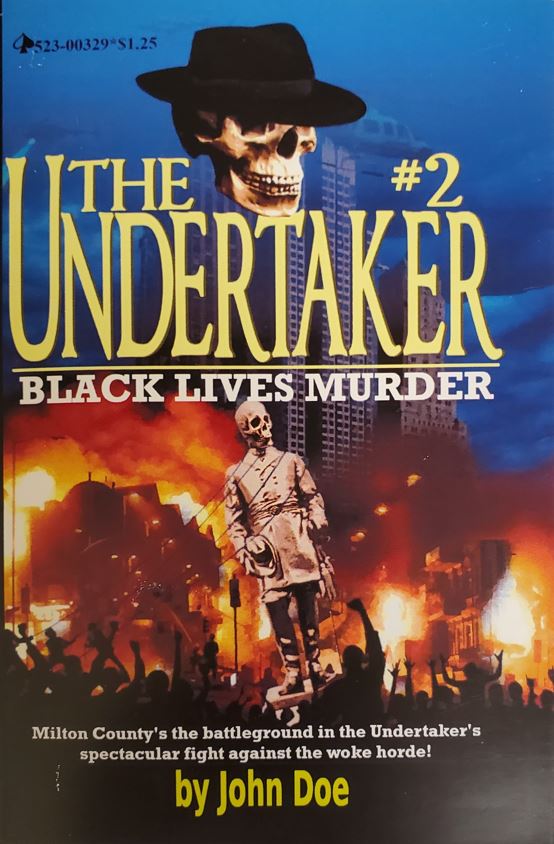
The Undertaker #2: Black Lives Murder, which was another of the best books I read last year – I mean if you get the first one you should get this one, too! 


If you like thigh-boot wearing Nazi she-devil vixens, and you like John Eagle Expeditor, then you’ll certainly enjoy John Falcon Infiltrator: The Hollow Earth


The Triggerman: Brains For Brunch, in which Johnny Larock, the Triggerman (who is of course not to be confused with The Sharpshooter or The Marksman), satiates his hunger for Mafia blood!


Mentioned above, Super Cop Joe Blitz: The Psycho Killers is the previously-published adventure with Joe Blitz...one involving a rather grisly rape case.

And like the old Pinnacle house ads said, there’s more to come…

Wednesday, April 5, 2023

They Thirst


They Thirst, by Robert R. McCammon
May, 1981  Avon Books

Robert McCammon was a name I knew well in my horror-reading teen years; you’d often see copies of his super-fat paperbacks in middle school and high school. I was a Stephen King guy, though, and rarely ventured outside his world to other horror fiction. I do recall attempting to read McCammon’s Swan Song at some point in high school – yet another super-fat paperback, this one about the end of the world – but I couldn’t get over how similar it was to King’s The Stand (which I’d read in its recently-published uncut version shortly before), so I put it aside. Literally the only thing I recall about Swan Song was the description that one of the characters, a black professional wrestler, had a stomach that had gone to “marshmellow” due to his eating donuts or something, and that “marshmellow” description always stuck with me. 

 Well anyway! I’ve been on a horror kick lately, though to tell the truth it’s starting to wane now (it actually lasted longer than previous horror fiction kicks!), and I decided to give McCammon another chance. But as usual with me it couldn’t be easy. The book that really caught my interest was this one, an early novel of his, yet another super-fat paperback, about vampires in Los Angeles. Another one seemingly inspired by King, in this case Salem’s Lot. But folks They Thirst ain’t easy to get hold of. The days of Robert McCammon’s paperbacks being ubiquitous are long gone, especially when it comes to the first four he published, which McCammon himself has kept from being reprinted. They’re now known as the “Condemned Four.” 

Predictably, this means that those first four books are overpriced on the used books marketplace, even though they each went through a few printings. And They Thirst is the most overpriced of all. Hell, there isn’t even a digital scan of it on The Internet Archive. Sellers want $30 and up for copies. I became so obsessed with finding this book that I actually purchased a coverless copy of the original Avon Books edition…and it cost me a dollar. The thing is in super beaten shape, but hey, I just wanted to read the book, you know…I don’t really get worked up about “mint condition” and etc these days. Plus the cover’s kind of lame on this edition. And also, for the first time I’d been called for jury duty, so I thought I’d bring the book along to read. You don’t have to worry about maintaining the condition of a book when it’s already missing the front cover, has a broken spine, and in general looks like it was carried in a backpack on a trek across Europe. I also thought if they saw me reading a book about vampires in L.A. they wouldn’t pick me for the jury, but unfortunately that didn’t work and I was picked anyway. 

Running to 531 small-print pages, They Thirst is not a quick read. Not by a long shot! It took me a few weeks to read it. And I have to say, there were times when I was sufficiently caught up in it that I wanted to read nothing else. (I’m not always faithful to long books when I’m reading them.) I thought They Thirst might be this year’s Colony or The Tomorrow File, a long book that could’ve just kept going on and on, such was my enjoyment. And speaking of Ben Bova’s Colony, it seems to me that Robert McCammon was attempting the same sort of thing, like also what Larry Niven and Jerry Pournelle did with Lucifer’s Hammer: a genre novel written in the style of the bestselling mainstream fiction of the day. They Thirst is ostensibly horror, but like those other novels it offers a panoramic view of a large cast of characters interracting across a large canvass of action, with the idea of appealing to a larger readership than just horror fans. 

But here’s the thing. They Thirst is usually loglined as “vampires in Los Angeles.” It wasn’t until around page 400, though, that I realized IT WASN’T EVEN A VAMPIRE NOVEL. I have no real knowledge of Robert McCammon, haven’t researched him at all, but if I am correct he has “banned” They Thirst and the previous three novels because he considers them subpar, or at least not good indications of his writing. I don’t know what he holds particularly against They Thirst, but my own personal guess would be because the novel suffers from identity confusion. I mean the first two hundred pages are like a crime novel about a serial killer in L.A., sort of a prefigure of Marcel Montecino’s The Cross Killer. Then They Thirst turns into an end-of-the-world disaster novel, before transforming yet again into a quest novel in the final quarter. Actual vampire stuff is scant, and like John Steakley’s later Vampire$, the vampires that do show up come off more like zombies. 

To be sure, this is not a Dracula type of yarn; these vampires are not the suave sinister types who lure in young women (or men) and have their way with them one by one. Hell, Thirst is more of a “traditional” vampire novel than this is. Rather, They Thirst is more of a virus contagion sort of yarn, with vampirism quickly spreading across sections of Los Angeles and turning regular everyday folks into bloodthirsty vampires who thirst for blood. To me, it just all seemed more like a zombie apocalypse sort of story, only McCammon wants his cake and to eat it, too, as he tries to have it both ways – vampirism spreads to such an extent that almost the entirety of L.A. has become vampires, or knows about vampires, yet our author also wants to have it that the actual existence of vampires is still questioned by most people, especially those outside of L.A. This becomes especially hard to buy as the action becomes more and more apocalyptic in the final section. 

Oh and I almost forgot: above I wrote that They Thirst clearly seems to cater to the bestselling fiction template of the day, but one thing I was bummed to learn was that it was very tepid in the sleaze arena. I believe there’s only one sex scene in the novel, early on, and it’s minimal at best. What I’m trying to say is, this is certainly no Live Girls. And hell for that matter, McCammon doesn’t even exploit the setting much. When I saw this novel was about “vampires in L.A.” I imagined, you know, vampires running amok in the neon glow of Sunset Strip, but that never happens in the book. We get a lot of namedropping of various streets, buildings, and sections of the barrios, but for the most part the zombie-like vampires lurk in the shadows of empty houses, and the king vampire himself lurks above the city, in a castle built by a murdered horror movie actor. 

Now this bit really grinded my gears. Another thing the McCammon of today might not like about They Thirst is that there’s so much setup with little payoff, from characters to subplots. One of the latter concerns the wonderfully-named Orlon Kronsteen, a Bela Lugosi-type horror actor who starred in a movie about Jack the Ripper (and other stuff, though we are told woefully little of him) and had a castle built above Los Angeles. But “several years ago” Kronsteen was murdered, apparently in some sort of ritual deal, with his head cut off or something…and Prince Vulkan, the king vampire of They Thirst, decides this castle will be his perfect home base. But nothing whatsoever is made of Kronsteen, the entire mystery of why or how he was killed just totally dropped from the narrative…even worse is that some random biker seems to imply that he was there the night it happened, but this biker too is dropped from the narrative. 

It's like that throughout. In pure “bestselling fiction” style, Robert McCammon introduces sundry characters at the start of They Thirst, but he turns out to be like a pet-sitter who takes on too many animals to watch. I mean pretty soon most of these characters are just plain gone, and folks by the end of the novel they still haven’t come back! In fact it’s a wonder Avon Books didn’t package They Thirst like a blockbuster-type novel, giving a quick logline of the many main characters: 

Andy Palatazin – Los Angeles police captain who knows vampires are real and ultimately sees himself as the only man who can stop the infestation. Plus he’s haunted by the ghost of his mom. 

Gayle Clarke – Hotstuff reporter for a tabloid; when her boyfriend tries to drink her blood she realizes vampires might exist. Intermittently disappears from the narrative, only to return hundreds of pages later. 

Prince Vulkan – Dead since the 1400s, turned into a vampire as a teen, with the appropriate temper tantrums of an undead teenager. The chosen disciple of “The Headmaster” (ie the devil in all but name), for reasons not explained he’s only now decided to conquer L.A., despite being hundreds of years old. 

The Roach – Serial killer freak with a penchant for murdering hookers who look like his dead mother and stuffing cockroaches in their mouths. Serves as the would-be Renfield to Prince Vulkan’s Dracula. 

Kobra – Albino biker with the memorable intro in which he blows away some rednecks in a bar with his Mauser for absolutely no reason. Perhaps the most wasted character in the novel; Kobra is developed as this super cool badass but anticlimactically drops out of the narrative, only to return sporadically afterward. 

Tommy Chandler – Another teen, this one alive, a monster movie fan with posters of Orlon Kronsteen on his wall and also who knows how Kronsteen’s castle is layed out, thanks to a feature in an old issue of Famous Monsters Of Filmland

Wes Richer and Solange – He’s a rising star on the comedy scene with a hit show in which he plays a moron Sherlock Holmes; she’s his “Afro-Asian” mistress, a stacked beauty with a penchant for reading ouija boards and whatnot. In fact it’s through one of these that the title of the novel comes into play, as Solange receives the message “THEY THIRST” from the spirit world. 

Ratty – A ‘Nam vet who lives in the sewers beneath L.A., where he grows his own drugs. In his “Timothy Leary for President” shirt he’s the highlight of the novel, though only appears in the final quarter. 

Father Silvera – A brawny priest with a hidden disease that’s killing him, he takes the expected route of denying that vampires exist, then realizing it, then refusing to go on the quest to the Kronsteen castle to kill Vulkan, and then instead saving his flock…before finally heading to the Kronsteen castle. 

There are sundry other characters, many of them unnecessary, like the hotstuff real estate lady who helped Vulkan buy the castle. She gets a few chapters, then just flat-out drops from the narrative. Same goes for the owner of a funeral parlor chain. Or Rico, who is searching for his lost girlfriend in the barrio. Or a doctor at a hospital who realizes too late that her “dead” patients are really vampires. Many of these characters are of course turned into vampires, but even then they disappear afterwards, with no “I’m a vampire now!” shock return. It’s a bit disappointing, but it must be said that, while you’re reading the book, you don’t realize that the majority of this stuff isn’t going to pan out. I mean it’s about the journey, not the destination, as I’m sure Ratty would say, but still. It wasn’t until around page 500 or so that I realized so much of this stuff was not going to be resolved. 

The first couple hundred pages were by far my favorite. McCammon delivers a taut suspense thriller with only minor supernatural overturns; this opening section is almost a standard crime novel, with Capt. Palatazin obsessed with finding and stopping a serial killer the papers have dubbed the Roach. It’s very much a police procedural, with no action, just Palatazin going about the work of deduction and following clues. And we have stuff from the Roach’s point of view; curiously, his day job is as a pest exterminator, same as the serial killer in Lou Cameron’s The Closing Circle. The horror novel stuff gradually develops, mostly through the strange bit of corpses being mysteriously dug out of graves at night. Palatazin, whose father was bitten by a vampire when Palatazin was a child in Hungary, knows something is going on. 

But the “vampire virus” stuff builds up and soon it’s more of a zombie apocalypse yarn, with whole sections of the barrio for example overrun by vampires. Then the end of the world vibe begins; Vulkan uses his powers to bring down an apocalyptic sandstorm on Los Angeles, blocking the city off from the world and keeping people from leaving. Phone lines are down, planes can’t leave, etc. This section goes on for a long time and again made me think of King’s The Stand. It’s very much a piece of disaster fiction now, with long sequences of various characters getting trapped in cars or in their homes and trying to get out before the daylight goes away so they can kill vampires. This part was my least favorite in the novel. 

Then the final quarter takes on a quest angle. Some of the characters band together to get to the Kronsteen castle, where they figure the “king vampire” might lurk. This too takes up a large brunt of the narrative; I mean they aren’t like “Let’s go there,” and then they’re at the castle the next chapter. It’s almost grueling and again takes away from the vampire stuff the reader might want. It’s really just characters fighting their way through blinding clouds of sand and trying to figure out where they are. To tell the truth it was exhausting to read. What makes it worse is that McCammon drops the ball in the finale. Major characters are dispensed with in an almost offhand fashion, and worse yet the entire point of certain characters even being here is rendered moot. No spoilers, but Palatazin in particular. I mean this guy’s dad turned into a vampire, so he has a personal, uh, “stake” in the matter, but he doesn’t contribute much to the climax. 

Even funnier, McCammon doesn’t seem to know when to end the novel. So even after the good guys have sort of won, we get like an extended 20-page bit where Gayle Clarke, who has mostly disappeared from the novel at this point, tries to escape from the military base in which survivors are being held. And it just keeps going on and on. All so she can get out to the real world and tell the story that vampires exist…not that anyone believes her. Even though the entirety of L.A. turned into vampires, complete with even the deejay on a radio station taunting the last few humans in the city. But like I said, McCammon wants his cake and to eat it too. 

So yeah, I was a bit underwhelmed with They Thirst. I do think though that I enjoyed it more than Will did, over at Too Much Horror Fiction. I was sufficiently caught up in it, at least for the first few hundred pages. But once it got to the apocalyptic sandstorm bit it started to lose my interest. I also felt the climactic assault on Vulkan in Kronsteen’s castle could have been more thrilling, but McCammon was so focused on showing how dire the plight of his characters was that he did succeed in making it all seem hopeless. But then he makes it seem so hopeless that the climax is a bit hard to buy. 

I’ve got some more Robert McCammon novels which I might read someday; one of them, Wolf’s Hour, about a werewolf in World War II, is one I really wanted to read back when it came out, but just never got around to.

Thursday, June 30, 2022

Kiss Kill


Kiss Kill, by Roy Sorrels
April, 1990  Pinnacle Books

For a book with a cover blurb by none other than Lawrence Block, Kiss Kill is very obscure these days, and likely went under the radar even back in 1990. I discovered it a few years ago, and only because I was searching for everything Pinnacle published in the late ‘80s, once the imprint was run by Zebra Books. This was also how I discovered the similarly-obscure Steel Lightning series. But it was only recently that I actually picked up a copy of Kiss Kill, given that I’ve been on a bit of a “cop thriller” kick. It sounded interesting, even if it was outside my safe space of ‘70s crime-pulp…I mean 1990 seems “new” to me, given that I pretty much live in the 1970s. 

But other than an occasional mention of fax machines, crack, or a character wearing a Batman T-shirt (those were incredibly ubiquitous at the time – in fact I remember a female comedian at the time saying that she didn’t plan to actually go see the Tim Burton film; she’d just see it frame by frame on the T-shirts of the people who passed by her on the street!), Kiss Kill could just as easily be set in the ‘70s. Actually, the novel is most reminiscent of the late ‘80s/early ‘90s revisions Nelson DeMille did of his Ryker and Keller books, ie The Smack Man and Night Of The Phoenix. Just as DeMille took the grungy midtown Manhattan of the original ‘70s books and updated it to the grungy Lower East Side of the late ‘80s, so too does Kiss Kill mostly occur in this downtrodden area. In fact Midtown and Times Square are rarely mentioned, with most of the action taking place along Third Avenue and environs. 

And this is truly a “New York” novel. Author Roy Sorrels is certainly familiar with the city, and brings it to life in all its tawdry splendor. I’m no expert on the city – again, the New York that exists in my mind is the one I read about in novels from the 1970s – but I was always under the impression that New York cleaned up its act by the ‘80s. Kiss Kill dispels that notion, and it would appear that 1989 (the year the events seem to take place) was just as tawdry as, say, 1974. It would appear that the city didn’t really clean up its act until Rudy Giuliani was elected in 1994, after which all those tawdry places became Disneyfied. Now that I think of it, Steel Lightning also took place in this same grungy, immediately pre-Giuliani Lower East Side. 

But let’s get back to how scarce Kiss Kill is, with so little detail available about it. There are only two reviews on Amazon as of this writing, the first just a rehash of the back cover copy, the other by a person saying it’s “the best mystery/suspense novel” they’ve ever read. Speaking of the back cover copy, what’s funny about it is that it sort of gives an idea of the plot, while being very misleading; it was certainly written by some editor at Pinnacle/Zebra who only gave the book a cursory glance. Here it is:


So there was no other info I could find about Kiss Kill than this, no Google Books listing with a Snippet View of the contents (no Google Books listing at all, in fact). Nothing to go by other than that back cover. In fact I kept wondering if the “lover” mention meant that the hero cop Duggan was gay; it’s my understanding that “lover” was a term used mostly by the gay underworld before all the straights co-opted it. (Humorously, as if somehow predicting my incorrect assumption, Duggan informs a character in the first few pages that he is not gay!) So I took a gamble and ordered a copy of the book – scarce as mentioned, but luckily not overpriced, at least not yet. It was pretty much what I expected, an overlong Pinnacle/Zebra book of the day (320 pages), with the embossed cover…and I admit, I was a little bummed when I discovered it was in first-person. As anyone who has spent just a little time here will know, I prefer my pulp in third-person. 

But man, I was not prepared for how much I would enjoy Kiss Kill. I mean I planned to take it to work and read it during lunch, or whenever I felt like leaving my desk…and I ended up doing that and also taking it home with me to keep reading it there. I finished the book in a few days. And sure, it has some problems…I mean the length is a major problem, as one can detect that Sorrels was given a big word count by the publisher and thus had to pad a bit, resulting in a little repetition. But other than that the book was pretty much everything I could want in a novel about a cop taking on a serial killer. Plus snuff flicks! 

There was also the mystery of the author. I could find nothing about Roy Sorrels other than that he’d published another fat Pinnacle paperback the same year, a horror novel titled The Eyes of Torie Webster. (In a cool bit of connectivity, Torie Webster is mentioned on page 98 of Kiss Kill, a “local newscaster” in New York – surely the same character as the titular Torie Webster of the other Sorrels novel, who per the back cover is a newscaster.) I found a FictionDB listing which misleadingly implied that “Roy Sorrels” was the pseudonym of a female author named Anna McClure. But as it turns out, it’s the other way around: per this 1985 UPI article, “Anna McClure” was the pseudonym Roy Sorrels, a literature professor, used for his Romance novels, which he started writing at the behest of his wife. It seems clear though that Sorrels found more success under his pseudonym, given that he only published these two obscure Pinnacle books under his real name. 

Now let’s take a look at the also-misleading back cover. Reading that, I got the impression that Kiss Kill would be about a bitter, lone (and possibly gay!) cop wandering the neon streets of Manhattan in search of a serial killer who preys on prostitutes, like a late ‘80s take on Without Mercy. As it turns out, the fact that Phil Duggan’s “lover” was killed in a shootout is incidental to the story at best, and only mentioned once or twice. And yes, the lover was a she – Duggan commited the “sin” of falling in love with his female partner, and they planned to marry, but she was killed in a shootout. Duggan, who as stated narrates the novel, is a 15-year veteran of the force, and when we meet him he’s already part of the Undercover Squad, along with a few other cops, and he’s already on a case: posing as a taxi driver as bait for a serial killer who is killing cab drivers across the city. 

What the back cover copy doesn’t make clear – and the copy is masterful in how it captures the reader’s interest but gets so much about the novel wrong – is that it’s Duggan’s new “lover” who is the first victim of another serial killer, and Duggan goes off the books to find the killer. Now, I’ll try to refrain from my usual spoilers here, but this isn’t a spoiler – we know on page one that Duggan’s woman, a former streetwalker named Mary, is dead, as the novel opens with Duggan providing her ID in the morgue. Indeed, we learn later in the novel that it was the newscast of Torie Webster that even alerted Duggan that the corpse of a torture-killed Jane Doe was found in an alley, and Duggan had a sixth sense that it was his missing girlfriend. 

From there we go back a few weeks to the various “meet cute” incidents in which Mary became a short – but meaningful – part of Duggan’s life. First he gives her a free lift while driving his cab, Mary running from some fat guy she claimed just hit her, though later we’ll learn she actually took the guy’s wallet. Duggan takes her back to her apartment, which is in an otherwise-vacant building, and ultimately turns down her offer of sex in exchange for the drive. (Mary being the character Duggan tells he’s not gay, by the way – she questions why he’d turn down a free lay.) Somehow Mary gets under Duggan’s skin and he keeps thinking about her, looking for her on Third Street and ultimately starting up a relationship with her, with Mary moving in with Duggan in his cramped apartment in the Village. 

The relationship is a bit hard to buy, but then falling in love itself is inexplicable, so I didn’t have too much of a problem with it. Mary however is a bit too flighty and flaky; she has a hard time remembering Duggan’s name and seems spaced out all the time, despite not being on drugs. She is also a supreme liar, telling Duggan a host of tall tales about her past. Duggan will have to sift through these lies when he investigates who killed Mary. Some of this plays out in memorable ways, like Mary – who by the way is only 20, or even younger – claiming that her dad was a famous wrestler, who would beat her unmerciful. Duggan tracks the man down in Jersey, only to find a rail-thin drunk who has gone to seed…a guy who lies just as much as his daughter did, and who also apparently raped his daughter. 

Mixed in with the blossoming Duggan-Mary relationship is the assignment Duggan is currently working on, the taxi driver killer. Sorrels thanks a host of cop-world figures at the start of the book, and it’s clear he did his research. The first half of Kiss Kill is a probing police procedural steeped in realism and detail. Sorrels populates the tale with grizzled cops working out of a Village precinct, peppering the narrative with their random oddball stories. It’s humorous stuff, but not nearly as egregious as the “cop tales” that made up Hellfire. And it’s very much a procedural, with no random action scenes; Duggan informs Mary that most cops don’t even take their guns out, and he personally never fires his .38 in the course of his actual investigation. 

But by page 100 we get back to the opening sequence, of Duggan identifying Mary’s corpse, and from here Kiss Kill takes a new tack, with Duggan investigating on his own. The detectives who got Mary’s case have no interest in finding out who killed some nobody street whore, and Duggan’s boss refuses to loan him to that precinct so Duggan can investigate it himself. It’s here that the Duggan-Mary thing becomes hard to buy, as Duggan informs us that only “idiot cops” fall in love with hookers; sure, they can take freebies every once and a while, as long as the sex is discreet, but only a fool would fall in love with a hooker. But Duggan is a fool, and he loved Mary, and he’s determined to find out who slashed her throat and dumped her corpse in an alley. So he tracks down the clues in his off-time. 

The back cover is accurate in this, as Sorrels well brings to life the street people of the Lower East Side. Duggan makes his way through an assortment of drug addicts, drug pushers, pimps, and whores as he tries to figure out who would kill Mary and why. The procedural vibe remains; despite his grief Duggan does not rush into the fray and takes his time tracking clues and evidence. There’s also a long discussion with the M.E. who autopsied Mary’s corpse, and we learn she had sex shortly before she was killed, was then chained up or handcuffed (apparently willingly), and then was sliced innumerable times by a blade so that she bled profusely, before her throat was ultimately slashed. 

A curious thing about Kiss Kill is that it isn’t overly graphic. Mary’s corpse – and the corpse of the second girl to be murdered – is not even described, and the few action scenes operate more on an emotional spectrum than a visceral one. The sex too is fairly inexplicit; there’s none of the exploitation of Mary or the other hookers Duggan encounters, and perhaps the most explicit scene in the book is a random bit midway through where Duggan has sex with a cop groupie who picks him up at a bar. Here we learn that Duggan, uh, “pulls out” before finishing, given that he’s lost interest in the whole thing. Duggan is a lot more emotional and introspective than your typical cop protagonist, not that this stops him from kicking a little ass. 

There’s a lot of that cool crime novel stuff I always enjoy, with Duggan infiltrating the criminal underworld and working his way around as he seeks his goal. We get a part where he buys a gun from a dude who sells crack to elementary school kids(!), and later on Duggan tangles with a pimp who goes around with a trio of rottweilers. All this stuff takes precedence in the narrative, but to his credit Sorrels doesn’t forget about the other case Duggan’s working, with the killer targeting cabbies. Again to his credit, Sorrels plays this out realistically as well, having buried clues early in the novel, clues which bear out with the uncovering of the killer’s identity. But with this disposed of, Duggan is free to pursue his own personal case. 

For a veteran cop who has seen it all, Duggan’s a little slow to figure out what happened to Mary. When another young girl is found dead in an alley – a girl Duggan’s met in his investigation – Duggan knows it’s the work of the same killer. Ultimately he’ll discover that it all has to do with the illicit world of adult films…and it isn’t until Duggan literally sees the videotaped evidence that Duggan realizes it’s snuff films in particular. Duggan has a contact who runs a newstand, and this guy tells Duggan that “back in ‘76” there was a movie released in mainstream theaters which claimed to be a snuff film, but was clearly fake – presumably this is the real-world movie Snuff being referred to. But now someone is doing the real thing, and Mary was the unwitting performer; the embossed cover art, then, is indication that at least someone at Pinnacle read the book, what with the “film strip” angle. 

Skip this paragraph to avoid spoilers; I’m only writing this paragraph in case others who have read Kiss Kill would like to discuss. Duggan finds the place that secretly made the snuff film Mary “starred” in, and it’s run by a hotstuff brunette who makes mainstream porn films…and who appears to have stepped out of a pulpier novel. Her name’s even Venus! Duggan, preposterously enough, manages to get a part in the latest mainstream porn film Venus is making, ransacking the place for evidence of snuff when no one is looking. At last he uncovers the videotaped murders of Mary and the other girl, but when Duggan gets the upper hand on Venus and the guy who “starred” in the two movies (ie the actual murderer)…Duggan calls in the police, and there follows a harried finale in which we learn that Venus and her colleague are given twenty-five years to life, “the maximum sentence.” While this I guess is believable given that Duggan’s a cop who upholds the law, I felt it was disappointing. I mean I wanted Duggan to waste them. 

Anyway, end spoilers. I can only say again how much I enjoyed Kiss Kill, I mean I was really caught up in it. Yes, some of it could have been cut, and there was a bit of repetition; for example Sorrels drops a wonderful phrase early in the book that Duggan’s nervous, and it feels like two kids learning to skateboard in his stomach. Unfortunately he repeats the same line later in the book. 320 pages of smallish print is a lot of words, and I could detect at points that Sorrels was trying hard to meet a requirement; the same thing that plagued those Steel Lightning books. I have no evidence but I’m certain Pinnacle/Zebra insisted on a big word count; just look at the bloated Doomsday Warrior books. But the fact remains that Roy Sorrels is a helluva good writer, so you don’t really mind – I’m almost even tempted to check out The Eyes Of Torie Webster, even though I haven’t been on a horror-novel kick in years. 

It's a damn shame Kiss Kill is so obscure, and that Sorrels himself is an unknown. I tried looking him up but couldn’t find anything; I even went on Facebook but had no luck finding him. It would be cool if some publisher brought Kiss Kill back into print, like Brash Books or someone. I highly recommend this one; it brings to life the crime-ridden, pre-Giuliani Lower East Side, features a host of memorable characters and dialog, and is narrated with just the right amount of literary aplomb – not to mention a good bit of dark humor. So then I totally concur with Lawrence Block’s succinct cover blurb: “Bravo!”

Friday, June 10, 2022

Dirty Harry


Dirty Harry, by Phillip Rock
No month stated, 1977  Star Books
(Original US edition 1971)

Phillip Rock, who wrote the awesome Hickey & Boggs novelization, handles the tie-in for the first Dirty Harry flick, and it’s another good book. It doesn’t come off like an entirely new story, like his novelization of Hickey And Boggs did (likely because Rock was working from Walter Hill’s original screenplay for that one). Instead, Rock’s Dirty Harry is pretty much the prototypical film novelization, serving up mostly the same story as the film but with minor variations. 

This slim UK paperback seems to be a direct lift of the text that was originally published by Berkley Books in the US in 1971. There are US-style double quotation marks instead of UK-style single quotation marks, and there doesn’t appear to have been any tinkering by Star Books. Initially I wondered if the f-bombs had been removed, as sometimes we’re informed that Dirty Harry might utter a “short, harsh, four-letter word,” and I suspected skittish British editors might have bowdlerized Rock’s original text (because they don’t use the f-word over there in England, btw). But then later in the book the word “fuck” appears, so there went my suspicions. The strangest thing though is why Dirty Harry was even reprinted in the UK in 1977. This was a year after The Enforcer was released, which was the last Dirty Harry movie until 1983’s Sudden Impact

It's been 7 or 8 years since I last watched Dirty Harry, but overall the difference I noted between the film and Rock’s novel is that, mainly, there is more characterization of the villain, Scorpio, in the novel. Here we see how much of a whackjob he truly is; he has forgotten his real name and spends most of the time looking up at the sky, wondering where the stars are. He’s very much into the astrology scene, and Rock puts the occasional horroscope for Scorpio in the book. There is more of an attempt by Rock to make Scorpio a rounded figure than there is in the film itsef, and the same holds true for Rock’s take on Dirty Harry. In the novel it seemed to me that Harry – whose full name, we’re informed, is Harry Francis Kallahan – is a bit more of a team player, and a lot of the book is comprised of him doing standard police detecting instead of making quips and busting heads. 

We’re also informed that Harry has been a cop for nineteen years and that he’s from San Francisco; he grew up in the apparently-rough Potrero Hill neighborhood of the city. I don’t know anything about San Francisco, but Philip Rock certainly seems to, as Dirty Harry is peppered with topical details about the city, to the extent that you assume Rock must have had more than a passing familiarity with the place. It’s one thing for the film to show famous locales, but another for Rock to tell us precisely where things are taking place; he even shows familiarity with San Francisco’s public transit system, down to the exact stops. Given this, I felt more of an awareness of San Francisco in the novel than I did in the film itself. I also thought it was interesting that Rock so tied the locale into the setting, given that the Dirty Harry men’s adventure novels, part of Warner Books’ “Men Of Action” line in the early ‘80s, often took Harry outside of his city. 

As mentioned Rock follows the film pretty faithfully, so I assume he must’ve gotten to view a workprint or a final draft; if I’m not mistaken, Dirty Harry was in development hell for a long time, with such actors as John Wayne supposedly at one point slated to star in it. The book even opens the same as the movie, with Scorpio up on a roof and sniping a beautiful young woman as she swims in a hotel pool. But as ever with tie-ins, we are brought more into the minds of the characters, from the insane thoughts that propel Scorpio to the thoughts of the girl in the pool – who’s here, we learn, because she’s having an affair with some lawyer she plans to marry. We also learn that her “last thought on Earth” concerns “what her breasts looked like as she drifted across the pool.” (It’s nice to know that even girls think about boobs all the time!) 

The setup here also shows how Harry comes into the fold; he simply answers the phone in the inspector’s room at his precinct because the other inspectors are busy. Whereas the film had that great time-lapse bit with the murder followed by the investigation, here it’s a bit more drawn out with Harry getting the call and heading over to the hotel. One thing to note is that Rock makes Harry a bit cheaper than in the film; indeed, we’re told he’s “a tall man, but whip-thin” and that he looks like “an overworked cop in a cheap suit.” You almost get the impression Harry's “whip-thin” because he doesn’t have the money to eat; we’re also informed that, when Harry bums a cigar from a fellow cop, he carefully pinches it out and puts it in his pocket to smoke later. 

But as mentioned, Harry comes off more as a “realistic” cop here in the novel than the one-man army he was in the film. That said, the famous opening with the bank robbery is here in the book. Same setup too, with Harry enjoying a hot dog and noticing how no one seems to be coming out of the bank across the street, even though people keep going in. The ensuing gunfight even plays out the same…save for Harry’s famous line. Here, when he holds his .44 Magnum on the lone surviving bank robber, Harry does ask whether he fired five times or six, but we get the added detail that “regulations” say he should only have five bullets…and the question is whether he’s gone against regulations and put a sixth bullet in the chamber. The film made a very wise decision in cutting out this detail; it sounds a lot more badass to just leave it as “how many times did I shoot?” Another change – instead of the more powerful “it’ll blow your head clean off” of the film, here in the novel Harry says his .44 Magnum will “turn your head into hash.” 

I should watch the movie again, because it’s the middle portion of Rock’s Dirty Harry that seemed different to me. First of all Harry’s given a new partner, whether he wants one or not: new inspector Chico Gonsales. The two begin canvassing leads, and here in the novel there’s much more of a procedural vibe than I recall the film having. Here again Rock brings San Francisco to life, with Harry and Chico driving around various neighborhoods and asking about any suspicious characters. And also here Scorpio is certainly given more inner depth than he was in the film, with periodic bits where he’ll wander around the city, often trying to hit on women who ignore him, or looking up at the sky and wishing for a place where he can view the stars. But still even here I didn’t feel that his astrological gimmick was fully worked into the plot; I mean the movie has it that he’s a psycho, which is obvious, but Rock tries to integrate the horoscope stuff into it – all of it no doubt inspired by the Zodiac Killer

Harry runs the case and a lot of the plot hinges around him bucking the stupid higher ups who want to string Zodiac along…in particular “The Mayor,” as memorably portrayed by John Vernon in the film. One of Harry’s biggest ideas is to lure Scorpio to the one building not guarded by the cops, Harry correctly guessing that Scorpio’s arrogance will prevent him from realizing it’s a trap. Harry, armed with an “elephant gun,” gets in a shootout with the serial killer, but Scorpio manages to escape, and a cop dies in the melee. But this will be it on the action front for a good while; instead it’s back to Harry and Chico canvassing the city and looking for leads. There’s also no sleazy action for Harry, though we learn in a minor aside that his wife was killed in a car accident, though they hadn’t been married long and “it was a long time ago.” 

The action returns in the final quarter. First, there’s the famous sequence where Scorpio makes “bag man” Harry run around San Francisco from payphone to payphone. Rock really brings home how much misery it would cause to run around with a suitcase filled with $250,000 in small bills; Harry only belatedly realizes he should’ve gotten a backpack. This leads to yet another shootout, and Harry employing a switchblade – something he’d insisted on bringing along, despite the reservations of the Chief of Police. And, same as in the film, Scorpio’s cleared because Harry has trampled his rights in the gathering of the incriminating evidence…yet it’s kind of hard to believe that a guy who has been a cop for 19 years wouldn’t have thought of any of that. 

Rock also captures the ravaged horror of Scorpio’s face after he pays a boxer to beat him up…so the “assault” can be blamed on Harry, who has been following Scorpio around. But this subplot doesn’t go anywhere. Rather, same as the film it all climaxes in Scorpio taking hostage a school bus. This sequence in the film, by the way, features what I consider the highlight of Lalo Schifrin’s score…the “Scorpio Theme” played on a very mean fuzz bass. Even here it all plays out mostly the same as the film…with one minor but important difference. Proving out that the producers couldn’t decide which way the finale would go, Harry here in the novel does not throw his badge into a lake, though he briefly considers it. It’s my understanding that Clint Eastwood is the one who pushed for the “badge toss” finale. I always thought Magnum Force should’ve opened with Harry scuba-diving in search of his badge. 

Speaking of Magnum Force, that has always been my favorite of the Dirty Harry movies. I know this first one gets all the acclaim, but the second one just does more for me. However Philip Rock didn’t write the novelization for it; this was the only Dirty Harry novelization he wrote. And he does a fine job, bringing the characters and their inner turmoils to life. So again I say Dirty Harry is pretty much the template for a movie tie-in, as there are no glaring differences from the actual film, and mostly it just gives a more complete look at the characters themselves.