Monday, November 14, 2022

The Texas 27 Film Vault


I only recently discovered this show, which ran on Saturday nights from 1985 to 1987 on Channel 27 in Dallas. Unfortunately not much of the show survives, but there are some clips on Youtube (like this one above), and I’ll link to them in the post. 

So basically The Texas 27 Film Vault was a locally-produced “horror host” program, more notable than most because it was a precursor to MST3K with its sarcastic vibe and its elaborate host segments. Obviously The Texas 27 Film Vault never achieved the fame of Mystery Science Theater 3000, but it did at least precede it; the show was already off the air before Joel Hodgson and crew began MST3K on Minneapolis public access in 1988. 

While the vibe might be the same, what elevated MST3K from the other horror host shows was that Joel and the Bots inserted themselves into the films, riffing on them; other horror hosts had done similar things in the past, but usually for just a random joke. None of them had done anything on the level of MST3K. The Film Vault is only similar in its high-concept setup; whereas Joel, per his show’s story, is a janitor who is sent to a satellite to watch “cheesy movies” with a pair of robots and riff on them (all for science, of course), in The Film Vault we have a pair of hosts who live in a massive vault beneath Dallas and whose job it is to protect cheesy movies.

But here’s the thing. I discovered MST3K around the summer of 1991; I was flipping channels one Saturday afternoon and came upon what I thought was a rerun of Dynaman, a show that had played on the TBS (or was it TNT?) show Night Flight some years before. Dynaman was a redubbed Power Rangers-type show from Japan, the dubbers – some of whom were from The Kids In The Hall, I seem to remember – giving the shows surreal/goofy plotlines. But in reality what I’d stumbled upon that Saturday afternoon was the MST3K episode Time Of The Apes…yet another Japanese production, but this one a Planet Of The Apes ripoff. And the comedians weren’t dubbing it – they were appearing in silhouette in the lower right corner of the screen and making fun of it. 

Needles to say, I became a fan…and even though I have tons of MST3K DVDs and episodes recorded on tape from back in the day, I still haven’t seen every episode. And most importantly…to this day I have never watched one of the host segments. I always skip right through them (and when the show was “live” on TV I’d surf other channels). The Joel years, the Mike years, it makes no difference. I find the host segments on MST3K irritating and unfunny, and I just want to watch the movie riffing. 

It’s the complete opposite scenario with the The Texas 27 Film Vault. In this case, I want to see the host segments and I’m not that interested in the featured films. This is because, instead of going for the goofy vibe of the MST3K host segments, the Film Vault crew went for more of a surreal, action and horror-themed setup, with the hosts blasting machine guns at giant rats and stop-motion dinosaur things. The special effects were very impressive for a locally-produced show in the mid-‘80s…indeed, the host segments in The Film Vault look even better than the professional productions MST3K featured in its latter Sci Fi channel years. 

This comes down to the show’s special effects guy, Joe Riley. When I saw his name upon discovering The Texas 27 Film Vault it really took me back – when I moved to Dallas in 1996, public access was still a thing. I soon discovered a show called The Hypnotic Eye, in which a one-eyed puppet hosted a gonzo program of Japanese monster movies, old commercials, random features on local areas of interest, and etc. The show was created, produced, hosted, and everything else, by someone named Joe Riley. Now at the time I briefly got involved with Dallas Public Access courtesy a friend named Taylor Hayden, who did his own show on there: Voodoo Plastic Arm. This show was nothing like The Hypnotic Eye, just Taylor and a random selection of local wanna-be actors doing skits (or “sketches,” as Taylor insisted on calling them). There was no theme to the show, but sometimes the skits got surreal. 

However, Joe Riley himself was a fan of Taylor’s show, and indeed snippets of Voodoo Plastic Arm can occasionally be seen on The Hypnotic Eye (for example the sixth episode; that’s Taylor at the 2:36 mark). I recall Taylor told me that he never actually met Joe Riley; Riley contacted Taylor via the Dallas Public Access community board and asked for Taylor’s permission to include some Voodoo Plastic Arm bits in his show…and of course Taylor said sure. 

Actually now that I think of it, both Taylor and I did briefly meet Joe Riley. It was at the Crystal Awards in the summer of 2000…the Crystal Awards being for Dallas Public Access. I think both Taylor’s and Joe Riley’s shows were up for “Best,” and of course The Hypnotic Eye won. I was only there because I’d written a few “sketches” for Taylor’s show…none of the ones featured in The Hypnotic Eye, though (my one chance at fame, blown!). As I recall there was a big group there with Joe Riley…in fact he might have been wearing a costume, I can’t really remember. I know I have the event on VHS somewhere. 

Well anyway I went into this digression because Joe Riley’s work is key to the high-dollar look of The Texas 27 Film Vault; there’s some cool stuff in the video above, from miniature work (including a Ray Harryhausen-type monster and a guy flying across the massive vault in a jetpack helicopter) to submachine guns that blast real fire. What makes this all the more impressive is that Riley was only 22 or 23 years old at the time, but he was capable of all these effects. Also key to the look is the set design of Ken Miller, who apparently killed himself in 1988. And speaking of which, Joe Riley himself came to a too-soon end; he died in 2007, still living here in Dallas, and he was only in his early 40s. 

Pretty much all I know about The Texas 27 Film Vault I learned from Balladeer’s Blog. Proprietor Balladeer has done a huge amount of research on the show, and even interviewed co-host Randy Clower, who per the credits wrote and directed most episodes, if not all of them.  Also the credits of the show are a lot of fun, poking fun at the people involved.

Speaking of Randy Clower, he appears to be the “RooMan296” who has created a Youtube Playlist with selected clips from The Texas 27 Film Vault, including a full episode of the show. I haven’t watched all of the uploads on the playlist yet, but one that deserves mention is the 1st Rat Attack clip, which is a compilation of host segments from two episodes in which hosts Randy and Richard, as well as the other “technicians” in the vault, go up against invading rats in a storyline that predates Aliens. But talk about super-random: a little halfway through the clip, sci-fi author John Steakley shows up, sporting a copy of his novel Armor. That paperback was ubiquitous in the ‘80s; as a sci-fi geek kid I recall seeing it everywhere, though I never read the book. 

That’s another thing that separates The Texas 27 Film Vault from Mystery Science Theater 3000: it has a bigger cast. Not only that, but there’s some definite “eye candy” in the Film Vault; with pretty women often posing as egregiously as possible in the background (not that I’m complaining). Some of the humor is also more risque than MST3K; as I say, it was certainly a more “adult” or at least “mature” show, and it easily could have become huge if it had been picked up for syndication or gotten onto cable. But if it had, it’s interesting to wonder if MST3K would’ve ever happened. 

Well anyway, this is a somewhat random post, but given the Halloween season I thought it might be a bit topical. Here’s hoping more footage is found and put up on Youtube – I think the show’s pretty great, and plus it’s a nice reminder of the lost art of original programming on local television. (Me personally, I grew up with Count Gore Vidal/Captain 20 out of Washington, DC.)

Thursday, November 10, 2022

Shade


Shade, by David Darke
May, 1994  Zebra Books

Yet another horror paperback I picked up some years ago but never read, Shade is a (sort of) latter-day Zebra PBO that is copyright Ron Dee. If you’ve ever wondered what it would be like if Anne Rice herself was a vampire, this might be the book for you. The only problem is, Dee is a pretty clunky author, with a tendency for confusing sentences and vague description. That said, the novel is filled with depraved, graphic sex, so there’s that! 

Not sure why Dee even bothered with his “David Darke” pseudonym, as his name’s stated on the copyright page, and he also craftily mentions his own novels in Shade. But it looks like he was pretty prolific under either name, however this is the only of his novels I have (I think). He certainly tries to bring to life the world of sci-fi and horror conventions, but I’m assuming there must be some tongue-in-cheekery at play because, in Dee’s world, only total losers read horror novels, particularly vampire novels…and all of them dream of being vampires themselves. This I found so puzzling that I immediately had a disconnect with Shade; I mean vampires are cool in novels, but I’ve never read say Salem’s Lot and thought to myself – “Hey, I wish I was a vampire!” 

Dee calls this subset of horror readers “convamps,” ie vampire novel enthusiasts who congregate at horror conventions and pretend to be vampires themselves. Only, in the case of this novel they’ve been killing themselves at the conventions…all so as to become real vampires…all at the inspiration of the wildly popular horror novels of Scarlett Shade. The Anne Rice analog of the novel, Scarlett Shade – we learn on the first page, not to mention on the back cover – is herself secretly a vampire. What’s more, one that uses her vast network of fans for her own personal blood supply. Dee doesn’t waste any time bringing us into this sordid tale; literally the first 50 or so pages are comprised of various one-off characters having sex in fairly graphic fashion and killing each other in the process. 

And it’s so weird as to be jarring, because as mentioned Dee’s powers of description often fail him and the reader (at least this one) often has to re-read sections to figure out what the hell is going on. For example, the book opens with a convamp guy dressing up as Count Downe for a convention, the vampire protagonist of Scarlett Shade’s famous series of novels. Then a hotstuff gal comes over, the spitting image of Countess Showery, the female vampire co-protagonist of the Shade novels, and this dude can’t believe his luck. Then “Countess Showery” turns out to be his buddy, dressed in drag for the convention…and after a chuckle the two dudes look in the mirror, see themselves as the “real” Count Downe and Countess Showery…and start having sex! “He slipped inside her hot, tight hole,” and etc. Uh, okay… 

Dee is just getting started with the depravity. I mean Shade is kind of wonderful in how grimy it is. We get another one-off character, this one an unhappily married woman whose husband forces her to suck him off every night(!), and she too imagines herself as Countess Showery, also seeing herself as the “real” vampire-babe in the mirror. “Suck me, please,” instructs her husband, and next thing you know the unhappy housewife is imagining she has fangs and then she’s, uh…biting it off… 

Even crazier is an ensuing sequence in which a wanna be reporter named Teresa, who used to be a stripper (and who had casual sapphic flings with other strippers), gets the coup of interviewing Scarlett Shade herself. A hotbod beauty with long red hair, Shade has been reclusive for the past three years; we’re informed she went out of the public view once so many of her fans began committing suicide. Also, Shade herself supposedly has sapphic tendencies…so Teresa starts unbuttoning her top during the interview to show off her cleavage. This leads to a full-on lesbian sequence between the two, one which of course has an unhappy end for poor Teresa – Scarlett Shade has gleefully admitted to Teresa that she is a vampire, and cannot let the truth out. 

Our heroes, such as they are, turn out to be a pair of casual lovers named Phil and Connie. Folks these two were about enough to make me toss the book. A pair of more self-centered individuals you will rarely meet in fiction. Phil, who runs a genre-themed bookstore in Oklahoma, was witness to all sorts of horrors as a child in Czhechoslovakia, and lately he’s been having nightmares and headaches about it. Phil suffers from a lot of nightmares and headaches in Shade, to the extent that he starts to come off like a Southern Belle suffering the vapors. I mean this dude is pure prima donna in the book, just as annoying as shit. 

But Connie’s even worse. She makes jewelry, but also works at a WaldenBooks (remember those??), and she’s just gotten divorced (as has Phil) and she’s had casual sex with Phil, but she’s not sure…she kinda likes good-looking but going-nowhere wanna-be writer Gary. Connie’s had a few abortions in the past (Phil asks her exactly how many at one point and Connie throws a fit!!), and Dee ultimately uses this to reinforce the theme of Connie’s self-centeredness, that she actually “killed the life” that was growing in her (dangerous ground for a writer to tread upon in today’s world!). Oh and when we meet her, Connie’s dining at the Y with her galpal Vicki…the latter’s been pushing for a little lesbian action for quite a while. I mean seriously, there’s a lot of dining at the Y in Shade

So anyway, long story short – all these people, we soon learn, are victims of Scarlett Shade. Like Phil, for example. He briefly met the famous author at some convention, and now Phil’s having all those flashbacks and nightmares, and plus he’s got these bite-like wounds on him that only show up in the mirror. This I thought was the one novel element of Shade, though it takes forever for the reader to figure out what’s going on: Scarlett Shade uses mirrors in her vampiric pursuits, flitting in and out of them like a ghost and emerging into the lives of her victims. This is why all those one-off characters were seeing themselves as Shade’s characters in the mirror in the opening of the novel, it was Shade possessing them. 

Dee stuffs Shade with a lot of in-jokery. He mentions a few “out of print books by Ron Dee” at a horror convention, and genre personalities like Tim Powers and Edward Bryant are mentioned. Dee also namedrops several real-world horror novels in Shade. However he does not really bring to life the novels of Scarlett Shade, and why exactly they’d be so wildly popular is not very clear…cause they sound lame as hell. Actually we don’t know much about them, other than that there are several of them and they seem to occur in the past, with castles and whatnot. They’ve got titles like “Vampire Bordello” and stuff like that, and they’re billed as “erotic horror.” We do get the first chapter of one of the books, printed in almost unreadable italics, and it’s all so goofy that it has to be more in-jokery on Dee’s part. 

One of the highlights of Shade is the subplot concerning Teresa, the aforementioned reporter who has sex with Shade. So as it turns out, when Scarlett Shade terminally sucks someone’s blood, the victim wakes up in their coffin…and will be stuck there for eternity unless they can use their dwindling power to project themselves as a corporal being aboveground and suck a victim’s blood. Teresa is one of the few Shade victims who figures this out, and the most fun part of the book concerns her gradual aims for revenge. She also figures out how Shade uses mirrors. But even here Dee can’t refrain from the goofiness, with Teresa projecting herself in clothing similar to a TV reporter she loved as a kid: Kolchak the Night Stalker! 

Indeed, Teresa is so fun that it only makes you hate loser Phil and self-centered Connie even more. Gradually they too figure out what’s going on (that is, once Phil’s bothered to get out of bed), but it takes too many of the book’s 348 pages for that to happen. (Though true to Zebra tradition, those 348 pages are some big ol’ print.) The problem is, they’re not just self-involved but also stupid. Denial seems to be a trope of the horror genre (ie “There’s no such thing as vampires!” and such), and boy does Dee drive this trope into the ground. Despite their increasing torpor, strange wounds that only appear in mirrors, and increasing taste for blood, these two morons still refuse to believe that Scarlett Shade is really a vampire. 

It's hard to say which of the two is the more annoying. When he isn’t passing out or popping aspirin, Phil acts like a petulant child. Connie meanwhile ignores all mounting evidence that vampires exist, fully buying the story that these “convamps” are committing suicide…even though their bodies are drained of blood. Even when casual bedmate Gary “kills himself,” right after meeting Scarlett Shade, Connie still doesn’t put two and two together. Only after she’s had yet another dining at the Y session with her galpal Vicki does Connie realize something is going on…because Vicki loses control of herself and starts biting Connie “down there.” I say, there are some squirm-inducing parts in Shade. However it isn’t too outrageous, because Dee’s tongue is clearly in cheek throughout: 


Or even:


Dee has a much better plot with Teresa putting together an army of the undead to take on Scarlett Shade, but instead he puts more focus on Phil and Connie. Teresa is by far the more interesting character here; her discovery of how Shade uses mirrors trumps anything Phil and Connie manage to do. Unfortunately it’s Phil and Connie’s bumbling that makes up the lame climax; even in the finale Phil manages to pass out. But then the entire novel is preposterous, and it’s to Dee’s credit that he doesn’t try to make things “seriously.” In sum Shade is a sordid horror novel positively filled with kinky sex, only undone by its unlikable characters and Dee’s sometimes-confusing prose. 

Since finishing Shade I’ve started reading another horror novel I picked up years ago, one that turns out to have a very similar plot: Warren Netwon Beath’s Bloodletter, also from 1994. It too deals with the author of a wildly successful series of vampire novels who himself might be a vampire. However it’s vastly superior to Shade.

Monday, November 7, 2022

New Book Listed At Tocsin Press

 
FYI a new book’s been listed at Tocsin Press – The Triggerman: Brains For Brunch, by one Bruno Scarpetta. Fans of The Sharpshooter will revel in this action and sex-packed tale in which The Triggerman, Johnny LaRock, blasts his way through 1970s New York in his never-ending quest to shed Mafia blood. 

Curiously, “The Triggerman” was the name of the pseudo-Sharpshooter in Len Levinson’s The Last Buffoon. Even more curiously, Len’s Triggerman character was named Johnny Ripelli, and we’re informed in Brains For Brunch that Johnny LaRock’s real name is…Johnny Ripelli. Very curious indeed! 

(Just to clarify, Brains For Brunch was not written by Len Levinson!!) 

So if you like The SharpshooterThe Marksman, or even Bronson: Blind Rage, I think you’ll really dig The Triggerman: Brains For Brunch

And let’s not forget the other books currently available at Tocsin Press… 


The Undertaker #1: Death Transition, one of the best books I read this year – and with its funeral parlor shenanigans, the perfect post-Halloween reading. 


The Undertaker #2: Black Lives Murder, which was another of the best books I read this year – I mean if you get the first one you should get this one, too! 


The most sleazy and grimy book at Tocsin (so far!), Super Cop Joe Blitz: The Psycho Killers is also great Halloween-time reading, what with its rapist-freak zombies… 


And hey, if you like thigh-boot wearing Nazi She-Devil vixens, and you like John Eagle Expeditor, then you’ll certainly enjoy John Falcon Infiltrator: The Hollow Earth

And like the old Pinnacle house ads said, there’s more to come…

Monday, October 24, 2022

The Penetrator #41: Hell’s Hostages


The Penetrator #41: Hells Hostages, by Lionel Derrick
March, 1981  Pinnacle Books

The only notable thing about this volume of The Penetrator is that it seems to be an installment of an entirely different series. In fact it’s almost as if Mark Roberts has used Hell’s Hostages as a trial run for his later series The Liberty Corps. Like the books in that series, this volume of The Penetrator is more a piece of military fiction, with Mark Hardin acting in the role of a field commander instead of a lone wolf crime-buster. 

There are some other changes to the series. For one, we have a slightly revamped cover design, which would last until the series end a few years later. Cover art is credited to George Wilson. The customary “Prologue” which has appeared in the previous volumes, detailing the origins of Mark “The Penetrator” Hardin, is gone. In fact, there are none of the typical Penetrator trappings this time: no opening in the Stronghold, no appearances of Professor Haskins or David Red Eagle. When we meet Mark he’s already on the field in Persis, an “independent sheikhdom” in the Middle East, commanding an assault squad. 

Roberts does tie back to previous volumes with some of the men in Mark’s outfit being returning characters: there’s Jim Jaffe, a “black mercenary” who appeared in #33: Satellite Slaughter, and also Uchi Takayama, who helped Mark fight Preacher Mann in #38: Hawaiian Trackdown. Curiously, that installment was by Chet Cunningham, meaning that Roberts was at least familiar with the books written by the other “Lionel Derrick.” These guys are all part of a larger force put together by a ‘Nam Special Forces badass named Toro Baldwin; in a flashback we learn that Toro (a nickname he got in the war, naturally) recently called together various men who served under him in ‘Nam to see if they’d be willing to take part in a mercenary operation and free some captured Americans in Persis. 

Very clearly rankled over the contemporary Iranian hostage crisis, Mark Roberts condems US foreign policy in the opening section, as expected raking the “weak-hearted liberals” over the coals. Toro gives evidence of how the only way to deal with hostage-takers, either foreign or domestic, is to go in with guns blazing. This he intends to do for the latest batch of Americans taken on Middle Eastern soil, employees of a corporation Baldwin now handles security for. Mark, we’re informed, was never in Special Forces, but did handle a job or two on the side for Toro in ‘Nam, hence Mark too has been summoned – Toro’s meeting with his potential soldiers rendered in a flashback sequence which occurs after the opening action scene. 

I forgot to mention! Roberts dedicates Hell’s Hostages to none other than Joseph Rosenberger


So in addition to William Crawford, that’s another Pinnacle writer we now know Mark Roberts was friends with. And also I love that “patriot” description of Rosenberger (“extremist” in modern parlance, btw), because from the get-go I realized that not only was Hell’s Hostages dedicated to Rosenberger, but it was also written like Rosenberger. In short, this could just as easily be an installment of Death Merchant, with Camellion on foreign soil and in charge of the latest group of redshirts. There’s even a “pig farmer” presence (though Roberts doesn’t use that phrase), with the Soviets funding the Islamic radicals who have taken the Americans hostage. The only difference is that Mark bangs the Soviet babe in charge. Otherwise even the action scenes are the same, with Mark even busting out martial arts moves while blasting away with a machine gun in total Richard Camellion fashion: 


The only problem is, it’s not The Penetrator, and it’s even more indication of how bored Roberts was with the series at this point. Nothing that gave this series its quirks is present in Hell’s Hostages. Mark’s entire point for being here is also brushed over….Toro Baldwin intimates that he suspects Mark might be the Penetrator, and also that Mark being on his force was a suggestion made by none other than Dan Griggs (ie the Fed that’s supposed to be tracking down the Penetrator but instead secretly assists him). But as we all know, the Penetrator generally operates in the US, yet here he is in the Middle East commanding various fire teams in attacks on enemy compounds. And the helluva it is, it’s boring – there’s none of the immediacy of typical men’s adventure action, going for that same pseudo-“military fiction” vibe of The Liberty Corps

Things are only salvaged by the presence of two women: Rosalyn Kramer, a “blonde, sloe-eyed beauty” who acts as Mark’s CIA contact in Persis, and Major Katrina Something-Or-Other (I was too lazy to write down her long Russian name), a hotstuff but “masculine” KGB babe in charge of the Persis guerrillas. Roberts gets kinda creepy-crawly pervy for the latter, serving up an arbitrary and explicit flashback detailing Katrina’s rape…at age 11. But on the more fun side of sleaze, Mark and Rosalyn get it on posthaste, in the first explicit sex scene in a Penetrator novel in forever: 


Like The Liberty Corps, a lot of the narrative is comprised of padding. Mark gets his own personal team together, part of the larger group Toro Baldwin runs, and trains them. There are periodic action scenes but for the most part Hell’s Hostages is a slow churn. Even more like that later series, there are even periodic cutovers to the various characters under Mark’s command, like this is suddenly a “team” series and not the lone wolf setup we’ve become accustomed to over the past 40 volumes. As I say, it’s as if we’re reading another series entirely. Things only pick up, again, when the female characters are concerned, as Mark is blindsided by a goofy reveal and soon finds himself a captive. This serves up a fun part where Major Katrina shows off Mark and the other captives for the world media – the US reporters of course left-wingers who clearly seem to be on Katrina’s side! 

But the finale just continues with that war fiction angle, with Mark and soldiers freeing the hostages at novel’s end – I mean literally, the entire 180 pages is just buildup to this one event. The only promising thing is that Major Katrina survives the tale and vows revenge on Mark. With only several volumes left in the series, we’ll see if she gets her chance. But anyway, Hell’s Hostages wasn’t very good, and one of my least favorite installments yet.

Thursday, October 20, 2022

Midnight


Midnight, by Dean Koontz
November, 1989  Berkley Books

Dean Koontz was one of those ubiquitous horror authors in the ‘80s; I’d see his name everywhere, but I never read any of his books. Of course at the time his image was that he was a second-rate Stephen King, or some other dismissive impression, and I didn’t know any kids in school who read his books. Of course, they lapped up VC Andrews and stuff like that, but that’s another story. All I mean to say is, you’d always see Stephen King books in my middle school and high school in the mid-‘80s to early ‘90s, but you’d never see a Dean Koontz book. In fact the only place I ever saw one was my mom’s copy of Twilight Eyes, which I never read. 

But, as has been documented in recent reviews, I’ve been on a random horror kick lately…and I was looking for a “creature feature” read…and I stumbled upon this Koontz novel, which seems to be the epitome of a creature feature. Indeed the contemporary Kirkus states this bluntly. So I decided to make Midnight my next horror read, even though it was pretty long – which seems to be typical of horror novels in general – coming in at an unwieldy 470 pages of small, dense print in this Berkley paperback edition. Long story short, Midnight served up the creature-featuring I wanted, with the caveat that the abundant description and character introspection ultimately ruined the impact, turning the novel into a chore of a read. Also, most curiously of all, the abundant description did not extend to the creatures. Lots of description of the fog and the mist and the forest, sure, but when it came to the werewolves, monsters, and even cyborgs who populated the tale, for the most part – at least for the first 300 or so pages – Koontz would only provide slight description of them. This I guess is akin to a monster movie where the monster stays in the shadows for the majority of the film. 

First off, this is the horror novel Burt Hirschfeld never wrote. Koontz’s prose style, with the heavy atmospherics and introspection, is uncannily reminiscent of Hirschfeld’s, at least in this novel. But then it occurred to me that Koontz was the guy who, the decade before, published Writing Popular Fiction, a book which gave specific directions on how to write like Burt Hirschfeld. However I mean this solely in the way the narrative unfolds, not in the content; unlike a genuine Hirschfeld novel, Midnight is not overly concerned with the sex lives of its characters. In fact the novel is relatively anemic in the sexual arena. What a bummer, man! But in the constant probing of its characters’ thoughts and emotions it is very reminiscent of something by Burt Hirschfeld. 

But whereas this constant probing of emotions works in a Hirschfeld novel, where the emotions of the characters compel them in their sexual urges and whatnot, it unfortunately becomes a drag in a horror novel. I mean when you have werewolves, cyborgs, and a creature that’s literally stated as looking like the titular monster from Alien, the last thing you want is to incessantly be informed about how people feel, or what they think, or what incident in the past caused them to think and feel the way they do now, and etc. I mean the plot Koontz delivers requires a fat-free delivery to really work. Instead it becomes a ponderous bloat with way too much extranneous detail and stalling. The monsters are lost amid the rampant navel-gazing. 

That said, the writing is very good…it’s just too much of a good thing. I did enjoy the atmospheric word-painting, with Koontz very much bringing to life the coastal Californian town in which Midnight occurs. I also dug the glimpse into the inner views of the cast of characters. But around page 150 I felt like I’d hit a brick wall. Even crazier was that Koontz wouldn’t let up on it; I mean the novel is split into three parts, the entire thing taking place over a day or two, and part one gradually (very gradually) builds up the creature feature you’ve been wanting. Then part two takes three steps back with immediate and obtrusive flashbacks for the main characters – even an egregious dream sequence that goes on for several pages. I could only imagine what a more streamlined author could’ve done with the plot setup. 

For make no mistake, Midnight is straight-up pulp horror in its conceit: it’s literally about a mad scientist who conducts Island Of Dr. Moreau style experiments on the populace of a small town. But Koontz clouds the pulp fun with way too much introspection and discussion, explaining everything away to the point that it’s not nearly as fun as it should be. I mean even late in the game, when the few heroes have finally found one another, the sole humans in this monster-plagued town, and decide to do something about it…even here we get long-winded discussions on the “nature of man” and how “not all scientists” are like the crazy bastard here in town who has patterned himself after Dr. Moreau. I mean who gives a shit? Go kill a friggin’ werewolf or something! 

But man those first hundred pages or so I was really into Midnight. Koontz sets the scene with an evocative opening in which a young woman goes running at night through Moonlight Cove, a closeknit community on the coast of California. Soon she is chased by creatures, and here Koontz’s “keep them off the page” motif actually works, because they’re just shadows with luminescent eyes. The poor young woman soon meets her fate, which starts the story proper. Hers is not the first murder in town; Sam Booker, the character who comes closest to being the main protagonist, arrives in Moonlight Cove shortly thereafter to figure out what’s going on. Sam is an FBI agent, and the Bureau has taken stock of the untoward amount of “random deaths” in the small town. 

Another new person in town is Tessa Lockland, “cute” blonde thirty-something documentary filmmaker who happens to have been the sister of the young woman killed in the opening scene. She too will soon learn that there are monsters about. Also there’s Chrissie Foster, an 11 year-old who has experienced first-hand the weirdness that has taken over Moonlight Cove, given that her parents have turned into monsters(!). Along with a disabled ‘Nam vet named Harry Talbot (and his service assistant dog Moose), these four people will be Moonlight Cove’s only hope. 

Meanwhile there’s the villain of the piece: Thomas Shaddack, a Bill Gates type who is mega-wealthy due to his work in the tech field and lives in a mansion in an exclusive area of town. I thought this book was right up my alley when Shaddack was introduced in what could’ve been a scene out of Altered States, floating in a sensory deprivation tank and literally getting off on the thoughts of his own grandeur. But Shaddack too is undone by the dense onslaught of introspection and narratorial padding; he starts the novel like a pure villain but ends it as a whimpering narcissist. On the villain side there’s also Loman Watkins, police chief of Moonlight Cove and one of the prime movers of the “accidental death” lies which have brought Sam Booker to town. 

Long story short, Shaddack has devised methodology for advancing the human body, turning them into “New People” via injections which shoot various technology into the system, making people undergo “The Change” before they are reborn as supermen and superwomen with all kinds of augmentations. But one doesn’t get much choice when it comes to “the jab.” First Shaddack forced the change on Loman and the rest of the cops, then injections were given to the public in random groupings. The title of the novel has to do with Sam’s discovery that Shaddack plans to have injected the entirety of Moonlight Cove by “midnight” of the night after Sam’s arrived in town. Personally I felt the title was not suitable for the novel; “Midnight” implies almost a Gothic sort of vibe and doesn’t convey the glut of monsters one will encounter in the book. 

It takes quite a while for Sam, Tessa, and Chrissie to learn all this, though. The first hundred-some pages concern the three of them trying to make their way across a strange and dangerous Moonlight Cove. The stuff with Chrissie definitely has a Stephen King vibe to it, first with her parents – who are apparently werewolves – chasing her out of her house, and the plucky little girl making her laborious way through the woods, hiding underground, hitching rides, and etc as she tries to get to safety. One might say Chrissie is a bit too plucky for an 11 year-old, though Koontz has it that she’s an avid reader (one who dreams of being a writer one day), but I was an avid 11 year-old reader (not too many years before this book was published, in fact), and I certainly wouldn’t have been able to handle myself as well as Chrissie does. 

Koontz really goes for a slow burn in this opening part, with Sam and Tessa slowly realizing something very disturbing is amiss. But the suspense angle is blown for us readers due to the sequences that focus on Thomas Shaddack and Loman Watkins, as we immediately know what’s going on in town. Thus there’s a feeling of “figure it out already!” when we get back to Sam and Tessa trying to deduce why everyone’s acting so weird. Oh and also there’s Harry Talbot, confined to a wheelchair, who snoops Rear Window style on the community with a telescope; he too knows something is going on, and in fact it was his letter which brought the FBI onto the scene. I have to say, though, I had a hard time understanding how a crippled ‘Nam vet was able to afford a three-story structure on a hill that provided a view of the entire town. 

Only gradually do the monsters come out of the shadows. For the most part they’re werewolves, and we do get a nice horror sequence where Loman and his fellow cops take on a local who has “regressed” to werewolf state and can’t turn back into a human. Here too though we get that onslaught of explanation; even though this werewolf is snarling at them and ready to pounce, we have a lot of dithering on what caused him to turn into a werewolf in the first place. Here too we learn that Koontz is basically taking monsters from contemporary films and putting them in the novel; the werewolf’s hand reminds one character specifically of the werewolf in The Howling, and soon after Chrissie encounters a character who mutates into a monster specifically compared to the titular Alien

But man, the forward momentum is just constantly lost. Like that part with the werewolf. After Loman handles things, Shaddack shows up to appraise the situation…and he and Loman get in a practically endless conversation about the nature of “the change,” just right overtop the werewolf’s corpse, and it’s just…dumb. And like I said, Part 1 builds up momentum, taking place over the span of a few hours, and when Part 2 opens the next morning Koontz gets back into the introspective stuff instead of continuing on with the momentum he painstakingly built up. Even here, with all the heroes congregating in Harry’s house, we don’t get to any action…Koontz clearly had a movie in mind, as he has all this “movie moment” stuff in here, like Chrissie singing pop songs the morning after she was nearly killed by monsters as she prepares a hearty breakfast. It just comes off as contrived, like “I could see Goldie Hawn playing this part!” And made even worse because Goldie Hawn is constantly referenced in the book itself. 

At least we get more real monster stuff here, but it’s repetitive. We have back-to-back sequences in which two different characters meet two different cyborgs, both of whom (both of which?) are literally connected to their computers. But on that point Koontz is really ahead of the curve; he writes about computers and technology way beyond what I expected from a late ‘80s novel. The only thing that sets Midnight in its era is that Moonlight Cove has been shut off from the rest of the world by Shaddack’s closing down of the phone lines. This entire subplot would be undone in our modern cell phone era. Oh I forgot to mention Koontz also throws The Blob into the mix, with a weirdo bit where three of the monster-people regress even further, into a protoplasmic ooze which hungers, of course, for human flesh. 

That said, the book seems like it wants to end somewhere in the 300s, but it continues on for another 100-plus pages. Like for example one character vows to personally kill Shaddack…and this subplot just churns. Meanwhile Shaddack becomes increasingly dumb an ineffectual to suit the demands of the plot; there’s a ridiculous part where he says he doesn’t know who “Dr. Moreau” is. It just goes on and on, losing the power and mystique it had in the opening section, to the point that it’s a relief when things finally wrap up. There’s also a Maguffin about Shaddack’s heart being tapped into all those who underwent the change, or somesuch, a dead man’s switch sort of thing that would kill everyone in town if Shaddack himself were to be killed. But again, as buffoonish as this guy acts in the finale you wonder how he ever even thought of any of this stuff. 

Special note must be made of the end, though. It’s so reactionary it’s hilarious. So Sam has a teenaged son who listens to “heavy metal rock” and he and Sam don’t get along much. Sam worries about the kid, hinging all his concerns on that damn heavy metal. Meanwhile, we learn in one of those incessant flashback/introspection deals that Sam’s wife – ie the kid’s mom – died of cancer a few years ago. Gee, do you think the kid might just be dealing with his mother’s death in his own way? Regardless, Midnight ends with Sam stomping on his son’s heavy metal CDs and then forcing him into a bear hug. I mean even the producers of the ABC After School Special would’ve thought that was too much. But then maybe Koontz had his tongue in his cheek. 

Otherwise, I found Midnight too bloated to recommend. But Koontz was/is incredibly prolific, so I don’t think it would be fair to judge the guy on just this one book. And hell, others might enjoy it more than I did. I just wanted more creatures and less atmospheric word painting about the fog, mist, and buried emotions.

Monday, October 17, 2022

The Protector #3: Hit Parade


The Protector #3: Hit Parade, by Rich Rainey
December, 1983  Pinnacle Books

It’s the ICE squad versus the Commies in this third volume of The Protector, Rich Rainey turning in what is basically a Cold War thriller with only a few action scenes. The best part about Hit Parade is its wholly unexpected detour into rock novel territory, as one of the Commies poses as the member of a popular music group. Otherwise the novel wasn’t my cup of tea, and seemed overlong and sluggish at 200+ pages. 

One new thing this time is that cipher-like series protagonist, Alex Dartanian, gets lucky; curiously he didn’t in the previous volume, even though he spent the narrative hanging out with a porn queen. Rainey is not one to exploit violence or sex, though, meaning that Dartanian’s bedroom shenanigans occur off-page. Same too goes for the musician-slash-KGB-assassin mentioned above, Mikhail Dragovia, who at one point in the novel satiates himself with a pair of young groupies. Speaking of which, Dragovia’s fame in the rock world is what I’m assuming inspired the title of the book, a play on the then-popular music magazine Hit Parader

Well anyway, the story is pretty simple. A KGB official in Vienna named Esenkov is in danger of losing his position and, to curry favor with Moscow, decides to wipe out all the CIA agents and undercover agents in the city. To this end he employs top assassin Mikhail Dragovia, who plays “synthesizer strings” for famous “electronic/classical quartet” Exechequer. Known as “The Monk,” Dragovia is a sadist who enjoys wiping out the agents – cue several scenes in the novel in which one-off characters are killed off by the Monk and his hit teams. 

Meanwhile Dartanian, when we meet him, is taking a page from a concurrent (but vastly superior) Pinnacle offering: The Hitman. Posing as a drunk in New York, Dartanian has been trailing a guy who managed to beat the rap on a few murders. Our hero dispenses his own personal law and order via his customary Skorpion submachine gun, shooting the guy down in cold blood. This will prove to be Dartanian’s most memorable moment in the novel. Otherwise there’s nothing that really sticks about him and he’s one of the more forgettable men’s adventure protagonists. 

That said, we’re informed that Dartanian quit the CIA and started up ICE because he intended it to have the “heart and soul” that the Agency itself didn’t. Uh, okay. Last time I theorized that Rich Rainey might’ve been another pseudonym of David Alexander, and I still detect at least a little Alexander-esque vibe in Hit Parade. I mean the title alone might be a giveaway; wasn’t “hit parader” one of the descriptive phrases Alexander would use for random gun-toting thugs in Phoenix? Not only that, but the plot of Hit Parade is similar to the second installment of Alexander’s later Nomad series (which I started reading months ago but never finished for some reason), with random CIA agents being gunned down. 

Dartanian takes the job from a former CIA colleague who is desperate to stave off the assassinations in Prague. He puts the army of ICE on the job, but as ever it comes down to Dartanian’s two erstwhile sidekicks: Sin Simara (the Asian one) and Mick Porter (the muscular one). This time we also meet the Smurfette of the group, Val Wagner, “the sole female ICE operative.” Dartanian and Val are a former item, but romance hasn’t fully bloomed ‘cause they could each get killed at any moment, yadda yadda. Regardless, Dartanian puts the moves on her when he arrives in Vienna, but the extent of the sex scene is a lame, “The naked clash of their fine-tuned bodies was long and gentle.” 

So yeah, this probably isn’t David Alexander under a pseudonym. Even the violence is minimal, with simple declarative sentences like, “He shot him in the head,” with no ensuing description of the fountaining gore. But then, Alexander showed the same restraint in Nomad, so who knows. I haven’t spent much time researching Rainey, and just know his name was attributed to the last two volumes of The Warlord, which he wrote as “Jason Frost.” 

The novel soon becomes repetitive, with Dragovia and his squads wiping out one-off CIA agents, and then Dartanian and team sending out retaliatory hit squads. More focus is placed on the Cold War thriller angle, with lots of dithering among various agents and information peddlers as Dartanian tries to figure out who is behind the sudden attack on the CIA in Vienna. Meanwhile we readers know who it is, and also that Dragovia the Monk is the key assassin. Midway through the novel things really pick up when Rainey focuses on Dragovia’s day job in Exechequer, and we learn the group is like an ‘80s take on the prog pomposity of Emerson, Lake and Palmer: 


Stuff like this isn’t enough to bring the novel out of its lethargy, though. The action scenes just fail to be spectacular, mostly because they lack much momentum: 


The suspense angle continues to take precedence even into the homestretch, with plotting between Dragovia and KGB boss Esenkov, mostly centered around Esenkov’s mistress, whom Dragovia wants for himself. In fact this plotting takes away the promise of a big action finale, with the Monk’s comeuppance dealt with in what I considered an altogether anticlimactic fashion. 

Who knows if ensuing volumes picked up the pace, as The Porn Tapes and Hit Parade are currently the only two volumes of The Protector that I have.

Thursday, October 13, 2022

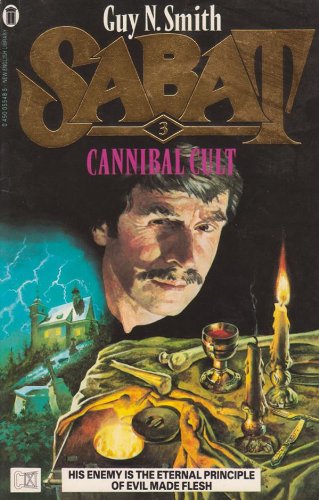
Sabat #3: Cannibal Cult


Sabat #3: Cannibal Cult
November, 1982  New English Library

This third volume of Sabat is easily my least favorite yet; Guy N. Smith seems determined to make us hate his (anti)hero Mark Sabat – but then, is it Mark Sabat for the majority of Cannibal Cult? As we’ll recall the schtick of this series is that Sabat, an ex-SAS commando turned roving occult-themed action hero, is half-possessed by the soul of his evil brother Quentin, and Quentin is always trying to completely take over Mark Sabat. This actually seems to happen in the third volume, meaning the “Sabat” who features in the narrative isn’t Mark but Quentin. 

Or is it? Smith plays some trickery by, as usual, referring to Sabat as “Sabat” in the narrative…but occasionally will even have Sabat himself wonder who he is, Mark or Quentin. It’s kind of annoying, and another indication of how Smith really wants to play up the “anti” in antihero. Because Mark Sabat himself is a creep, so it isn’t like he’s a white hat hero. Actually he’s a creep on the level of Justin Perry, with that same obsessiveness over sex and violence, particularly the mixing of the two. Forever Sabat is suffering from an “erection” at the worst of times, like even when sitting on a stakeout to kill someone who is stalking his latest female acquaintance. The dude is constantly thinking of the women he’s screwed, or just has sex in general in mind – especially sado-sex – or about the women he's screwed who have died. I mean this dude and Justin Perry could have a beer together. 

Another schtick of the series is not showing Sabat in the best light. I tag Sabat as men’s adventure, and Brad Mengel includes the series in Serial Vigilantes, but really it isn’t men’s adventure, because Sabat displays none of the qualities one would expect of a hero in this genre. He only acts when pushed, and even then it’s never in much of a heroic light. He carries around a .38 revolver (which of course just screams “ex-SAS commando”) but he seldom uses it, and the narrative is filled with asides where Sabat pep-talks himself into springing into action. Humorously, he often reminds himself of how he’s “killed before,” so I mean this guy isn’t the most action-prone of heroes. He’s even less action-prone in Cannibal Cult, getting in one fight in the middle of the book and then walking around the astral plane for the big climax. 

But back to Sabat not being shown in a good light; Sabat is introduced, in what is another schtick of the series, while masturbating in his bed. I mean seriously, this dude has jerked off in every volume. And of course he’s thinking about past lays, particularly with women who are now dead…oh, and er, there was that time when he was young and another guy took advantage of him, but let’s just pass that bit by. Oh and I forgot the real opening is about how Louis Nevillon, the “Beast of France,” has been guillotined in France, a serial killer with cannibalistic proclivities. Well anyway, Sabat’s worried that this guy might not really be dead, so of course Sabat starts jacking off…then he feels dark forces assail him…then he passes out…and he wakes up several days later in the hospital, having collapsed from a sudden and magically-transmitted bout of the flu. Does this dude know how to play with himself or what?! 

I show the original NEL covers in my reviews, but I’m actually reading the Sabat novels in the Dead Meat anthology, published in the US by Creation Books in 1996. This trade paperback is littered with so many typos, misprints, and errors that even a Leisure or Belmont-Tower copyeditor in the ‘70s would’ve been embarrassed. Cannibal Cult suffers from the worst yet, with a chunk of the story missing – not sure how much, but Sabat insists he leave the hospital, starts walking in France or something, and next thing we know he’s talking to a young lady named Madeleine who claims to recognize Sabat from the stories about him in the paper. How much of the novel is missing here I don’t know, but Madeleine’s intro is certainly missing. It’s like a missing frame in a film. 

One thing Dead Meat does have going for it is it includes two Sabat short stories by Guy N. Smith; one of them, titled “Vampire Village,” is referenced here in Cannibal Cult (and the story is placed before this volume in the anthology). Not sure if the story is also mentioned in the original NEL edition, but here in my book Madeleine has read about Sabat fighting a “village of vampires” in France and now she wants Sabat to help her, she being a super-hot beauty with “small breasts” who is “fresh out of a convent.” 

Of course this doesn’t prevent Madeleine from throwing herself at Sabat in the hotel; she makes a big deal out of his being circumcised, but surely that couldn’t have been such a big deal in Europe in the early 1980s. But hell who knows. The important thing is that, once again, Guy N. Smith delivers a sex scene that focuses more on Sabat than it does the girl, again (perhaps intentionally) lending the series a homoerotic tenor, what with the frequent jack-offery and the dwelling on death which leads to “erections.” Pretty much like Justin Perry: The Assassin. I mean Sabat and Justin Perry were pretty much made for each other. Anyway, again the sex scene isn’t too explicit, with stuff like, “suddenly [Sabat] was exploding violently.” Damn, sounds like he might end up in the hospital again! 

Here's where Sabat makes his sole kill; Madeleine claims that a bad man is following her, and Sabat sits out in the cold night waiting for this dude. Thinking about his recent tussles with Madeleine and getting “erections,” of course. Then when the stalker shows up in the shadowy forest, Sabat strikes and kills the guy…only thinking later that he might’ve been hoodwinked. Then Madeleine takes him to a place in the French countryside that’s filled, to Sabat’s dismay, with “hippies.” 

Only, as Sabat will soon learns – these aren’t just hippies, they’re hippie cannibals, man. Smith really piles on the lurid bullshit here with the cult basically insisting that Sabat join the fold…by serving him a special “meat” his first night here, and Sabat trying his damnest to place the unusual flavor of it. Of course, it turns out to be the flesh of a child, recently killed in a car crash, and now that Sabat has eaten human flesh he is “one” of the cult…and will do absolutely nothing but serve them for the remainder of the novel. For the cannibal stuff has unleashed Quentin, or something, and now “Sabat” is really Quentin Sabat. 

But like I mentioned this isn’t a men’s adventure series, not really. For yet another child is soon cooked up and eaten by the cult, this one a “mongol” who is abucted in the countryside. Sabat, seeing the frightened boy, consoles himself that “nothing can be done” to help, given that the kid is mentally retarded and doesn’t even realize the danger he’s in…indeed, killing him off and eating him will be “for the best!” That’s our hero, folks! But this time not only does Sabat again have to eat the cooked flesh, he’s also given the honors of slicing up the victim and serving the cult! 

But Smith isn’t done debasing his protagonist. Madeleine, who is revealed to be the consort of the Beast of France, now relishes Sabat’s lust, forcing him to “dine at the Y” until she’s satiated…and only giving herself to him once he’s at the bursting point. It’s all just so weird and unseemly, especially given the clinical “British” pulp style Guy N. Smith employs. Throughout Sabat does nothing heroic, and is sent around France like an errand boy for the cannibal cult, even at one point guarding the corpse of Nevillon, the Beast of France. The cult you see hopes to bring Nevillon back to life – by eating his flesh, so that his spirit will be reborn in all of them. 

Sabat’s so lame, it isn’t even him who stops the cult. First a French cop shows up, one who has been hunting the cult, but Sabat – whom the cult members believe now to be Quentin – has been ordered to kill him. Our hero struggles with whether he should help or harm this French cop, who happens to be an old acquaintance. And then in the finale, Sabat is possessed – for the second friggin’ time in the novel – by the spirit of an ancient “Witchfinder,” one who took down this cannibal cult in ancient times. Smith further amps up the supernatural horror element with Nevillon’s severed head magically rejoining the body, so the Beast of France truly walks the earth again. 

Really though, Cannibal Cult wasn’t much fun. The cannibal stuff was a bit too much, as was Smith’s insistence on making Sabat seem a fool. I mean this guy isn’t good for anything except playing with himself. Fortunately there was only one more volume. Actually I should’ve also read that “Vampire Village” story and reviewed it here, but I was so annoyed with Cannibal Cult that I couldn’t even be bothered with it, even though the story was only about 5 pages long.