Trawling the depths of forgotten fiction, films, and beyond, with yer pal, Joe Kenney
Monday, November 16, 2015
Boxer Unit OSS #2: Alpine Gambit
Boxer Unit OSS #2: Alpine Gambit, by Ned Cort
November, 1981 Warner Books
Another short-lived entry in Warner’s “Men Of Action” line, Boxer Unit OSS was like The Hook in that it was set in an earlier era: namely, WWII. Strangely though, the series takes place in the final months of the war, which makes you wonder how long they expected it could last.
The series was credited to the house name Ned Cort, but apparently it was the work of an author named Tom Jagninski, with whom I’m unfamiliar. Whoever he is, he’s more interested in exploring the brooding thoughts of his characters, waxing poetic about art and philosophy, or mulling over man’s inhumanity and etc, with the few action scenes quickly and almost perfunctorily rendered. The series only lasted five volumes, and maybe this is why. At any rate Boxer Unit OSS is about an American team of commandos who take on the Nazis (the series blurb in the back of the book implies they also fight on the Pacific front, but that’s not mentioned in the book itself).
Here’s how the first page breaks down the team:
I’ve gotta tell you, though, I had a hell of a time telling these dudes apart. And contrary to the cover depiction, there’s no female member of the team; in fact, the sole female character in the novel appears on maybe ten pages of text (four of which are sex scenes), and isn’t even graced with a name until near the end. Anyway the Boxer Unit itself is sort of like everything you wanted the Inglourious Basterds to be; whereas the characters in that film spent the majority of the time talking or being more sadistic than the Nazis they were after, the Boxer Unit parachutes in behind enemy lines and sows chaos and disruption.
Their present mission has them in Austria, where they are to determine if a rumored cavern complex, the so-called National Redoubt, actually exists. Intel has it that the Nazis, realizing the end is near, plan to hole up in a massive underground fortress in Austria and continue their Reich from within. Intel also has it that the Werewolves, ie the prepubescent terrorists who were former Nazi Youth, have also been spotted in the area in which the National Redoubt supposedly resides – also, there’s question if the Werewolves themselves exist or are yet another PR story by Joseph Goebbels.
The Werewolves do indeed exist, as our heroes learn late in the tale; it’s March of ’44 and the beleaguered Nazis have to rely on kids to do their fighting now. We get one of our few action scenes after the Boxer Unit parachutes into Austria; meeting up with their Russian contacts, they find an SS garrison has already detained them. A pitched but brief firefight ensues, complete with the memorable image of Chris Romer firing a submachine gun with each hand, something for which he’s well-known. Again, all like Inglourious Basterds should’ve been.
But from there it’s all downhill; the Unit splits up, with Chase and Kirilis off to Innsbruck, posing as SD intelligence men, while D’Arcy waits behind with a Russian soldier to monitor the radio and Romer goes off to pose as a worker. Rome in fact is taken out of the action quickly; the Germans have him transporting priceless works of art, plundered from Europe’s museums, to a castle near Innsbruck – a castle which turns out to be the mysterious Redoubt. Rather than an underworld complex, it’s just a castle in which the Nazis plan to store artwork and train Werewolves, to be unleashed on the invading Allied armies. But Romer’s quickly uncovered and spends the rest of the narrative captive.
The author also spends a lot of time on how D’Arcy doesn’t trust his Russian counterpart, who turns out to be a sadist who gets off on killing Germans. Meanwhile Chase and Kirilis go around Innsbruck in the leather fetish wear of the SD, sowing fear in the German rank and file. It’s all like that Star Trek episode Patterns of Force, where all you have to do is pose as a high-ranking Nazi and everyone will do whatever you want. Given their inhuman skill with German language (and I love how the cover boasts that the Boxer Unit is “multi-lingual” – I mean, watch out, Nazis!!), the two easily fool the SS and Nazi officers in Innsbruck into believing that they are true-blue members of the infamous Nazi intelligence party.
Much of the narrative is comprised of Chase and Kirilis interrogating Nazi “subordinates” in Innsbruck, trying to separate the Goebbels-created fantasty from reality. It’s all a headscratcher, really, as we readers already know the Redoubt doesn’t exist, thanks to the sequences featuring Romer. Meanwhile D’Arcy and his Russian comrade get in a few firefights with various Waffen SS troops. Along the way Kirilis manages to score with some German gal, who humorously enough isn’t even named; we just get a fairly explicit two-page sex scene where he boffs “the girl,” our author clearly, uh, “inserting” the scene due to some editorial demand.
Things don’t really pick up until Chase and Kirilis are escorted to the nearby castle in which Romer is being kept prisoner. Here Colonel Seibel, the young SS officer in charge, eagerly shows off his Werewolves; boys no older than 15 who are more lethal than men twice their age. The author adds some bizarre stuff with the appearance of Frederick, a 14 year-old Werewolf with steel hands! And he’s purposedly had his real hands cut off, replaced with these razor-sharp appendages…plus he can shoot the damn things off his arms!! It’s all so crazy and weird you have to love it, but unfortunately Jagninski doesn’t do much to exploit it, save for a too-brief bit later where Frederick and another Werewolf attack our heroes.
D’Arcy meanwhile heads for Innsbruck himself, where he not only deduces that Kirilis, a notorious hound, got laid, but also somehow deduces who he laid. Yep, it’s “the girl” again, and this time we’re informed she’s a German widow who has slept around with a vast assortment of SS brass. After a less explicit sequence than the earlier one, the girl points D’Arcy in the direction of his two undercover comrades…oh, and meanwhile, she knows who they all are. Turns out “the German girl” is really Caroline Chalmers, herself deep undercover, a spy with British Intelligence. Not only has she now slept with two members of the Boxer Unit, she also wants to help them take out the Werewolf castle.
Romer freed and the Unit back together, our heroes, still using those SD credentials, gather up a bunch of explosives and head on out over the snowsept roads for the castle. There they set the charges and blow the sonofabitch sky high, priceless works of art (and young Werewolves) inside or not. And that’s that. Meanwhile Wild Bill Donovan, OSS chief and overall commander of the Boxer Unit, lights a pipe and exchanges more witty banter with his British colleague – the novel arbitrarily cuts over to these two characters, discussing the war in Paris or something, in an obvious page-filling gambit.
Overall, Alpine Gambit doesn’t have much sex or violence, features four main characters who are interchangeable (and easily confused), and really isn’t very memorable. It has a great cover, though.
Thursday, November 12, 2015
Come Die With Me (Mark Hood #1)
Come Die With Me, by James Dark
July, 1965 Signet Books
Ian Fleming died in August of 1964, just as Bondmania was gripping the world. One more James Bond novel was published after Fleming’s death, The Man With The Golden Gun, but spy fiction fanatics would have to look elsewhere for their pulp espionage fix. Luckily, there were about a million cash-in Bonds operating out of the various paperback publishing lines; secret agent Mark Hood was just one of them.
Hood, a studly man of wealth (later volumes would give his age as 36), is American by birth but studied at Oxford, resulting in a worldly air with an American/British sort of accent. He’s world-famous for various things, not just due to his millionaire playboy status; he’s a pro cricket player, race car driver, and a karate champion, not to mention a world-class lover of the ladies. He also served in the US Navy, fought in the Korean War, and apparently was a commander of a destroyer-class ship at some point. But now he’s a top agent for Intertrust, a secret organization made up of “the four nuclear powers” of the world, its mission to prevent nuclear annihalation.
The Mark Hood series started life in Australia, but what’s interesting is how American it seems. Hood was born on Long Island and relates things to his American upbringing, yet the creators wanted to have their cake and eat it too, thus Hood also comes across as British thanks to his Oxford years. In other words the series appears to be a cash-in on both the James Bond novels and Nick Carter: Killmaster. And indeed author J.E. MacDonnell (aka “James Dark” in the US editions of the series) has a writing style that would be right at home in the world of book producer Lyle Kenyon Engel: pulpy but polished, clearly written in a hurry to meet a deadline, and yet still very professional.
The series ran for 14 volumes* from 1965 to 1970, but only 12 of the books made it over to America: #5: Spy From The Deep (1966) and #13: The Reluctant Assassin (1970) were for whatever reason not reprinted in America by Signet Books. Like Fleming himself, it appears that MacDonnell (“Dark” from here on out, cause it’s a helluva lot easier to type) began the series on reasonably level narrative ground before getting crazier, sort of how Fleming went from the staid (ie boring) Casino Royale to more out-there plots like Dr. No and Thunderball. Later volumes of Mark Hood feature mermen and underwater cities (#8: Operation Octopus) and even voodoo priests turned nuclear terrorists (#11: The Invisibles).
However this first volume, Come Die With Me, is more “realistic” than the series would gradually become. It does set the pace for the following books, though; the novel runs to only 128 pages, but be advised it’s got some small damn print. Hood is given a bit more of an intro than he likely will be in later books; nothing too page-consuming, just an overview of his international education, his military background, and how Intertrust works. Based out of Geneva, Hood reports to, at least this volume, two Intertrust bigwigs, one American and the other British. They give him his latest assignment: head to the Bahamas, where a trio of torpedo boats have been stolen. The atomic torpedos onboard aren’t the real worry; the third boat held a top-secret gizmo that could rattle the free world if it got into the wrong hands.
We’ve already seen the theft of the third boat in the opening sequence of the book. The mastermind behind the nefarious plot is a gaunt, “aesthetic”-faced sadist named Gauss who is a die-hard Nazi and served with Hitler years before. Making off with millions of stolen Nazi loot after the war, he’s now mega-wealthy and lives in a mountaintop fortress forty miles outside of Rio De Janeiro, right overtop the sea. (We eventually learn the torpedo boats are hidden in a cove far beneath his fortress, protected by an electrified cliffside stairway!) Gauss of course wants to start the Third Reich all over again, and plans to conquer the world, but the dude’s no Blofeld; he appears to just have a few henchmen working for him.
The novel has that old-school vibe which the Bond “continuation authors” of today fail to grasp (either due to changing social mores or the demands of their publisher): Hood smokes incessantly, drinks even more, calls women “girls,” and has that casual racism/elitism that was natural for Fleming’s Bond. So then Haitians are referred to as “Negroes,” and racial baiting and taunting is par for the course throughout. And as usual, while this stuff, antiquated and unpublishable in today’s world, is rampant throughout the book, the stuff that is considered okay today – like cursing and graphically-depicted sex – is missing.
And for the most part, so is the violence. Hood, despite being presented to us as a badass, constantly frets over things and tries to keep things from becoming too bloody. His weapon of choice appears to be a .32 automatic, not that he uses it; Hood relies mostly on his karate skills. His intro has him sparring with his karate sensei Murimoto (“the Jap,” per Dark); a glance through future volumes shows that Murimoto will be a recurring character. (Like a true obsessive I’ve already gotten all 12 of the Signet editions – and for a pittance!) Hood gets in his first scrape soon after arriving in Nassau, after quickly figuring out that the mysterious Gauss was likely behind the torpedo boat thefts as well as the murder/kidnapping of their officers.
Gauss has two henchmen: one is named Lott and is a former Nazi Youth (now “Gauss Adult” Hood later reflects) and the other is a “monstrous Negro” named Siboney who can almost decapitate a man with his bare hands. Siboney works as a bartender at a club owned by Gauss, the club in which the Navy officers were last seen, and Hood, there with sexy Prue Balfour, (secretary of Hood’s contact in the Bahamas, the Governor himself), baits Siboney into mortal combat. This is the most brutal action scene in the novel, as Hood uses savage strikes on the hulking thug, crushing his throat and tossing the corpse into the ocean.
But after that it’s all dialog, introspection, and exposition. Hood is quickly caught, drugged, and escorted to Cuba, where Gauss reveals himself and, you guessed it, asks Hood to work for him. As a test he has Hood beat up a “wineshop proprietor” who owes Gauss money or something. From there it’s to Gauss’s mountaintop aerie in Brazil, where he has used his vast wealth to pay off the local government. For a guy with delusions of world conquest, Gauss doesn’t seem very prepared; other than loyal Lott, Gauss only appears to have one or two other guys serving him, one of them a chaffeur/race car driver with a horriying face. This, we’re to believe, is why Gauss is so eager to employ Hood: he needs more men!
Also in Gauss’s castle is the lovely Maria Parana, a Brazilian beauty who works in the lab on the property and has no knowledge of her employer’s plans for global dominance. Maria has a specialty in bacteria research and Hood instantly deduces that she must be working on the “secret weapon” Gauss has been intimating to be in his possession. Sure enough Maria, in between telling Hood how “lonely” she’s been here in the castle, tells him that her new strain of super-bacteria could save the world – unless that is you happen to sprinkle it with certain material. Then it turns in to a goddamn nightmare! Global crops could be ruined…and yeah, she did mention all of this to Gauss, and he did seem interested to hear it, but why do you ask?
Cue the long-expected sex scene which doesn’t even fade to black; it happens between sentences, apparently, as Hood’s leaning overtop Maria’s still-clothed form and the next sentence they’re both smoking post-coital cigarettes. Mark Hood moves fast, baby! At dinner that night Gauss explains that he plans to begin his conquest the next day, so Hood, quickly recounting her employer’s horrible deeds, wins Maria over to his side. Her job will be to fool Gauss into thinking she wants to go into town for shopping but in reality she’ll sneak away to Rio and call the Governor in Nassau, telling him where Hood is and what’s going on.
The finale continues with the suspense angle, with the action still rather low-key; Hood karate-chops the chaffeur, gets in a race with him in which the chaffeur plummets off the cliff, and then he hops on the torpedo boat as it’s coming out of the cove and battles Lott and his comrade. The US troopship isn’t destroyed and Hood ends up launching the boat’s clean nukes right back at Gauss’s castle, killing the villain off-page, as it were. In the end a gloating Lott will inform Hood that poor old Maria was in one of the captured torpedo boats, and thus died along with Gauss when Hood nuked the place. Bummer!
As I finished Come Die With Me, it occurred to me that the book was more like Fleming’s Casino Royale than I realized. Like Bond in that book, Hood starts off the mission experienced but untried, and he too ends up falling in love with the girl (seriously, he and Maria even discuss marriage!). There’s even a shady club from which the villains operate. And like Bond Hood suffers heartbreak and desolation, presumably emerging from his first adventure a changed and hardened man.
As mentioned I’ve got the rest of the series, so while I wasn’t floored by this book I do look forward to reading more of Mark Hood’s adventures.
*The James Dark house name was also used in Australia, and two novels published under this name, The Spy From The Grave (1964) and Operation Jackal (1967), are sometimes listed as part of the Mark Hood series. I have contacted some booksellers who have copies of these scarce, Australia-only books, and they have confirmed for me that the two novels are not part of the Mark Hood series.
Monday, November 9, 2015
14 Seconds To Hell (aka Nick Carter: Killmaster #37)
14 Seconds To Hell, by Nick Carter
No month stated, 1968 Award Books
Jon Messman’s first contribution to the Nick Carter: Killmaster series isn’t as great as his masterpiece The Sea Trap nor is it as middling as his later entry The Executioners. At the very least the guy hits the ground running, with Nick Carter getting lucky within the first twenty pages and scoring his first kill in the first fifty. Messmann answered an ad series producer Lyle Kenyon Engel placed in the New York Times, seeking new ghostwriters, and he went on to deliver thirteen more installments.
Like many of the other early Killmaster novels, 14 Seconds To Hell has Nick going up against the Chicoms, ie the Red Chinese. In fact he’s already on assignment in Hong Kong when we meet him, sent here to Asia by boss David Hawk to take down Dr. Hsu Fan, a fanatical Chicom scientist who plans, without his government’s blessing, to launch an atomic attack on both the US and the USSR. Given the threat to Russia, Moscow has sent in its own agent to assist Nick, and who will be surprised when it turns out to be a super-hot blonde babe with a phenomenal bod?
Her name is Alexi Lubova and, promptly after meeting Nick, she takes him back to her shack in the “rooftop people” gutter section of Hong Kong and proceeds to bang the holy hell out of him. Already with his first volume Messmann displays how his sex scenes are a bit more graphic and descriptive than his fellow ghostwriters, though to be sure it’s not exactly hardcore porn or anything. We do get the memorable tidbit that Alexi thrashes around in such enjoyment that Nick’s afraid she’s about to knock over the shack! And, just as in a similar instance in The Sea Trap, Messmann proves he’s not above back-to-back sex scenes, with Nick and Alexi exchanging a few lines of dialog before going right back at it again, banging away on those poor shack walls.
Surprisingly enough, Messmannn proceeds to write yet a third sex scene, when Nick and Alexi meet again the next morning in Nick’s hotel room; but this time Nick notes how Alexi, rather than thrashing about, has a “quiet, intense purposefulness” about her during the humpin’. This continues for a while, Nick and Alexi meeting up either at her place or at Nick’s hotel, trading brief dialog about the assignment in between all the banging, and the gal’s either thrashing crazily or being all “quiet” and “intense,” and Nick’s getting confused. But one thing that can be said about Alexi is she can handle herself; when a Chinese official tries to take her off for questioning, she quickly kills the guy with some fancy martial arts moves.
Gradually Nick finds out the surprise reveal – ruined thanks to the back cover copy – that he’s actually working with a pair of twin spies! Alexi is the thrasher and her twin sister Anya is the quiet one – for Nick has discovered this is the one true way to tell the ladies apart. (And by the way, Messmann does not go all the way with it and write a scene with Nick entertaining both girls at once, though he does have Nick wondering what it would be like!) Now that all that’s gotten out of the way, it’s time to get on with the mission.
The middle half is a bit slow, with Nick and the sisters finding their contact on a Chinese junk has been compromised (another brief action scene with both Alexi and Anya taking out some Chinese soldiers) and thus having to figure out how to get over to the Chinese mainland. They steal a junk, get to the mainland, steal a convoy truck. Along the way Messmann delivers a great scene where the trio is spotted by a Chinese boy and Nick demands that they catch “the little bastard” because in Commie China everyone’s a government spy. They track the kid down to a shack in the middle of nowhere, just the kid, his mom, and his dad, but the dad’s already high-tailing it to the village center to report the three foreigners.
Nick chases him down and a brutal fight ensues, the farmer going at Nick with a scythe. Nick kills him, goes back to the shack – and says they have to kill the kid and the mom, too. The girls are of course appalled, and Nick thinks to himself this is another reason why there should be no female secret agents; their maternal instinct gets in the way of the cold-bloodedness sometimes required of the job. Yet the girls know Nick is right; the kid and mother could blow their whole mission and millions might die as a result.
This sequence, brief but tense, is more powerful than any modern spy movie, where the protagonists go out of their way to avoid collateral damage and whatnot – for example, my wife watched this stupid summer TV show called The Whispers, which featured several “emotionally gripping moments” where the male and female FBI protagonists kept trying to prevent various alien-controlled/world-destroying children from getting killed. Yeah, right!! But anyway, Nick opts to interrogate the mom and son separately, and given they both deliver the same responses, he decides to spare them – tying them up and throwing them in a cellar.
Dr. Hsu Fan resides in a remote fortress in the hinterlands of South China, where he has seven nuclear warheads ready to launch on America and Russia. AXE has given Nick a can of shaving cream that disassembles into seven miniature atomic bombs; he’ll use these to blow up each of Hsu Fan’s rockets. But when he and the two women sneak onto the base, they’re spotted and these strange metallic discs come up from the ground and spray the compound with knockout gas. Nick wakes up, nude and bound, Alexi and Anya bound and nude beside him. Here they meet Dr. Hsu Fan, who comes off exactly like Dr. No, only without the metal hands.
Around page 100 things get real insane. This tech wheels in an EKG-like machine and hooks up electrodes to Alexi and Anya’s nipples, then insert a phallus-type gadget into each of them. My friends, it’s an orgasm machine, and Dr. Hsu Fan happily reveals how he is a believer of “exquisite pain” instead of old-fashioned torture. A person can steel himself to withstand torture, but when it comes to pleasure he or she might find his defenses lacking. In short, this orgasm machine will give a woman the most powerful climax she’s ever had…again and again and again. It goes from ecstasy to misery.
To prove this, the sadistic doctor takes Nick into his veritable chamber of horrors: a room containing caged women, each of whom were tortured by the machine. They’re now each mind-shattered wrecks, pitiful, destroyed things, and it’s not only all so wonderfully crazy and bizarre but it’s also a precursor to the similar scene of the caged, maddened women in The Sea Trap. Nick, coming to the obvious conclusion, realizes Hsu Fan is an “unholy, perverted sonofabitch,” and was likely spurned by a Western woman, hence his hatred of them – the majority of the women in here are white, and the doctor shows special relish in torturing Alexi and Anya.
We get to see the orgasm machine in action, the two sisters quickly reduced to shuddering, gasping, climaxing misery. Nick knows they’ll go nuts if the machine isn’t turned off, and Anya’s already showing signs of losing her mind. Nick plays like he’s in love with her and pleads with Hsu Fan to stop the torture, giving him a bullshit story about the three of them just being sent to see what’s going on here. Per tradition Hsu Fan buys it and tosses Nick and the two women in a shack, rather than just killing them; he wants Nick to watch as he launches his seven warheads the next morning, as a veritable final slap to the face of the West or something. And who will be surprised when Nick soon turns the advantage to himself?
Dr. Hsu Fan is almost perfunctorily disposed of; after voice-activating his planted charges the next morning, destroying the missiles before they can launch, Nick then dispatches the sadistic doctor with a Chinese broadsword. Unfortunately, there are about thirty pages still left to go. The final quarter of 14 Seconds To Hell is composed of a long chase sequence, as Red Chinese soldiers scour the countryside in search of Nick and the two women, both of whom are still frazzled from the ecstasy-torture. When all hope seems to be lost, the army surrounding them from all sides, help arrives from the most unlikely source – the kid Nick was going to kill!
In a complete bullshit copout, the kid shows Nick and the sisters a hidden way out into the ocean, saying that now “the debt is repaid,” as Nick could’ve killed him but didn’t. That Nick killed the kid’s dad is conveniently overlooked. A US sub picks them up and takes them to safety. Now Nick’s big concern is making sure Alexi and Anya can completely recover. Anya is going back to Russia, but Alexi wants to stay in the US; Hawk hooks them up with a posh suite in a New York hotel and Nick devotes his entire being to giving the gal some good lovin’ to help her recover.
Messmann again proves why he’s one of the best Killmaster ghostwriters, ending the novel on a three-page sex scene that’s not only more explicit than those that came before, but also has a bit of emotional content to it, as Nick’s skills in the sack succeed in bringing Alexi out of her damaged psychological shell. While it never becomes total porn it’s still pretty graphic, more so than any other Killmaster novel I’ve read from this era, save for The Sea Trap.
Anyway, this was another fun, quick-moving installment, and this is becoming one of my favorite series.
Thursday, November 5, 2015
Kane's War #1
Kane's War #1, by Nick Stone
March, 1987 Ivy/Ballantine Books
Coming off like an ‘80s take on the Killinger series, Kane’s War ran for seven volumes and appears to have been, like that earlier series, an attempt at melding Travis McGee-style “marina mystery” with the men’s adventure genre. Unlike Killinger, though, this series, at least judging from the first volume, isn’t a snoozefest, and turned out to be a lot more enjoyable than I expected. Even if it is way too long at a bloated 260+ pages of small print.
Like Killinger, our hero Ben Kane is a studly, muscle-bound dude who lives on a fancy Chinese junk, the Wu-Li. He even has a talking parrot on board, same as Killinger. Also, Kane is a blonde bronzed giant, unlike the brown-haired character depicted on all seven covers of the series (humorously, on the last volume Kane was given a perm on the cover art). A river boat captain in ‘Nam (just like in Apocalypse Now!), Kane eventually started working for the CIA, reporting to a shady operative named Cord Weaver. Kane’s War opens with a prologue set in 1979 or so, in which Kane wants to quit but figures Weaver will have him killed, because who’s ever heard of a retired spy?
On his last mission Kane manages to stash away a million dollars, courtesy some drug dealers who try to kill him. Kane fools Weaver into thinking the money sank in the boat with the now-dead drug dealers, and then Kane says so long. Eight years later and Kane runs a charter boat business in the Virgin Islands, which he started with the stolen money. He’s now very successful, both in business and with the ladies, who come on hard and strong to the V.I.’s resident ‘Nam vet superstud. Kane’s brought along some old ‘Nam pals: Ganja, a dreadlocked Jamaican who gets his name from the copious weed he smokes and served on a boat in ‘Nam with Kane; Chief, a gruff older guy (compared to actor Victor McLaglen) who act like a mother hen or something; and Miles, a former Navy SEAL who does absolutely nothing this time out.
It must be said that Ben Kane doesn’t acquit himself very well in this introductory volume. In the course of Kane’s War he’s swindled, captured, tortured, left for dead, knocked out (many, many times), and even shot multiple times (saved only by a bulletproof vest). It’s almost comical in a way; seriously, Kane spends the first half of the novel convalescing, lying around in bed and hobbling on crutches. When he gets back to his old fighting self he still comes off like a klutz, getting knocked out by richocheting bullets, gunned down by submachine gun fire, even constantly dropping his pistol in the leadup to the novel’s climactic action sequence.
The tomfoolery begins posthaste, with Kane deciding to tuck in early one night. When he goes back to the Wu-Li, this hotstuff brunette with the greatest body Kane’s ever seen (and apparently he’s seen a bunch) is waiting for him. She claims they met once at a party (Kane is sort of a notable on the island, invited to all the VIP events) and Kane gave her an open invite to his junk; he’s forgotten all about this, but the lady does look familiar, and then there are those awesome boobs she’s got…the lady kisses Kane, who despite his excitement is still smart enough from his spy years to suspect a trap, reaching for the .32 he keeps in his pocket, concealed by a handkerchief. Then the lady digs her fingernails into the back of his neck and Kane spirals into darkness. Poisoned fingernail polish!
Here begins an overlong torture sequence, which even features ‘Nam flashbacks as Kane’s mind comes close to snapping. A group of masked men surround Kane, who is tied to a chair on his own house-boat. They electrocute him over the course of several hours, the attractive (and clearly distraught) bait still there, watching it all; at one point the Talker (as Kane refers to the only member of the group who speaks) even offers the girl to Kane for a week of mind-blowing sex. All if Kane will tell them where he keeps his money. You see, these dudes know Kane’s business is doing well, but he came out of nowhere and set himself up on the island too quickly, so he must have an in-line to major cash.
After mucho torture, the sole of Kane’s left foot (which was injured in the war and occasionally still gives him trouble) almost singed off, our hero finally gives up and tells the bastards where he’s stashed the remainder of his million bucks: in an old suitcase no one would notice onboard the ship. But the guys are certain Kane has even more money and that he’s working with drug runners; they want him to work for them. Kane tells them where he got the money but they don’t believe him. They give him a few days to think about it and leave. When Kane comes too he’s in the hospital, near death and with an almost-ruined foot, but meanwhile the hot busty nurse keeps checking him out and vice versa.
Kane receives an assortment of visitors, chief among them his sometimes-girlfriend Michelle Mullhaney, hotstuff twenty-something daughter of Mike Mullhaney, who owns a shipyard or something and is a business associate of Kane’s; we’re treated to some flashback sex as Kane reminisces about the time Michelle, whom he’s known since she was a gawky kid, came to him as a now-gorgeous young adult and announced, “I want to get fucked!” Also, given the publication date, the sex scenes in Kane’s War are stronger than what you’d read in earlier examples of the men’s adventure genre; not total hardcore, but certainly explicit. Michelle begs Kane to come stay with her when he’s discharged, so she can nurse him back to help; he accepts.
But then Kane’s visited by yet another father-daughter combo, and again it’s a case where Kane’s been boffing the daughter without the father’s knowledge (curiously, that Kane’s sleeping with two daughters of wealth isn’t much explored): Lord Philip Carlisle, Crown Commissioner of the British Virgin Islands, and his hotstuff blonde daughter Jessica. Lord Philip invites Kane over to his mansion on B.V.I., saying that he’s set Kane up with some prospective clients, as Kane’s been wanting to branch out into the lucrative British Virgin Islands for a long time. More importantly, judging by the way she’s batting those eyelashes at him, Kane figures it’ll also make for a perfect opportunity to screw Jessica again.
And we get another explicit sexual event, as Jessica visits a still-weak Kane in his room in the mansion that night; poor old Michelle’s pretty much forgotten. And meanwhile she’s abducted, spirited away in a helicopter by another group of drug smugglers who want to find out where Ben Kane gets his stuff. Poor Michelle will be taken to a yacht, stripped, pawed by the overweight lecher who has kidnapped her, and even licked all over the place by the lecher’s female sidekick. Meanwhile Ben Kane keeps on boffing Jessica over on the British side of the islands, oblivious to the fact that at least three criminal factions are looking for him, let alone Cord Weaver, who has shown back up and wants Kane to work for him again.
Action is for the most part sporadic. First a fake doctor tries to kill Kane while in the hospital, but Kane breaks the dude’s neck, instantly spotting him as a would-be hitman. Later Kane and Jessica are shot at by a sniper, who is taken out by one of Weaver’s men – the goofily-codenamed Waiting Fox, who works with Kane a few more times in the novel. Things don’t pick up until Kane, recovered enough (and having engaged Jessica in a few more sex scenes), teams back up with Weaver for “one last mission.” Here Kane is informed that Michelle’s been kidnapped and is being held on a yacht. Kane’s eager to go kick ass.
Despite all the text given over to Kane’s horribly-injured left foot, he’s suddenly able to parachute over the Caribbean in the pre-dawn hours with a Weaver commando team, landing on the drug kingpin’s yacht. A brief action scene ensues with submachine guns blazing. Kane proves again his ineptitude, knocked out like a second after he lands on the deck. Our hero, ladies and gentlemen. His bacon is saved by a pair of Weaver agents who pose as father and daughter. After reuniting ever so briefly with Michelle, Kane’s informed by Weaver that there are two more drug factions out there, still gunning for him; plus Weaver knows, has known all along, who captured and tortured Kane back in the beginning of the book.
This takes us into the homestretch, as Weaver instructs Kane to pretend as if he’s going to cater to the drugger demands, after all, and hook them up with his (fictional) drug contacts. In particular these druggers, revealed to be new-style Mafioso, are looking for designer drugs, similar to what that brick shithouse-bodied gal used on Kane at the beginning of the book. Speaking of whom, the gal’s name is Pammy, Weaver reveals, and she’s a notorious Virgin Islands whore who serves as a honey trap for various criminal factions, though Pammy herself is an innocent little lamb…she just likes to screw a whole bunch.
And Kane finally gets to do her, two hundred pages after they first met, Pammy taking him back to her mirror-ceilinged bedroom, and another fairly-explicit sex scene ensuing. Unfortunately the climactic action scene is perfunctory; Kane, with Ganja and Waiting Fox, choppers in to a remote destination to trade drugs for money with the mafioso. But Kane instantly realizes he’s been handed a suitcase of counterfeit and his chopper has likely been wired to explode. So he whips out the Czech machine pistol hidden in his briefcase (that is, after klutzy Kane has tripped and fallen into an empty swimming pool) and blows away a few of ‘em. But meanwhile the boss turns out to be a lookalike and the real one’s back in the States, safe from any prosecution.
Kane swears that’s it, but Cord Weaver is certain Kane will again work for him, what with all the drug-runners and Commie agents moving into the Caribbean these days. Guess who’s right? An unusual thing about Kane’s War, at least so far as this first one goes, is that it doesn’t really capitalize on the Virgin Islands setting. I see that cover art and I expect cigarette boat chases and underwater scuba battles, but nothing of the sort happens. One of the villains lives on a yacht, but that’s about it. Otherwise the locale isn’t much captured.
The writing though is pretty good throughout, better than I expected it to be. POV-hopping is kept to a minimum and so is the ‘80s-mandatory gun porn. Dialog is pretty good, and the characters come off as more than just cardboard cutouts. The sex and violence are both graphically depicted, which as far as I’m conerned is a hardcore pulp fiction requirement. If I had any complaint it would be that some of the action scenes are a little confusing, given how they’re written, and the author relies a bit too much on dialog modifiers. Characters are always “quipping” or “retorting” or etc, instead of just plain “saying.”
So who was Nick Stone? The book’s copyright Ivy/Ballantine, so likely it’s a pseudonym. Unfortunately the name isn’t listed in Hawk’s Authors’s Pseudonyms, and I can find no listings of the Kane’s War books in the Catalog of Copyright Entries. But according to Martin O’Hearn, posting on Thomas McNulty’s blog, “Nick Stone” was actually Nicholas Cain, a prolific ‘Nam action series writer in the ‘80s, most known for his Saigon Commandos series, which he published under the name “Jonathan Cain.” I’m willing to bet that Martin is correct and that Kane’s War is indeed the work of Cain.
Monday, November 2, 2015
The Lady Killer (aka The New Lady From L.U.S.T. #6)
The Lady Killer, by Rod Gray
No month stated, 1975 Belmont Tower Books
The Lady From L.U.S.T. was another of those ‘60s spy paperback series that was packaged as sleaze but was really just goofy satire. I’ve tried reading these types of books before (M.O.T.H.E.R. Versus Mafia by Rosemary Santini, one of Clyde Allison’s Man From Sadisto books, etc) and they just fell flat for me; too much focus on ridiculous acronyms, character names, and plots, and too little focus on action, suspense, or thrills. In short, these books kind of suck, just light-hearted spy spoofs that aren’t funny.
The Lady From L.U.S.T. series was likely no different, but the books in this series go for stupid prices these days; apparently Gardner Fox served under the house name of “Rod Grey” for the majority (all?) of the 18 installments from the series inception in 1967 to its end in 1973. Two years later Belmont Tower brought the series back, this time as The New Lady From L.U.S.T., and it ran for two years, amounting to seven volumes. The Rod Gray house name was once again used, but apparently Gardner Fox wasn’t the writer this time. I’m guessing it was a revolving door of ghostwriters, and it’s only a fluke – actually, my own sad over-familiriaty with trash fiction – that led me to discovering who wrote this particular volume.
Anyway, what with sleaze being at critical mass in the mid-‘70s, the New Lady From L.U.S.T. was a lot more hardcore than the earlier series had been; I have one of those early installments, #4: Five Beds To Mecca, from 1968, and it appears to go for the expected lyrical/metaphorical approach in the sex scenes, which are of course light-hearted to begin with. Compare to The Lady Killer, in which the three brief sex scenes on offer are straight-up porn, with the anatomical parts in question clearly named and no purple prose getting in the way of the humpin’ and bumpin’.
That being said, the series, at least judging from this entry, is still pretty lame. The Lady Killer is not much of a spy novel, even comparitively speaking; it’s more along the lines of a private eye novel. Hell, protagonist/narrator Eve Drum is even made a temporary detective in New York City during the course of her investigation. Eve is a gorgeous blonde with a brick shithouse bod (she kindly gives us her measurements on the first page) and she lives in a penthouse in Manhattan where she poses as a worldly, well-to-do socialite. All very much like Cherry Delight, of course, and in many ways The Lady Killer is very similar to Len Levinson’s contribution to that series.
Eve works for top-secret spy organization L.U.S.T., and per the back cover her archenemy is the evil organization H.A.T.E., which not only plays on the SPECTRE deal but also is yet another indication of the unfortunate focus on punny acronyms these spy spoofs were known for. Now, H.A.T.E. is namedropped on the back cover, but the dudes don’t even really show up until the final page. Instead, The Lady Killer is an Agathie Christie-type deal where four doctors who have invented a new, stronger form of methadone are being killed off one by one by a sadistic redheaded female assassin. Eve Drum must figure out who is behind the plot and how to stop further killings.
The first few chapters alternate between Eve’s humdrum narration – her life in Manhattan, her casual sex affair with boss David Anderzanian, her current paramour Mac Morris, a famous mystery novelist – and third-person chapters in which an attractive redhead named Jobeena goes out on assassination missions. This alternating viewpoint stuff, particularly with the skewed viewpoint of the clearly-disturbed female villain, was the first element that started nagging at the ol’ memory banks – I was certain I’d read something almost identical to this before. As the book progressed, with Eve using her wits and beauty rather than weapons or karate, and particularly with Eve coming to the conclusion that the redhead was getting revenge for something that happened in the past, it all gradually came to me.
My friends, this is the exact same plot J.C. Conaway gave us in Deadlier Than The Male. It’s even written identically (save for the fact that Deadlier Than The Male is in third-person throughout), with the alternating viewpoints and the gradual reveal that something rotten happened on a college campus several years before, something which is now causing rampant death. It’s basically the same novel J.C. Conaway delivered two years later, once again via Belmont Tower Books.
At this point I did some deep Google diving and enjoyed one of my rare moments of vindication: according to the 1975 Catalog of Copyright Entries, The Lady Killer was indeed written by J.C. “Jim” Conaway.
As with that later Jana Blake novel, The Lady Killer is a slow-moving affair that’s more concerned with detailing the mundanities of the heroine’s high-society life while sleazing things up every once in a while with visits to New York’s more sordid establishments. You know it’s a ‘70s Belmont Tower book when the first murder takes place in a massage parlor, and Conaway brings the place to such grungy life that you suspect he might’ve visited a few such parlors for “research.” A later kill takes place in a gay nightclub called The Tubs which again has the same sort of over-the-top debauched vibe as the disco club in Deadlier Than The Male (where a murder was committed, as well).
And like Jana Blake, Eve isn’t an ass-kicking protagonist by any means. In the course of the 160-some pages of the novel she chops one dude in the throat and, in the very final pages, shoots two H.A.T.E. guys in the shoulder. She’s more in the brains department, but it’s not like this case is a puzzler. As mentioned Eve learns that these four doctors were pals in Harvard over a decade ago, where something mysterious happened. Eve’s certain that whatever it was is what’s causing these murders today. In yet another prefigure of Deadlier Than The Male, no one but Eve believes this theory, particularly the gruff New York detective who is working the case (yep, just like in Deadlier Than The Male).
While Eve isn’t much for the fighting, she’s quite capable in the lovin’ department, bedding her boss David, her boyfriend Mac, and a muscle-bound club bouncer. Each sequence runs a few paragraphs and leaves nothing to the imagination, though yet here again we have that strange conundrum where a male writer delivers hardcore sex scenes from a female character’s point of view. The scenes don’t go on very long, though, yet coupled with the massage parlor and gay nightclub stuff it all lends the novel an overall sleazy feel, which is again typical of every Conaway book I’ve yet read.
One difference between this and Deadlier Than The Male is that Eve, suprisingly, does not boff the studly detective she works the case with, though Conaway gives a few intimations that they might before he apparently forgets all about it. Rather, more time is given to Serena, a teenaged Gypsy girl who had a hardscrabble youth and now, at seventeen, works in the massage parlor in which the first murder occurs. Eve pities the young girl and actually takes her home with her (Serena’s lecherous boss at the massage parlor is the recipient of Eve’s karate chop), giving her nice clothes and eventually hooking her up with a job as a typist at L.U.S.T. HQ in Manhattan. (The novel features a “several months later” epilogue in which we learn that Serena has gotten married…to Eve’s boyfriend Mac Morris!)
It turns out that redhead assassin Jobeena was raped as a young Radcliff student a decade ago by those four Harvard doctors, and somehow H.A.T.E., wanting now to steal the secrets of their new drug and sell it to the commies, got wind of her sad plight and hired her as an assassin. Or something! Jobeena actually takes out three of the doctors (the third one she strangles with his blood pressure monitor) before Eve figures out what’s going on. However Eve herself is quickly caught by Jobeena, who delivers on her promise to H.A.T.E. by handing them Eve Drum on a veritable silver platter.
Things look bad for our heroine, but Conaway delivers another of his cheesy copout finales with the appearance of a little boy who lives in Jobeena’s building and who just happens to be going by the window of the cellar Eve and Serena are captive in. Eve gets the kid to come in and tells them they’re play-acting as spies and the kid unties them! Then Eve karate-chops Jobeena (who is eventually arrested and sent to an insane asylum), shoots a few of the H.A.T.E. dudes (not killing them), and that’s that.
So yeah, this was a pretty unsatisfying read, filled with mundane, expository dialog and boring snatches of non-action, salvaged only by brief flashes of sleaze – which pretty much describes every other novel I’ve read by J.C. Conaway!
Thursday, October 29, 2015
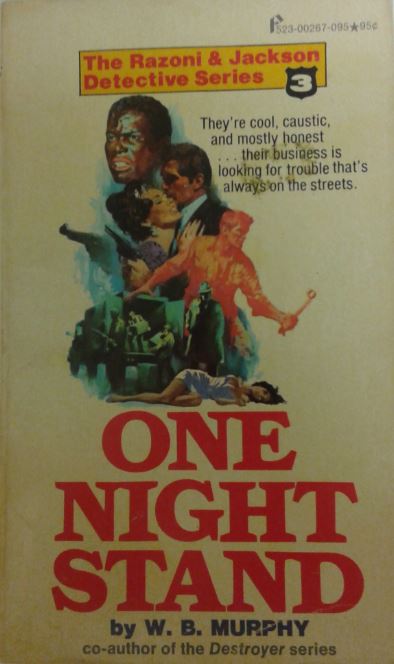
Razoni & Jackson #3: One Night Stand
Razoni & Jackson #3: One Night Stand, by W.B. Murphy
October, 1973 Pinnacle Books
Our favorite feuding detectives return in the third installment of the short-lived Razoni & Jackson series. As expected, the novel is low on action and thrills and more focused on witty banter, running jokes, and actual crime detecting. Author Warren Murphy again proves his mastery of dialog and character, though to be sure those looking for the lurid quotient expected of the men’s adventure genre will be a little let down.
The opening is appropriately sordid, though; an attractive young woman, wearing only a trenchcoat (a la Kiss Me Deadly), flags down a random motorist one night in New York City, pleading with him to give her a lift. A pair of cops, clearly in pursuit of the lady, pull the motorist over, and she tries to hide beneath the seat as she begs the driver not to tell the cops she’s there. But the dude, bowing to authority, does exactly that. The cops – one a lanky, gaunt-faced white guy, the other a muscle-bound black dude – haul the woman out of the car and there, right in the headlights, shoot her in the head.
Perhaps the biggest puzzler of One Night Stand is that these cops do not also shoot the would-be samaritan of a motorist as well. Instead they merely get in their car and drive off, leaving one hell of a witness behind. But, had they killed the guy, Murphy wouldn’t be able to work up the mystery which lies at the core of the novel. I had a hard time getting over this, but what the hell. The motorist gives his story to the police, and it’s yet another knock against New York’s finest, who have been coming under increasing fire thanks to the liberal scum who have taken over the justice system.
Chief among the scum is Jason McCarter, an inheritor of great wealth who decided one day to become a liberal lawyer, because liberal lawyers get the most “media space.” Championing the rights of “wrongfully accused” criminals and murderers, McCarter has becoming so powerful and famous that he’s headed for bigtime politics. He has an ace in the hole though; a dimwited clerical room detective named John Hardin, McCarter’s nephew, who hooks McCarter up with case files, which McCarter uses in court to exonerate his crooked clients.
When we meet them, Razoni and Jackson are currently trying to bust Hardin – without the knowledge of their boss, Captain Mannion. This is yet another of Murphy’s trademark humorous scenes, which has Razoni and Jackson taking out their respective lady friends (in Razoni’s case it’s his redheaded knockout of a girlfriend, Pat; for Jackson it’s his equally-attractive wife, whose name I’ve forgotten) to a fancy restaurant. What the women don’t know is this is actually a stakeout; the two cops are here to see if Hardin’s going to deliver a certain case file to McCarter. Unbeknownst to Hardin, this particular file was written by Razoni and Jackson themselves; it’s a fake, one designed to bring McCarter’s illegal practice out into the spotlight.
While it goes down smoothly, trouble ensues: a pissed-off Mannion informs our heroes the next morning that none other than Jason McCarter has been appointed by the governor (a notorious cop-hater) to look into police corruption, especially given this recent murder which was apparently perpetrated by two cops. The whole fake case angle might end up blowing up in their faces if McCarter finds out about it. Meanwhile Razoni and Jackson are given their urgent assignment: found out who really killed that young woman, who turns out to be a hooker named Claire Coppolla, and clear up the case before McCarter’s commission gets everyone fired.
As mentioned, Razoni & Jackson is not an action series by any means, even though it was packaged as yet another Pinnacle men’s adventure series. Our titular heroes use their brains more than their brawn – actually, they use their mouths more than anything else, bickering and bantering like an old married couple. This particular volume falls a little flat on the recurring jokery, though, in particular to a running gag about a “black jockey with bruises on his palms” or some such. Not that the racist-tinged barbs (from each direction) bother me, it’s just that they aren’t as funny this time out. But in between the back-and-forth our heroes try to figure out who killed Claire Coppolla and why.
Their investigation takes them across the dingier areas of New York, from the apartment Claire shared with another young and attractive girl (and also a hooker, though only we readers know that initially) named Renee Charver, to a truckstop diner/cocktail lounge called Delaney’s where Claire supposedly did a lot of secretive business. We also get a view into the long-gone world of rampant smoking, as the plot centers around a cigarette distribution facility in which tax stamps are put on cigarette packages; a sleazebag named Kitsky runs the place and Claire’s brother, an ex-con, works there, and we’re treated to lots of detail on how the machinery operates.
The most enjoyable sequence is also the most lurid; Razoni’s girlfriend Pat is once again used as bait. Having determined that Renee is a hooker and that she ran some sort of two-girl con job with Claire, Razoni and Jackson set Pat up as a hooker and send her to a bar Renee frequents. Let’s just say the two attractive ladies become real friendly real quick, with “AC-DC” Renee inviting Pat back to her place for some all-night lesbian shenanigans! And Pat eagerly accepts!! Murphy doesn’t write the details, but he does have an exhausted Pat calling Razoni the next morning to report, with Razoni increasingly jealous, bitter, and frustrated over what he suspects Pat spent the whole night doing.
It gradually develops that Delaney’s is run by a corrupt group that cons truckers who haul cigarettes; Kitsky, the distribution center owner, has come up with a scheme where these truckers are distracted by hookers (kindly offered by the propietors of Delaney’s), who talk the truckers into letting them ride along to the next city. But when the hooker gets the trucker to pull off the road for some quickie sex, a lanky, gaunt-faced guy named Al and a muscle-bound black guy named Earl storm onto the truck, disguised as cops, and threaten to bust the trucker, as it’s against the law for them to have passengers. Eventually the trucker will cop a “deal” with them, promising to drop off a delivery of illicit cigarette crates on each future trip in exchange for the cops keeping their mouths shut.
Razoni and Jackson don’t figure all of this out until the very end, though they do realize that Claire Coppolla was killed because she’d gotten wind of something she shouldn’t have. They themselves don’t get into danger until the final pages. Planning to bust the extortion racket, Razoni goes undercover as a trucker, his rig loaned to him by the boss of a local truckyard, who turns out to be Captain Mannion’s brother. Jackson is to wait behind and show up when the two fake cops storm the truck to “bust” Razoni. But things go to hell when a drunk Detective Hardin, still pissed over that fake case scenario, shows up when Jackson’s about to leave and hands him a subpoena, demanding that he show up in court asap. Why? Hardin’s been trying to set up Razoni and Jackson as the two cops who killed Claire Coppolla.
Razoni, thinking Jackson’s about to save him, blindly drives into the ambush and is almost beaten to death, his rig crashed by Earl and Al. When Jackson gets away from Hardin, who realizes he’s made a huge blunder, he’s alive with rage, particularly when Razoni’s battered, bloodied, and unconscious body is fished out of the truck wreckage and taken to the hospital. Murphy brilliantly shows the difference between our two heroes; where Razoni is quick to rant and rave but just as quick to forget about it, Jackson is cool and calm…until he gets mad. And when he gets mad, he doesn’t quickly forget about it; when he sees Razoni’s crushed body in the hospital, he’s “boiling over” with rage, to the point where you feel sorry for the bad guys.
The climactic action scene isn’t up to the caliber of The Executioner or anything, but it’s still pretty good. Jackson heads on over to Kitsky’s distribution center, having figured out thanks to his own sideline investigation that Kitsky was actually Renee Charver’s ex-husband and likely the brains behind this extortion scheme. Armed with his .38, Jackson takes on Kitskty and his two thugs, Earl and Al. It isn’t overly violent or spectacular, but this sequence does feature the memorable moment of Jackson strapping Kitsky onto the front of his car and smashing throught he facility’s gate. Surprisingly enough, Kitsky lives through it – and promptly spills the beans to the cops, thus exonerating Razoni and Jackson.
Not to end this review on a sad note, but I recently heard from Warren Murphy’s son, Devin Murphy, the sad news that his father passed away, on September 4th of this year. Here’s a nice writeup about him from the New York Times. I’m sorry to hear Mr. Murphy has passed on, but as was the case with Burt Hirschfeld, Harold Robbins, Don Pendleton, and so many others, he left behind a huge body of work, and will of course live on through it, continuing to provide entertainment to generations of readers to come.
Monday, October 26, 2015
Run, Spy, Run (aka Nick Carter: Killmaster #1)
Run, Spy, Run, by Nick Carter
February, 1964 Award Books
I’ve been curious how the Nick Carter: Killmaster series started life, so I figured it was time I checked out this first volume. It’s interesting how Run, Spy, Run sets the precedent for the 259 volumes that were to follow, quickly outlining who Nick Carter is and what gadgets and weapons he uses. But there are also little details in this first volume that would either be glossed over or forgotten entirely in the ensuing years.
First though there’s the controversy over who actually wrote this book. Most people credit it to Michael Avallone, who was hired by series producer Lyle Kenyon Engel to help create the series and to be its main ghostwriter. Apparently Engel came up with the series concept, the character of Nick Carter (intending to call back to the once-popular Nick Carter character of early 20th Century pulp), and Carter’s spy agency AXE. Avallone seems to have come up with the idea of Carter naming his weapons and gadgets, which is very pulpish. But Avallone’s actual writing wasn’t met with much favor. According to Will Murray’s article “The Saga of Nick Carter: Killmaster” (The Armchair Detective volume 15 number 4, 1982):
When the first Nick manuscript was submitted to Award editor Samuel H. Post, Post was dissatisfied with Avallone’s somewhat pulpish approach and his idiosyncratic style. Post and the Abramsons [ie Arnold and Robert Abramson, Universal Publishing execs who created the Award imprint] conferred and returned the story for revision, along with a synopsis Post had created for the second novel. Avallone’s revision and his draft of the second book, The China Doll, fell short of the American James Bond the others were looking for. Avallone, preferring to write like Michael Avallone, declined further revisions. Engel then turned the two manuscripts over to a young woman with no previous novel-writing experience named Valerie Moolman, who rewrote them, under Engel’s direction.
Engel had a bit more to say about this in an interview he did with Will Murray in 1981, which was eventually published in Paperback Parade #2 (1986):
I wrote the outline for the first two books and then I asked Mike to write the books themselves. Mike couldn’t write the books and I had a written understanding with him whereby if the publisher did not accept his stories, did not like his stories, then I would have a right to take my outline and give it to somebody else to write.
Finally, according to the Wikipedia page for Run, Spy, Run(!!), Valerie Moolman is the sole credited author in the Library of Congress records. All of which is to say it seems pretty clear to me that Moolman, and not Avallone, wrote this book. It’s been many years since I read a Michael Avallone novel, but one thing I do recall is his writing style was pretty unique. That unique style isn’t evident in Run, Spy, Run; in fact the writing here is pretty bland. As I read the novel something kept nagging at me, that the narrative was reading a certain way, and at last I realized what it was: Run, Spy, Run reads very much like a romance novel. Hell, there’s even a chapter titled “London Idyll” which is all about Nick and his hot new colleague Julia Baron being all lovey dovey in London.
All of which is to say, this is not the most slam-bang intro for the Nick Carter: Killmaster series. It lacks much bite, and comes off very “safe,” for lack of a better word. More focus is placed on Nick’s worries and feelings than on action. I know I sound like a sexist pig, but I suspect this is due to the female authorship. Not only that but Nick is prone to falling in love; rather than the love ‘em and leave ‘em rake of the other series writers, Moolman’s Nick Carter develops feelings for his conquests and acts, to risk sounding lame, rather gallant throughout. Compare this to the almost sadistic version of the character Manning Lee Stokes delivered, and you can see how Nick Carter changed so drastically even in his first few years.
When we meet Nick he’s on a flight back to New York, having just wrapped up a quick mission-turned-vacation in Jamaica. Like many other things in Run, Spy, Run, this is likely a reference/in-joke to the work of Ian Fleming, who wrote his James Bond novels in Jamaica and even set Dr. No there. We get a brief recap for Nick, with the interesting tidbit that he worked for the OSS in World War II, after which he apparently worked as a spy for a while, before joining the newly-formed AXE “seven years ago.” Nick Carter’s WWII background would be forgotten in the coming decades.
Another interesting element in this first volume is the revelation that Nick’s job, so far as the world is concerned, is as a private eye. No doubt this is intended as another reference, namely to the origins of the pulp Nick Carter, but this element too was removed, and for good; the later books got it much better with Nick solely being an agent of AXE with no concerns over a dayjob cover identity. But it’s this private eye cover that makes the beginning of Run, Spy, Run believable; while in his hotel in Jamaica, someone left Nick a handwritten note begging for him to board this particular flight. I had a hard time understanding why superspy Nick Carter would board the plane, not suspecting a trap. It makes sense then that he did so because the world at large knows Nick Carter as a private investigator.
There’s a bullish dude on the flight with a steel hand, and I thought for sure this would be supervillain Mr. Judas – whom Nick has never seen, but is aware of – but it turns out to be a South American diplomat who blows up when he disembarks the plane in New York, killing several other innocents in the blast. Nick meets up with an attractive stewardess named Rita Jameson, who turns out to be the person who wrote Nick that letter. There have been three airplane explosions in the last few months, one of them of a plane piloted by Rita’s fiance, and she’s certain there’s a coverup. Meanwhile, through boss Mr. Hawk (no “David” yet, this early in the series), Nick learns that each of these planes carried right wing government officials from various parts of the West, each of whom were opposing the Red Chinese.
Long story short, there appears to be a plot to wipe out these right wingers in plane crashes and replace them with Commiesymps. (I’m surprised Obama hasn’t thought of this yet.) Instead of rushing into action, Nick sort of mills around New York with Rita Jameson (whom he does not consort with), checking leads and working up cover identities. Things finally heat up in a carriage chase in Central Park in which a gunman shoots at Nick and Rita. Poor Rita ends up dead and Nick moves on with the assignment: now he’s to shadow an American ambassador named Harcourt on a flight to London.
Even more time is wasted with Nick’s elaborate cover story, which has him posing as a bookish art professor. Hawk also sets Nick up with a partner, a hotstuff female spy named Julia Baron (Nick calls her “Julie”) who, the way she’s described, must be Eurasian or something. Julia would appear in a few more volumes over the next several years; not sure if she was eventually killed off or just written out of the series. But yet more pages are wasted on her own cover story, which has her posing as Nick’s fiance. Meanwhile the two get to screwin’ pronto, in what is the novel’s most explicit sequence, but don’t expect anything too explicit; it’s more metaphorical/lyrical than anything. And once again, ol’ Nick is developing feelings for the gal…
The flight to London is also a snoozefest, with Nick pretending to be airsick so he can go to the lavatory, again and again, scoping out his fellow passengers to detect any threats. He settles on one dude with a broken arm, and sure enough this guy tries to blow up the plane midway through the flight, the plaster of his cast hiding a bomb. Nick and Julia save the day, with the outcome that their cover is blown – hilariously enough, before they’ve even got to London! Hence all that crap we had to read about their cover stories is rendered moot. After this they decide to pose as freelance spies, here to take on the infamous and elusive Mr. Judas, who they have determined is behind the plot.
In the final quarter of Run, Spy, Run, something magical happens – it becomes a Killmaster novel. Nick and Julia, captured, stripped nude and tied to wooden crosses, find themselves in a dank cellar, the captives of Judas and his deformed henchman Braille. Judas’s first appearance is suitably memorable, and here for once we get a proper description of the sadist:
Judas was a symmetrical man. Short, well-proportioned, compact; body as militant and cut-from the-mould as a Prussian Junker. In action, it would be a flying wedge of strength and iron control. The face and the strange right hand compelled attention.
Judas’ face was a shining globe of hairless, bloodless features, a one-color, one-surface mask of precision that might have been cast from an assembly line die. The eyes were slits which showed no more than narrow, unfathomable pools of liquid fire. The nose was small in the globular face, hardly raised above the flat cheek bones, finely chiseled, ruler-straight. The huge, permanently-grinning mouth beneath it would have looked more appropriate on a skull; some of Judas’ face had been lost in a long-ago accident and had never quite been replaced. Apart from the hideous grin, there was no expression on the face, save a fixed one of watching, of waiting, of preparedness to strike. The head, brows and lids were completely bald. It was not a view to be savored up close.
And as for that “strange right hand,” which Judas claims to have lost thanks to his own carelessness with a bomb he was trying to plant on a would-be victim:
The five fake fingers extended stiffly, shot toward Nick. Suddenly they halted, inches from his chest. There was a click, and a nasty little miracle occurred. The forefinger grew. The covering silver receded and a switchblade knife of gleaming steel paused a hair’s breadth from Nick’s throat.
So clearly, Judas was intended as a combo of Blofeld and Dr. No, with the bald head and deformed face of the former and the steel claws of the latter. Interestingly though, at this point in the Bond films Blofeld’s face had not been revealed (and in the Fleming novels Blofeld looked entirely different, and indeed drastically changed his own appearance in each of the three novels he appeared in), yet Judas’s mutilated face is almost a precursor to Donald Pleasance’s version of Blofeld in You Only Live Twice. Could the producers of the Bond films have been reading the Killmaster books??
Judas’s henchman, a blind brute jokingly named Braille, is even more monstrous, an “unspeakably hideous human being” who is “a mockery of mankind:”
He was very tall and very wide. His shoulders hunched forward, his thick knees bent a little more than necessary when he walked. Long arms ended in great knotted hands. His face was horribly pitted and scarred. Putrescent-looking lumps bulged from his forehead and neck. The diseased appearance of the flesh gave a crawling, loathsome quality to his incredible face.
Unfortunately this sequence doesn’t play out as over-the-top as it would in later installments; Nick instead manages to get a suddenly-gullible Judas to fall for a stupid trick (namely, that one of the items he lifted from Nick is really a bomb, one that’s set to blow). After Nick kills Braille in an unspectacular fight, he and Julia rush off to safety. From there it’s back to the bland feel of the rest of the novel, with Judas kidnapping Harcourt and basically pleading with Nick to meet him somewhere and talk deals.
The finale continues the low-stakes trend; rather than the Killmaster assaulting a compound of jumpsuited guards, he instead has another face-to-face with Judas, this time in a house near Piccadilly. Judas, holding a gun on Nick and Julia, reveals that Harcourt is bound in the house’s cellar; Judas wants Nick to work for him. When Nick refuses, Judas says he’s wired the entire house to blow. This sequence, which strives for tension, is pretty stupid, as Judas reveals they have ten friggin’ minutes until the house explodes. Finally Julia (not even Nick!) realizes they don’t have to just stand around and wait for the explosion(?!), and Nick gets in a brief scuffle with Judas, during which he shoots off Judas’s left hand (which explains why Judas has two steel claws in future volumes).
Of course, Judas escapes, and Harcourt is freed – and the house doesn’t even explode. The entire thing was just a bluff, yet Nick is certain Mr. Judas is an evil genius and knows they will meet again someday. We also get a brief scene from Judas’s viewpoint where he swears vengeance on Nick. Meanwhile, Nick and Julia are happy they can spend a little time in London together in a veritable Happily Ever After.
Moolman’s writing (or is it Avallone’s? Or Avallone and Moolman’s?) has that same polished feel as anything else Lyle Kenyon Engel produced, which lends credence to Engel’s claims that he edited and rewrote most everything he produced. I’m starting to suspect that the uniform feel in Engel’s productions is due to Engel himself. But it must be said that Moolman is a terrible POV-hopper; the first few pages in particular are a nightmare of hopscotching perspectives, as Moolman bounces from the thoughts of one character to another with no white space to alert the reader of the POV changes.
Not only that, but as mentioned Moolman’s style, at least in this first novel, is more akin to a romance novel. Run, Spy, Run just lacks bite, coming off for the most part as overwritten and padded, usually shying away from the sex and violence. I’m not saying it was terrible, but I didn’t enjoy it as much as other volumes of the series I’ve read.
Bonus note: Run, Spy, Run was included in its entirety in the 100th volume of the series, Dr. Death (1975), so if you pick up that one you’ll get double Nick for your buck. Actually triple Nick, as it also contains a Nick Carter pulp story from 1898.
Subscribe to:
Posts (Atom)