Wednesday, June 15, 2011

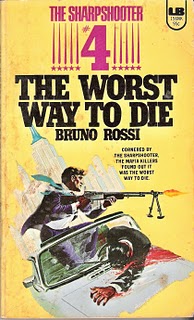
The Sharpshooter #4: The Worst Way To Die


The Sharpshooter #4: The Worst Way To Die, by Bruno Rossi
February, 1974 Leisure Books

Johnny Rock is back in another entertaining installment of the The Sharpshooter series, a little more slower-paced than the previous three volumes but still packed with the same grisly dark humor. This volume marked Leonard Levinson's first work on the series; Levinson is an author I first became aware of a few years ago when I discovered his unsung classic The Last Buffoon. Anyone who has read that novel will know that Levinson has a great sense of humor, one which is apparent throughout The Worst Way To Die. Also, this is by far the best-written volume yet in the series. (However I'm not saying it's the best volume. How could anything top the insanity of Blood Bath??)

What's strange is that The Worst Way To Die could almost serve as the initial volume of the series. Johnny Rock is only getting started on his vendetta. Mobsters aren't even sure who he is. Meanwhile, two volumes ago, in Blood Oath, he was so famous that magazines were running profiles on him. I guess you could say this novel is like a "missing chapter" from The Killing Machine. There's of course no mention of Rock's gorgeous female partner, Iris; Rock consistently reminds himself here that he is waging a lone war. It's as if he has never met her. (Or, more likely, that Levinson never read the first volume of the series!)

But this is a very human Johnny Rock in The Worst Way To Die -- so human in fact that Levinson refers to him throughout as "Johnny" rather than the more typical "Rock." He gets nervous before his hits on the Mafia, he worries he might get caught, he regrets that he cannot live a normal life. There are many scenes where Rock will walk through New York City and look at the people who pass him by, envying their humdrum lives, wishing he too could go home to a loved one and eat a nice dinner and watch TV all night. But for all of his hummanity Rock is still consumed by rage, and Levinson brings it to life in a big way. Indeed, you could say this installment shows how Rock became the twisted monster of the other volumes. For he repeatedly "hungers for Mafia blood;" if he goes just a few days without killing a mobster he is consumed with anger and can think of nothing else.

Another thing Levinson brings to life is the tedious lot of the Mafia-killer. Rock marvels over how he spends most of his time waiting, and so Levinson shows us this. There are many scenes of Rock wasting time while he plots his next kill. Shopping, walking around the city, reading the paper. In fact you could go so far as to say that parts of The Worst Way To Die are boring -- which is pretty unusual in that we're talking about a volume of The Sharpshooter!

But this is just a trick up Levinson's sleeve; he lulls you into the tedium of Rock's life, then out of nowhere delivers gruesome, shocking scenes that remind you of the previous volumes. He's done a fine juggling act here, presenting a Johnny Rock who considers himself a nice guy, yet who can still pull off violent acts of murder. In other words, he's delivered a protagonist who is a psychopath but doesn't know he is a psychopath.

The plot itself is standard -- Rock is initially captured by a Mafia enforcer with pronounced buggy eyes (ie, a proto-Steve Buscemi), an enforcer Rock dubs "Snake Eyes." This guy suspects Rock might be this mysterious person who has been knocking off Mafia, so to be safe beats Rock to a pulp and orders two of his men to take him off and kill him. Rock of course turns the tables and escapes, bloody and battered and consumed with gaining vengeance upon Snake Eyes.

Again, this is early in Rock's career, as he goes to a family friend's house, an elderly doctor, and has to explain to the man about his new purpose in life. The doctor patches Rock up and meanwhile his daughter Angela, a girl Rock's age, teaches him the art of disguise via makeup and wigs. Rock hits on her throughout, unable to believe how she has grown into such a woman since last he saw her. (Or, as Rock so memorably puts it: Jesus, how'd she grow those big tits?) Rock knows that he cannot involve any woman in his violent life and so eventually leaves the family; there is a funny scene later in the book where he hires a hooker to sublimate his feelings for Angela.

After lots of planning Rock gets his vengeance on Snake Eyes, and the whole sequence stays true to the brutal tone of previous volumes. Rock beats the guy to shreds with a pair of brass knuckles, blows his head off, and tosses the corpse onto the man's "swinger" girlfriend -- a stewardess whom Rock has chained to her own bed. "Start swinging," Rock tells the shocked girl.

But we're only halfway through the novel; even though he's attained his vengeance, Rock knows that there are countless more Mafia vermin out there for him to exterminate. He sets his sights on bigger fish, realizing that he hasn't yet killed any Mafia "bigshots;" further sign that The Worst Way To Die is an early chapter in Rock's career.

This entails a lot of planning and time-killing on Rock's part. This novel might be trying for most readers in that nothing much happens for long stretches of the narrative, but I really do enjoy Levinson's writing. Also, he was one of the men's adventure writers who was known for putting a lot of sex scenes into his books -- his Butler series, published under the psuedonym Philip Kirk, was notoriously sex-filled -- so there are a few scenes of Rock getting lucky, in particular with a hippie chick who rents the apartment beneath his.

At length Rock carries out his big hit, his victims a pair of brothers who have taken the place of the dead Snake Eyes. This is a great sequence which almost brings to life the awesome cover illustration for Blood Bath, as Rock wastes the mobsters while they're eating pasta in an Italian restaurant -- only here Rock first hits them with vomit-inducing gas grenades and comes out shooting while wearing a gas mask. Finally he pulls off his biggest hit, murdering the father of the men, a Mafia chief, as he attends their funeral. This last bit features the most shocking example of Rock's psychosis yet: with his sniper rifle, he first assassinates the chief and then assassinates his (no doubt innocent) young daughter.

And with this The Worst Way To Die ends -- Rock hops on his stolen Honda motorcycle and speeds off toward Manhattan, having just murdered several unarmed people, a young woman among them. There is nothing heroic or vengeance-sating about it, and it leaves a rotten taste in the reader's mouth. But I would bet this is exactly Levinson's intention. Again, the Sharpshooter series is a satire on Don Pendleton's "hero," The Executioner; Levinson is savy enough to know that in reality, any man who wages a lone war on the Mafia would have to be a psychotic bastard himself. And he shows it in unforgettable ways throughout this novel.

Levinson turned in a few more volumes of The Sharpshooter, including the next one. I also suspect he wrote a few volumes of the similar Marksman series, but I haven't found anything to confirm it.

Monday, June 13, 2011

SuperBolan #100: Devil's Bargain


SuperBolan #100: Devil's Bargain, by Dan Schmidt
January, 2005 Gold Eagle Books

This is a more recent example of the men's adventure novel; it's good to know the genre is still alive but it's obviously on life-support. Dan Schmidt may be a familiar name to some; since the mid-'80s he's ghostwritten 40-some Gold Eagle titles, and in the late '80s he wrote the Killsquad series under the psuedonymn "Frank Garrett." At the same time he also wrote the Eagle Force series under his own name.

Schmidt is usually taken to task for his "needless gore" and ultraviolence, especially amongst the die-hard Gold Eagle fans, but they just as often complain about the man's jumbled and padded narratives, with needlessly-overblown casts of characters. Reading Devil's Bargain, I can somewhat see what they mean, particularly on the latter criticism. In a way, this "SuperBolan" encapsulates why I stopped reading Gold Eagle books over two decades ago. It's almost monotonous in a way, and bores more than it entertains.

The biggest shame is that the villains of the piece have such potential: Alpha Deep Six, a deep-cover Black Ops squad so deep-cover that they've been missing for the past decade and presumed dead. These guys have the makings of awesome villains, US commandos who have gone rogue and now actually fund terrorists themselves. Each of the Six has been "reborn" with a mythical name: There's Crammon, the leader; Acheron, the second-in-command; Thor, a big guy who fights with double axes; and so on. Problem is, Schmidt does little to differentiate between them. I spent the whole novel confusing Crammon and Acheron.

In the middle of all this is Mack Bolan, the Executioner himself. I'm not sure if the guy is now like a comic book character, ageless; in reality he'd be in his sixties at least, which is hard to buy in the action genre -- but then, Sylvester Stallone proved it could be done (and damn well) in his 2008 Rambo. My guess is that these novels must occur in some time-stasis zone, as Bolan still acts like a man in his thirties...ie, just like the Bolan of the Pendleton originals or the Executioners I read back in the 1980s. To make it all the stranger, Crammon himself is a 'Nam vet, ordering around some men he considers his sons. I don't know. I guess I'm thinking about it too much, which is beside the point.

Devil's Bargain opens like an episode of 24, with a wave of terrorism slamming through the US. Bolan has been given highest clearance to stop the threat, which involves lots of bombings on commuter trains and buses. Schmidt pulls that old Gold Eagle page-filling trick I'd forgotten: opening the occasional chapter with pages and pages of the point of view of a terrorist who soon meets his end at the hands of Bolan. But then, Schmidt does that throughout; you only spend perhaps a page or two in a character's perspective before he hopscotches to the next one, leaving for a confusing and frustrating mess. The issue is not the multiple-character perspectives. It's that all of the characters sound the damn same.

While the US-attacks are going on, all of them the work of a certain Islamic group, the Alpha Deep Six guys kidnap Barbara Price, apparently a recurring character in the Bolan universe -- a lady who works for the top-secret "Stony Man" collective and occasionally sleeps with Bolan. She's kidnapped because Crammon and his men have heard of this ultra-secret commando facility which might impede their plans, and so kidnap Price as collateral. Or something. In fact this kidnapping angle only exists so that Bolan can become embroiled in the plot...and also so he has a personal reason to see the mission through. Because otherwise Price's kidnapping has nothing to do with anything, and after she's abducted she pretty much drops out of the narrative.

Once Bolan gets in the picture he begins to track down Alpha Deep Six. We gradually learn that the bastards have funded this day-long attack on the US as a sort of cover for themselves, so they could pull off a bank job. The bank they are robbing is the fictional "Bank of Islam," probably one of the more novel ideas in the book: an endless cache of dollars and gold hidden in an ancient crypt beneath Ankara, Turkey. The place is so secret that most US agencies consider it a myth, but Alpha Deep Six have learned that it truly exists. The place is heavily guarded and Alpha has recruited a team of Iraqi soldiers as well as disaffected US soldiers to raid the place.

After a few hundred pages of character-hopping the raid finally begins. It is a stirring scene, only again ruined by Schmidt's insistence upon hopping from one character to another every other page. It should be mentioned that Bolan is busy dusting his shelves while all this occurs; really, the Executioner is more of a guest star in Devil's Bargain. Though he wastes a few terrorists (as expected), he's instead always a few steps behind Alpha, trying to figure out what they're up to.

Meanwhile we have an endless but entertaining action scene as Crammon and his men wade into the booby-trapped bowls of the Bank of Islam. In a bit of dark humor they use their Iraqi soldiers as trap-bait, tossing them ahead into dark tunnels and letting them take the brunt of whatever trap has been set. It's all like Indiana Jones. Once through the traps of course they encounter armed resistance, and here Schmidt delivers heaps of ultraviolent fight scenes, but really it isn't as gory as I expected -- it's got nothing on Army of Devils, that's for sure. Along the way Alpha Deep Six suffers incredible casualties, and finally Bolan catches up with them while the battle is coming to an end. The climax of Devil's Bargain seems rushed and, well, anticlimatic, which is strange given the expanded page length of these SuperBolans.

But all the tried-and-true gimmicks you remember from Gold Eagle are still at play: endless detail about various guns and the ammo they use, right-wing philosophizing, and a protagonist more superhuman than possible. Don Pendleton was sure to give his creation a dose of hummanity, something which has obviously been lost over the past decades. I'm sure other Gold Eagle ghostwriters have attempted to keep the spirit alive, but separating the wheat from the chaff is a job for someone with a stronger will than mine -- I'll be much happier staying in the lurid and exploitative world of the Imitation Executioners, like The Sharpshooter or The Marksman.

Thursday, June 9, 2011

Able Team #8: Army of Devils


Able Team #8: Army of Devils, by Dick Stivers
October, 1983 Gold Eagle Books

Without a doubt, this is the most insane, brutal, sadistic, over-the-top gory book I've yet reviewed on this blog. It's great!! It goes beyond even the lunacy of Gannon or Blood Bath, which is shocking enough, but even more shocking is that Army of Devils comes from a most unexpected source: Gold Eagle Books. If more of their novels had been like this rather than generic, status quo terrorist-of-the-month stuff, then they'd be as hotly-collected as the earlier, more lurid examples of the genre. Because in reality Army of Devils is more like something Manor Books would've published a decade earlier.

"Dick Stivers" was a house name for the series; this novel was actually written by GH Frost, a man who wrote a dozen or so Able Team books, many of which are supposedly as insane as this one. When I was a kid in the mid-'80s I subscribed to Gold Eagle; every other month I'd receive a box of books. Able Team was always included, but I never read any of them. (They sure looked good lined up on my bookshelf, though!) Being such a fan of the publisher I knew all about them, though: a three-man commando team who usually responded to domestic terrorism threats, but would occasionally go abroad.

The Team is comprised of Carl Lyons, the leader and general alpha male, Pol Blancanales, and Gadgets Schwarz. It doesn't really matter though, as Lyons is the star of the book; the other two don't even show up until over halfway through, and even then mostly serve as back-up. This isn't a problem for me, as it allows Frost to concentrate on a protagonist and really build up the novel. Because quite honestly, Army of Devils is superbly written, with a level of character depth usually unseen in this genre; the action scenes are sadistic and brutal and insanely gory, but amid all of that Frost is still able to dole out exceptional dialog, narrative, and quiet moments of reflection.

But first the carnage. The novel opens with some of the most over-the-top stuff I've ever read, as Frost details the murderous rampage of a gang of punks one summer night in LA. Out of their minds on a variant of PCP which turns them into zombies, their only thought is to kill whitey. Yes, this novel preys on the fears of the conservative white male even moreso than the earlier Hijacking Manhattan.

These opening pages give the tone of a horror novel more than action, as the punks -- black and Chicano the lot of them, as Frost often reminds us -- kill with abandon, often in the most brutal of ways. And they truly do become zombies under the influence of the mysterious drug; unable to reason or talk, unable to feel pain. And the only way to kill them is to blow off their heads or sever their spinal columns! Just when you think this opening section has attained the peak of brutality, it goes even further, ending with another gang of punks killing the occupants of a broken-down car and then playing a quick game of ball with their baby...before finally tossing it out the window of their speeding car.

LA is set into a panic and Carl Lyons just happens to be on the scene, in town to provide a demonstration of an automatic shotgun to the LAPD. He's here with his girlfriend Flor, a pretty DEA agent who happens to be a sort of liason with Stony Man, the shady ensemble for which Able Team works. And who would believe that here we get an actual sex scene in a Gold Eagle novel?? Again, it's as if Frost has no idea who he is writing for, and more power to him. Beyond the shenanigans this is another well-crafted scene, with great dialog and introspection for the two characters. And Lyons himself comes off like a throwback to those earlier men's adventure protagonists, a hothead who's always about to blow a fuse.

Lyons hears all about the horror that was the previous night, and vows to find out what's up. He calls in his teammates and here the gory fun begins. The whole middle section of this novel concerns Able Team infiltrating a building filled with these drugged-up zombies, all of them armed and ready to kill. It's one hell of a gory ride, with the Team blasting apart wave after wave of zombie-punks, even hacking them up with machetes when they run out of ammo. In fact it gets to be so gory that eventually the Team finds themselves standing in ankle-deep blood!

Army of Devils comes off like Dawn of the Dead meets Assault on Precinct 13...or even like an NC-17 version of Death Wish 3 or Stallone's Cobra. If you have a fondness for those '80s action movies where middle-aged protagonists spend the entire film blowing away punks, then you owe it to yourself to check out Army of Devils. Just when you think he's topped himself, Frost rises to another peak and shocks you all over again. And again, it's not just a case of ultraviolence -- the man can truly write, even delivering some dark humor.

Every time I read one of these OTT novels I wonder how seriously we're to take the author. This is especially important when one is reading a Gold Eagle novel, a notoriously right-wing publisher. And Army of Devils does go out of its way to bash the "liberal media," the hippies of the '60s, the Black Panthers, and on and on. There's even a Geraldo Rivera-type who works for a "communist" public access show who suffers perhaps the goriest fate in the book, literally hacked to pieces by frothing, drugged-up punks -- Frosts's commentary on what the liberals deserve? There are also many instances where Lyons and his friends lambaste the liberal, tree-hugging attitudes of both the public and the media.

We learn early in the novel that the drug has been dispersed by a former Black Panther (of course, right?) who works with the CEO of a non-profit Hispanic American company. This non-profit guy is secretly a Communist agent and works to destroy the government (of course, right?). These two have amassed a veritable army of punks -- all of them black and Chicano, remember -- and juiced them with the drug, working them up into anti-white fits of rage. The idea is to foster a race war which will destroy the US. But the question is, where did they get this drug? The Team discovers there's more to the story than they first expected, and it all ends with a climatic battle with the Team in a helicopter going after a van which might be driven by CIA agents...a battle which ends in personal disaster for one of the Team.

Anyway, you can consider me impressed with the work of GH Frost. I'm definitely going to seek out more of his Able Team novels one of these days. This one comes highly recommended to all who want to see just how extreme the men's adventure genre can get.

Monday, June 6, 2011

MIA Hunter #1


MIA Hunter #1, by Jack Buchanan
January, 1985 Jove Books

I'm really taking a trip down memory lane, here -- as a kid I actually collected this series as it came out. I didn't have all 17 volumes,* but I had several of the earlier installments. The thing is, I don't think I ever read any of them; I was more into the gun-porn, terrorist-wasting world of Gold Eagle Books.

But man -- talk about some savy marketing! Cashing in on the mid-'80s "POW" boom (ie Chuck Norris's Missing In Action and Stallone's Rambo II), the MIA Hunter series is like an '80s action movie on paper. It's as if it was co-published by Canon Films or something. These days the series is most known for the involvement of bestselling author Joe R. Landsdale, who was one of the writers serving as "Jack Buchanan." Bill Crider also delivered a few volumes. Our pal Chet Cunningham even wrote a volume.

It's my understanding though that the main writer behind the series (as well as the plotter for each volume) was Stephen Mertz. This initial installment was written by Mike Newton, who like Mertz got his start as a sort of understudy with Don Pendleton. Newton also wrote the second volume of this series, as well as a hundred or so other men's adventure novels, including countless ones for the Gold Eagle stable, not to mention a how-to book on the craft.

Mark Stone is the titular character, a 35 year-old Vietnam vet who is very much in the mold of The Penetrator. Like Mark Hardin, Stone was known for infiltrating VC defenses and really kicked some shit during the war. Hell, the guys even have the same first name. Only Stone lacks the more pulpish charm of Hardin: he has no eccentric old scientist funding his campaigns nor an American Indian training him in metaphysical combat. Instead, Stone is a sort of private eye who uses the money from his work to fund his "second job:" namely, rescuing POWs.

Stone has two comrades in this: Hog Wiley, a mountain of a man who also served in 'Nam; Stone thinks of him as "the ugliest man he has ever known." A grizzled bulk who moves faster than his girth would imply, Hog gets off on violent action. I realized late in the book that if this novel had been published a decade earlier, Hog probably would've been the protagonist. The third member of the team is Terrance Loughlin, and a less-developed character you will never meet. Seriously, Loughlin says like four lines in the entire novel. A British commando who had to leave the SAS when his identity was exposed, Loughlin serves as the explosives expert, but generally just sits around on the periphery. You can tell Newton is uncertain what to do with him; in Loughlin's introduction he writes that the guy is "the British version of Mark Stone," and has done with it.

This first volume introduces us to Stone's world and hints at future developments. Stone is watched by the CIA and FBI and other government agencies; there's a fun scene early on where some government stooges harass him for his unsanctioned raids in Vietnam. Stone's defense is that he's just a private citizen visiting a foreign country. But Stone is known in underground channels as the go-to guy for POW extraction. He doesn't charge for his missions other than expenses for gear and etc. This time out he's contacted by a woman who has learned through various connections that her husband, missing for 15 years, might still be alive, and imprisoned in a Vietnamese camp. After verifying the evidence and getting a location, Stone takes the mission.

I actually enjoyed the second half of the novel best. Newton does a great job of bringing to life the Far East. There's a nicely-done scene where Stone meets his weapons supplier in an incense-filled temple, and Newton really captures the otherworldly air of the place. This leads to an action scene: the supplier stores his weapons in his home, and when they go there for them the team finds the place under attack. After fending off the killers and saving the supplier's pretty daughter, Stone goes on with the mission. I'm assuming this development will play out in later installments -- I mean, it's never even explained who the attackers were -- but we'll see.

Newton continues to build up the tension as Stone and his team work their way into the jungle and across the border. There's the obligatory fight scene with a sampan and PTO boats as Stone and his men are nearly caught by soldiers. At length they find the POW camp, which contains three badly-wounded and malnourished US soldiers. Stone attempts a soft probe of the site, but as expected the shit hits the fan and a huge battle ensues. A nice bit is that one of the freed POWs is a former Green Beret and goes wild with a captured AK-47, blasting apart his captors.

The only problem I had with this novel is the action onslaught of the final third. I'm not saying it falls to Death Merchant depths, but it comes close. We have the big battle in the POW camp, followed immediately by another as Stone and his team escape through the jungle and come upon a village which is being attacked by bandits. These guys have nothing to do with anything but Stone and his men decide to attack them, which is nice given that they're saving the villagers and all, but it comes off as too much too soon; we just read a big action scene a few pages ago. But then there's a third big action sequence immediately thereafter: after defeating the bandits, Stone is informed by the villagers that a contingent of Pathet Lao soldiers are on the way, as well as a tracking squad of Vietnamese soldiers who survived Stone's raid on the POW camp. So yet another big action scene takes place here, with everyone fighting everyone.

I know, there's nothing like complaining about too much action in an action novel. But the problem is the action is so samey. There are too many repetitive scenes of Stone giving himself pep talks, gearing himself up for action, and when it all goes down pretty much the same descriptive phrases are used throughout. I'm not sure how many times I read about a "headless corpse" falling down after a CAR-15 blast. Newton is good in that he doesn't POV-hop; when he gets into the perspective of a character he stays locked in, but the problem is all the characters sound the same. Even the freed POW Green Beret gives himself pretty much the same pep talks as Stone. The only flash of color here is Hog Wiley, who as mentioned really enjoys the thrill of combat.

Anyway, a strong first half that gets off the rails a bit with too many back-to-back action scenes in the last half. But it was still an enjoyable ride, not to mention a quick read: somehow I read this novel in one day, something I haven't done in a long time. In my usual fit of OCD I've acquired the entire series, so I'll soon be dipping back into the POW-freeing world of Mark Stone.

*Technically the series lasted 16 volumes, but there was an un-numbered volume, simply titled Stone: MIA Hunter, which came between volumes #6 and #7. This un-numbered volume is not to be confused with MIA Hunter #1, even though some online booksellers list it as such.

Thursday, June 2, 2011

The Marksman #1: Vendetta


The Marksman #1: Vendetta, by Peter McCurtin
April, 1973 Belmont-Tower

I've slowly been collecting this 23-volume series* over the past year, and figured I should finally get around to reading it. As many have mentioned, this series is pretty much the same as The Sharpshooter -- so similar in fact that the occasional writer of The Sharpshooter has mistakenly referred to the protagonist as "Magellan" rather than "Johnny Rock."

Philip Magellan is the protagonist of The Marksman series, and he and Johnny Rock are both emotionless ciphers who blitz their way through the Mafia, so you can't really blame the authors for confusing them. Peter McCurtin wrote this initial volume, and word is he also wrote the first volume of The Sharpshooter, The Killing Machine. But as usual, this leaves me with questions. McCurtin's name graces the cover of Vendetta, but The Killing Machine was published under the house name "Bruno Rossi." What bothers me, and I'll get more into it later, is how different the styles are in the two novels: I have a hard time believing that the same author wrote both books.

Anyway, Vendetta. This first volume throws you straight into the violent world of Philip Magellan without a safety net. There's no backstory, no origin for our protagonist, no sort of character introspection. What's funny is that the back cover features a rundown of Magellan's past, how he grew up learning about guns and waged war on the mob when they killed his family, but the novel itself doesn't mention any of that. Instead, we pick up with Magellan after he's become a boogey man for the Mafia, so feared that mobsters sit around and worry about the guy. Not only that but the police are hunting him.

The main plot here -- the only plot, actually -- is Magellan cracking down on a San Francisco-based mafioso. Vendetta doesn't even seem like a novel. It's more like an outline for a novel, with barebones narrative and clunky dialog. Even the action scenes are rendered boring due to the clinical way McCurtin writes them. The only time the author comes to life is when he describes guns. Anytime Magellan looks over his weaponry, or the weapons of his opponents, McCurtin wakes up and writes. One gets all sorts of information on certain pistols and shotguns and what kind of ammo they use. In a way, it's sort of like those Gold Eagle books from the '80s, only a lot more rough. Just straight-up gun porn. There is a telling moment, late in the novel, where Magellan "fondles" his weapons as he prepares for the final raid.

Magellan proves himself just as twisted and merciless as Johnny Rock: in the opening pages, as he flies into San Francisco, he realizes one of his fellow passengers is a hitman. Magellan beats the guy senseless and takes him along in his rental car, using the guy to call up his boss. In exchange for cash Magellan promises not to kill the man, but does so anyway. There are many such scenes where Magellan will string up some sap and torture him, then kill him. He takes particular relish in killing the "hippies" who work for the mobsters. Actually McCurtin can't seem to make up his mind if they're hippies or Hell's Angels; likely they're the latter as the guys are a bit too violence-happy to be true hippies.

Another twisted bit is where, for absolutely no reason, Magellan goes to the trouble of sawing off the head of a "hippie" he's killed. Magellan later tosses the severed head into the indoor pool of the hotel he's staying in, a mob-run and hippie-frequented crumbling landmark. It's unexplained why exactly he does this, but at least it's memorable. There's more unintentional comedy in the luck Magellan has throughout: I lost track of the number of scenes where he would sneak into some restaurant or bar, wearing a "hippie disguise," and sit down beside some mobsters...who would, at that very moment, be discussing not only Magellan but their plans to off him.

All told, this was a rushed and muddled effort, not very promising for the series itself. Later volumes were published under the house name "Frank Scarpetta," and thumbing through some of them it appears the series improves (and gets more sleazy!). But again, I have many questions about this novel. I'm not saying The Killing Machine was great literature, but at least it had a good plot and character development, with good dialog and well-crafted action scenes. Vendetta has none of that. Hell, even the tone is completely different.

So is it confirmed that Peter McCurtin actually wrote The Killing Machine? If so, then he must've banged out Vendetta in a rush, or at least after knocking back several bolts of whiskey. Or maybe, as I theorized in my review, The Killing Machine was planned as a standalone novel, and so McCurtin gave it more care, whereas Vendetta was churned out to be exactly what it was: the trashy first volume of a trashy ongoing series. I have my doubts, though. I'm betting someone else wrote The Killing Machine.

*The publishing history of The Marskman is as twisted as its protagonist. The first two volumes were published under Peter McCurtin's name. Volumes #3 - 22 were published under the house name "Frank Scarpetta." The Torture Contract, Murder Machine, Bloody Sunday, and Times Square Connection are all un-numbered volumes, but would be numbered respectively #19, #20, #21, and #22. The 23rd and final volume, The Reckoning, was published under the name Aaron Fletcher, and does not feature a number on the cover nor even "The Marksman." It was also published by Leisure Books rather than Belmont-Tower. Aaron Fletcher was one of the writers who served as "Frank Scarpetta," so perhaps this last volume was his attempt at a closure for the series? The only problem is, The Reckoning is by far the most rare volume of the series; after a year of debate I finally dropped $20 for a copy. At the time of this writing only a handful of online sellers list the book, with prices ranging from $18 to a whopping $160. Give me a few years to work my way through the series and I'll let you know if this final volume is worth the price!

3/9/12 UPDATE: Finally, after a ton of research, I have the truth behind Vendetta. Despite being credited to Peter McCurtin, this novel was actually written by Russell Smith. I learned this via the July-December 1973 edition of the Catalog of Copyright Entries, which states that "Peter McCurtin" was merely the psuedonym used by Smith for this particular volume. (McCurtin was in fact a real person, and indeed was the editor of both the Marksman and the Sharpshooter.)

Monday, May 30, 2011

The Penetrator #6: Tokyo Purple


The Penetrator #6: Tokyo Purple, by Lionel Derrick
October, 1974 Pinnacle Books

You know Chet Cunningham's back in the author's saddle when one of the first lines of the book is: Now he wanted a short vacation far from the smarting smell of cordite; away from the blazing guns and sudden death; far from the surrealistic display of a skull exploding three feet in front of him with brains, blood, and bone fragments splattering the nearest wall. Now that's how you start a novel!

Published the month and year I was born, Tokyo Purple finds our pal Mark Hardin, the Penetrator, taking a much-deserved vacation. As the title indicates, he settles upon Tokyo; he last visited the city during some r-n-r back in "the 'Nam." On his way there Hardin makes a brief stop in Hong Kong, sightseeing with his new girlfriend: Akemi, a genuine Groovy Stewardess. Hardin the superstud actually picked the lady up during the JAL flight; unfortunately Cunningham robs us of this scene. I would've given anything to see Hardin the pick-up artist at work.

Hardin figures he can rest a bit easy in Asia as he isn't a wanted man over here, and the mob tentacles likely don't reach this far. But this being an action novel, he's nevertheless attacked posthaste. With only his dart gun, nicknamed Ava, Hardin kills the pursuers. They appear to be Japanese and each of them carries a purple cord. A horrified Akemi informs Hardin that these men are members of the Sendai Purple, basically the Japanese mafia (Though he sprinkles the narrative with some basic Japanese, Cunningham never uses the term yakuza.)

Once he and Akemi move on to Tokyo, Hardin discovers that he's for sure being hunted. The Sendai Purple is after him, and at length he discovers why: back in the fourth volume, Hijacking Manhattan, Hardin ratted out on his Japanese arms supplier in exchange for some needed intel. It turns out the supplier has now sicked the Japanese mob on Hardin in retaliation. This is enough plot for a men's adventure novel, but Cunningham muddles it with a subplot: Hardin's benefactor, Professor Haskins, calls Hardin to tell him that an American girl named Melissa Broadhurst has gone missing in Sendai, and wants Hardin to try to find her. And guess who kidnapped the girl? Yep, the Sendai Purple. It's a bit too pat, but what can you do.

Melissa, despite being a brick-shithouse blonde, is a nuclear scientist, and the boss of the Sendai Purple wants her to build some triggers for atomic bombs he plans to sell to the highest bidder. This boss is named Kamisori, aka the Razor, and he runs his show from a fortress in Sendai, surrounded by armed guards. The novel's more lurid stuff occurs early on: Melissa refuses to work for Kamisori, who then strips the girl nude and locks her in a room, telling her he will come back to rape her in three days if she doesn't change her mind. And he carries through on the threat, even going so far as to torture her a bit.

Meanwhile Hardin, who has left Akemi back in Tokyo, drives across rural Japan searching out clues in Melissa's disappearance. Vast stretches of Tokyo Purple come off like a travelogue, which makes sense...Hardin is on vacation, after all. And after the action onslaught of the previous volume, it's good for the guy and the reader to get a little breather. Cunningham also takes the opportunity to butcher the language as the native Japanese speak in overdone pidgin English.

But to be sure Cunningham does provide the occasional action sequence, including a nice one early on where Hardin is trapped in a pulping plant, hurtling down a tube to be pulped with old newspapers and junked books: a fitting end for a pulp hero. There's also a funny scene where Hardin visits a steam bath, but can't handle the lava-heated water. I spent a semester of college in Japan and fell in love with these things (onsens), but then, when I was in one armed thugs weren't coming after me.

After hooking up with a group of anti-nuke students who have aligned themselves with a high-tiered member of Sendai Purple -- who is against Kamisori's plans to use atomic weapons -- Hardin infiltrates the fortress headquarters and goes into action. This is another action-packed sequence with Hardin again taking a massive beating, not to mention ruptured eardrums after one guy fires a howitzer within an enclosed space. During the battle Hardin finds Melissa, who helps the injured Penetrator get out of the burning building; Cunningham builds up some romantic tension between the two but then quickly drops it.

One thing I enjoy about this series is that authors Roberts and Cunningham always provide a novelty death for the main villain. A lot of these books usually suffer from anticlimatic endings, with the boss bad guy either just getting shot or blown up or done away with in an offhand manner. The Penetrator series however delivers climatic final fights that are more satisfying for the reader. In the case of Tokyo Purple it's Hardin going up against Kamisori in the bowels of the Sendai Purple headquarters, fighting each other with an array of vintage handheld weaponry.

And by the way this volume features my favorite cover art yet in the series, with its groovy psychedelic pattern and foxy nude lady (who appears to lack nipples, but you can't win 'em all).

Wednesday, May 25, 2011

The Enforcer #3: Kill City


The Enforcer #3: Kill City, by Andrew Sugar
June, 1973 Lancer Books

First off, I want to say thanks to Ralph Blanchette for posting a comment on my review of Enforcer #1. Ralph, an artist, was friends with Andrew Sugar in the '70s and collaborated on some work for Argosy Magazine with him. (He's also confirmed that Sugar was indeed a man!) Unfortunately Ralph doesn't know what happened to Sugar, or even if he's still alive.

Kill City features the return of everyone's favorite clone, Alex Jason, who once again has been given a new body which will last for 90 days. But at this point Jason is used to the constant changing of bodies. Given that his mind stays the same with each new body, he's now focused upon honing his ESP skills. He's also focused upon his relationship with Janet, the attractive doctor he met in the previous volume. Janet is a non-clone but also works for the Institute, and now lives with Jason in their HQ in downtown New York City.

Out for a beer, taking a break from his writing (the world at large doesn't know that famous author Alex Jason was dying of cancer a year ago), Jason is mugged on his way back to the Institue. Like a true man of action, he takes the opportunity to test his martial arts skills. He nearly gets his ass kicked. He's saved by two guys in tan uniforms who show up in an Impala(!) and shine a light on both the hood and Jason. Suddenly Jason wants to kill himself. Using his sharp mental skills he defeats the raging impulse. The hood meanwhile takes his revolver and shoots himself.

The rescuers identify themselves as members of "The Patrol," a sort of unofficial citizen's police force. They admired Jason's fighting skills and ask him to consider joining. Jason however can't shake his suspicions and investigates. As in the previous volume, Jason goes undercover. And once again he discovers a plot to undermine the country, with the Patrol really a sort of strike force commanded by Lochner, Jason's arch-enemy. Lochner's method of destruction is "The Suzy," that beam which "saved" Jason in the opening pages; it zaps the mind and triggers the brain's self-destruct mechanisms. Only 1 in 10 people can withstand it, Jason of course being one of them.

Whereas the previous volume was a padded-out bore, Kill City is much more entertaining. Sure, there's lots of stuff that could've been cut, but Sugar keeps the action at a nice pace with occasional shootouts, fights, and sex scenes between Jason and Janet. The thing is though that the Enforcer series is just so much better-written than the average men's adventure novel. Sugar remains locked in Jason's POV through the entire book, really fleshing out the character. The most incredible thing is that there's actual character development here: Jason is a much different character than he was a mere two volumes ago. This in itself is a novelty in the genre.

Regardless, one must be ready to slog through many scenes of Jason and his comrades sitting around and talking. There are many, many scenes of one character unloading theories or beliefs upon another character. Kill City is much more plot and dialog heavy than the average men's adventure book. But then, I realized something with this installment: Sugar really isn't writing a men's adventure sort of series at all.

It's my contention that instead Sugar used this series as a forum from which he could advance his political and philosophical beliefs. This is the same thing Ayn Rand did with Atlas Shrugged, only Sugar has done it in the wild and wooly world of men's adventure novels. The characters Jason meets -- politicians, self-styled police, scientists -- rail against the government, the sheeplike mentality of the common man, the growing corruption and how it could all easily be avoided. And Jason acts as the bellwether, agreeing with certain things but arguing against those that fall outside the rubric of Libertarianism. Not that the Party is ever mentioned; it's all more of a subtext sort of thing. To be sure, it makes for some slow reading at spots, but at the very least I can respect it as it's something different than the genre norm.

Another thing I like about this series is how Sugar encapsulates the lost art of being a guy: Jason and his pals sit around and discuss big issues while drinking brandy and smoking cigarettes. And unlike the usual men's adventure protagonist, Jason's a more sensitive sort (Sugar insinuates that this is because Jason is a writer, and so more open-minded), and he's careful to shelter Janet from "male chauvinism." And Jason truly does love her, which again is different from the genre standard: Janet is the only woman Jason's with in the course of the novel...but that doesn't stop Sugar from again delivering graphic sex scenes between the two.

In 1975 Sugar took the series over to Manor Books, who reprinted Kill City along with the other three Lancer originals. Here's the cover: