Thursday, November 4, 2021

Four Came Back


Four Came Back, by Martin Caidin
February, 1970  Bantam Books

Another in the sequence of Space Race novels Martin Caidin published in the ‘60s and early ‘70s, Four Came Back almost comes off like a sequel to his later novel The Cape, even though there are no recurring characters. The Cape took place in 1972 and concerned the launch of a manned space station; Four Came Back also occurs in 1972 and concerns a group of astronauts trapped on a manned space station. And the reason they are trapped there is very resonant with our modern era: a mysterious virus has run amok, laying waste to half the crew. 

In fact, the title of the novel pretty much blows the suspense Caidin tries to develop over the 215+ pages. And speaking of which, take a look at the cover, which per the blurry signature (and the style itself) appears to be the work of Sandy Kossin, who later did the covers for the John Eagle Expeditor series: The Andromeda Strain is specifically referenced in the blurb, giving the impression that Four Came Back is a similar thriller, one with perhaps a military angle. There’s no mention of space anywhere, and Kossin does not feature any Saturn rockets or astronauts in his illustration. So clearly by this paperback’s February 1970 printing date, “space” was no longer considered much of a selling point, giving more indication of how quickly the public’s interest in the subject waned after Apollo 11 landed on the moon in July of 1969. 

But as with No Man’s World, Martin Caidin is writing a “near future” thriller here; the original hardcover was published in 1968, and Caidin was likely writing it in 1967. Certainly after the Apollo 1 disaster, which is referenced in the text. Otherwise he mostly sticks to detailing Gemini missions, and of course there’s no mention of the Apollo 11 crew. But then Caidin in his space race novels didn’t try to do roman a clefs, per se; he uses NASA and the general framework of Apollo-Saturn, but incorporates his own cast of characters. The shame of it is that it apparently never occurred to Caidin to feature recurring characters, making this into a loose sort of series; I mean he could’ve easily featured some of the astronauts from Four Came Back in The Cape, or for that matter even featured some of the characters from Marooned (original edition 1963, revised tie-in paperback 1969 – and the only one of Caidin’s space race sequence I haven’t read yet, though I’ve seen the movie…twice! And stayed awake both times!). 

The title isn’t the only thing that blows the suspense; for some curious reason Caidin opens the novel with a chapter written in first-person (in ugly italics), documenting the journal of the unnamed captain of the space station Epsilon. Here, over the course of a few pages, the captain tells us of how a strange virus broke loose two weeks before the crew was scheduled to return to Earth. Eight people were originally aboard Epsilon, and the captain tells us, incident by incident, how four of them grew sick and some of them died. So already in the first chapter we know that “four” will come back because the other four are dead or incapacitated, and we also know which of those four died and how! All so puzzling and unintentionally humorous, like starting off a murder mystery with a first chapter that tells you who the killer is, then backpedaling and trying to play out a mystery angle for the rest of the novel. 

After this opening we jump back three weeks and things go into third-person; the captain of Epsilon is your typical rugged Apollo astronaut type, former hotshot combat and test pilot Mike Harder, and we meet him as he goes about his usual captain duties on the orbiting station, meeting with the rest of the multinational crew. Why Caidin didn’t just start the novel here is a mystery. Harder, despite his rugged virility, is pretty much a buffoon, at least when it comes to the ladies. I mentioned that the station’s multinational; it’s also made up of both men and women, with NASA here even in the world of fiction getting bullied for only sending men into space. Race isn’t mentioned, though; an interesting perspective is that in Caidin’s era it was gender that whipped the SJWs into a lather. Thus, NASA has relented and sent up six men and two women, from all around the world…but they’re all still white. 

The crew has been up here some months, and as with the other novels of his I’ve read, Caidin tells the story via somewhat clunky backstory or exposition, usually at the expense of any forward momentum. And also without much in the way of structure; we’re not told Harder’s backstory, for example, until well into the novel, even though he’s the main character. Anyway I was mentioning that he’s a bit of a doofus with the ladies. Well, one of the crew is a hotstuff brunette babe from Norway named June Strond, “a raven-haired thirty-one-year-old woman scientist” with ample curves in all the right places. And, per Harder’s incessant navel-gazing introspective musing, them Norwegians treat sex like Americans treat kissing. Meaning it’s no big thing to them, and it’s clear June wants Harder to make a pass at her so they can get right down to it up here, four hundred miles above the Earth, in one-G gravity. 

But Harder, for inexplicable reasons, can’t bring himself to make the pass; he’s flummoxed and fears he might be in love with June, and doesn’t want to spoil anything. Or something like that. The entire premise is so lame, particularly given that Harder’s in his 30s, a vet, and, Caidin assures us (almost desperately), has had his fair share of women. Compounding the issue is that another of the crew is a French dandy named Henri Guy-Michel, a lothario who is known for his womanizing. Guy-Michel’s already gotten busy with Epsilon’s other female crewmember, blonde American beauty Page Allison. But the French louse also wants to add June to his scorecard, and in one of Caidin’s clunky bits of backstory (clunky because they come off like they’re occuring in the main narrative, but are really in the past) we see Guy-Michel make his move – and get punched by Harder. 

And really, this soap opera dynamic is what fuels the first half of Four Came Back, with Caidin gradually filling in the backstory of the crew. None of them make much of an impression, though. There’s Koelbe, the German, who hides a Nazi past, and a couple engineers and other assorted astronauts who might as well be wearing red shirts, if you get my drift. The main characters are really Harder and June, and Caidin spends a lot of the narrative on this lame “will they or won’t they” storyline, which gets to be as annoying as any such storylines can be. Too bad Guy-Michel wasn’t the star of the show; now there’s a guy who knows how to have some sordid fun in one-G, but sadly Caidin doesn’t feature the character as much, and only tells us of his plans to do randy things with Page. Once again I can only regret that Harold Robbins never wrote a novel about the space race. 

According to the copyright page, Four Came Back was originally published in hardcover in November 1968, and as mentioned I assume Caidin was writing it at least in 1967. Well before Apollo 11, which would become one of the definining moments of the 20th Century, not to mention one of the most watched events in TV history. And yet Caidin was already able to predict the dwindling interests in the space program. Notably, the moon landing is not mentioned in the text as having happened or about to happen, however Caidin still has it that the public has moved on from the whole “space” thing, and NASA drummed up this multinational space station idea to curry interest, even giving in to public pressure and finally allowing women to take part in it. This, Caidin informs us, went over so well with the country that the Epsilon space station became the biggest draw NASA ever ran, with millions of fans around the world avidly keeping up with events on the space station…for nearly a full year, now, and their interest has not waned. 

Per the times, the sexual angle is a big draw for the crowds on Earth, with everyone mulling over just what might happen with the four male astronauts and two female astronauts up there in space. In particular Guy-Michel’s exploits have garnered much rumor and speculation; as with Countdown, we have here an alternate reality in which the papers publish gossip material about the space industry. As the novel opens, Epsilon’s been in orbit for nearly a year, and the crew has maintained the public’s interest with regular TV broadcasts of them doing this or that scientific experiement, or reporting on their findings up in space. None of it sounds like anything that would keep up interest for a day, let alone a year; we learn that Page Allison has grown plants that are stories tall in the weightless environment, and we also have an overlong bit where Harder and another of the rugged astronaut dudes cavort in a water tank like “human fish” for an experiment. 

The plot promised on the back cover only arises well past the halfway point. And it intrudes right on that “will they or won’t they” subplot. After nearly a year of being skittish over June’s clear interest, Mike Harder finally decides to give her the goods, despite this being right after the two of them have endured a grueling EVA and are all grimy and sweaty and whatnot. But a call from Guy-Michel interrupts them pre-boink. The station is approaching a “dust cloud” and the scientists aboard want to study the hell out of it. Harder, after getting the details – and leaving a jilted June back in her quarters – gives them the go-ahead to study the cloud. But as it turns out, this cloud will contaminate Epsilon with a strange space sickness that fells half the crew in just a few days. 

There’s a vibe of Alien as the crew, one by one, starts to come down with a mysterious illness that initially has no explanation. And yes, the two redshirts are the first to suffer, with one of them sprouting a strange rash and then gradually going nuts, even trying to kill the others. Strangely enough it reminded me of the penultimate episode of Gerry and Sylvia Anderson’s UFO, in which a moon crystal or somesuch caused some people at SHADO to go nuts. But this novel predates even that. However Caidin doesn’t much exploit the horror potential. In fact he totally misses one such opportunity; early in the novel, during an EVA, Harder and June must wait for a fellow crew member to open the airlock door for them so they can enter Epsilon. Knowing the plot of the novel, I figured this was foreshadowing that, once the virus ran amok, someone would get stuck in space. However this never happens. 

Indeed, when the mysterious virus hits the crew, it’s treated so methodically as to be boring. Koelbe, the medical doctor, confines some to bed, puzzling over the illness, before he too is felled by it – the bit that reminded me of UFO, in fact, with Koelbe literally racing from his nightmares through the corridors of the space station. But other than the part where the one redshirt goes crazy and tries to attack people, there’s no real chaos, no real space horrors. In other words, there was a lot of potential here for a more thrilling read. Heck, even the sexual subplot is poorly handled; when Harder and June finally get to it…Caidin leaves it off page! The very act he spent the entire first half of the book setting up, and he feels it’s unworthy of actually being described. 

Caidin does unconsciously hit upon some prescience; when word gets to Earth of the space virus, the public goes insane, going to great lengths to protect itself from the threat. And yes, here too the media does its best to drum up the fear, with no attempt to face the threat with rationality. This leads to all sorts of insane reactions on Earth, yet even Caidin couldn’t think of the insanity of our real modern world. Regardless, the fictional space virus is pretty survivable: note that Harder, June, and Guy-Michel don’t even get any symptoms, and some of their crewmates die “with” the virus, not “of” the virus. But that doesn’t prevent any panic: the people on the ground are terrified that the returning crew will unleash an apocalyptic plague. This leads to nicely-rendered scenes of people going crazy and rioting in Houston, trying to destroy any further rocket launches – and destroying themselves by stupidly molotov-cocktailing the rocket fuel tanks. Caidin really enjoyed tearing this place up in print; there was a similarly apocalyptic Johnson Space Center incident in The Cape. 

Caidin fails in the airlock foreshadowing, but he does pay off on another bit of foreshadowing: midway through the book someone mentions Orson Welles’s The War Of The Worlds radio broadcast, and how it generated fear. Late in the book it’s mentioned again, and Wells’s source novel as well, in that the Martians were taken down by basic everyday germs. Thanks to Harder’s memory of a Gemini mission in which someone in Houston got sick after the crew’s return, it’s soon determined that germs are the culprit here, as well – though it’s the reverse of the Wells novel. Now it’s the absence of those germs, in the antiseptic world of space, that has caused the crew to get sick, when mixed with that space dust. Or something like that. At any rate it’s germs to the rescue at novel’s end. 

Of the three Caidin space novels I’ve read, Four Came Back is the one that most takes place in space, but perversely has the fewest scenes in space. The entire novel really occurs in the 90 foot tall, 13-story Epsilon station (built, as in the real-life Skylab of the real-life 1972, around a Saturn V rocket), with frequent and overly long flashbacks to the crew members’s lives on Earth. Despite the brevity the novel is pretty sluggish, and again that’s due to how Martin Caidin tells the tale; as with his other books, he constantly stalls forward momentum with awkwardly-placed flashbacks and never really gives his characters a chance to breathe. I also wanted more of the sleaze in space that Caidin promised in the opening pages!

Monday, November 1, 2021

President’s Agent (Bart Gould #1)


President’s Agent, by Joseph Hilton
No month stated, 1963  Lancer Books

Look everyone, yet another ‘60s spy series that tried to tap into the success of James Bond! But judging from the publication date, Bart Gould was one of the first on the bandwagon, coming out a year earlier than even the long-running Nick Carter: Killmaster. A big thanks to the Spy Guys And Gals site, which clears up the mystery of authorship on Bart Gould; this first volume was written by (and credited to) an author named Joseph Hilton, but the remaining seven volumes were written by a variety of authors and credited to the house name “Joseph Milton.”* 

This initial volume was written by Joseph Hilton, then, and it looks like he returned for one more installment: Baron Sinister, which was the fifth volume of the series and published in 1965. His writing is fast-moving and economical and brings to mind the work of J.E. MacDonnell in the similar ‘60s spy series Mark Hood. And, like Mark Hood, this series starts off on relatively realistic ground before getting into more fantastical realms (juding from the back cover synopses of later volumes, Bart Gould doesn’t seem to get as fantastical as Mark Hood, though). Hilton does a fine job of introducing us to the titular character and bringing to life the settings and the characters, and also doles out more action than I expected in the final quarter, including gunplay. Unlike Mark Hood and other swinging ‘60s spies (ie Jonas Wilde), Bart Gould doesn’t just rely on his martial arts skills and is fine with blowing off the faces of his enemies. 

An also unlike those other characters, Gould is not a secret agent when we meet him. Rather, he’s an international playboy type, one with a varied background (race car driving, some military service, big game hunting, etc). Hilton doesn’t dwell on Gould’s backstory, which is one of the things I dig about vintage pulp; he just leaves it that Gould’s been around the world – even getting a Medal of Honor at one point – and now at 36 he’s bored with it all. He grew up in wealth and now lives in a luxurious pad near Washington, DC; when we meet him one of his servants is giving him a rubdown after a quick boxing match. That night Gould gets a call from a former Senator named Titus Banning, an older man who now works in an unstated capacity for “the new President.” Banning has some business he wants to discuss with Gould. 

The never-named “new President” is clearly John F. Kennedy, and likely President’s Agent was written in 1962: he’s nine years older than Bart Gould, and also was sort of a mentor to Gould when they both were kids in Cape Cod. The President even makes an appearance in the text, but he’s not described and is presented more as dashing figure from myth, someone everyone looks up to regardless of partisan politics. He personally has tasked Titus Banning with summoning Gould and offering him this particular job: to go down to San Barrios, a fictional Caribbean country, and look into a plot that might entail sending a bunch of uniformed troops across the border into the US as a veritable invading army. 

Gould’s offered the assignment not only because he knows the President – and also because the President is aware of Gould’s military record and all-around adventuring skills – but also because he owns land in San Barrios. As mentioned Gould comes from wealth, and has inherited land down there, so it makes for perfect cover for him to abruptly visit the country. So then, Bart Gould in President’s Agent isn’t your typical secret agent; he has no training, and has literally been sent on the job by the President himself, mostly due to their past friendship. Also it’s interesting to note that Gould is a lot more hot-tempered than your average ‘60s spy protagonist, with none of the calm, cool, professionalism of someone like James Bond. 

Hilton brings to life the tropical paradise that is San Barrios, with Gould going about the capitol city and trying to find out what happened to the Foreign Service ambassador here – whom we already know has been killed, thanks to a suspenseful opening which features a memorable villain (an oversized muscular dwarf who serves as henchman for the novel’s main villain). Action is not really frequent, but at least it’s not a slow-moving dirge like another ‘60s spy paperback set in Latin America: The Survivor. Gould isn’t even that focused on the local beauties, though he “promises himself” he’ll find the time for some of them as he flies into San Barrios. As it turns out, Bart Gould won’t get lucky until novel’s end. 

Hilton seems to be taking us into that direction early on; Gould on the street is approached by a sexy young lady (whose name turns out to be Paquita), but she’s just a cover for some guy who tries to shove a knife in Gould’s back. Our hero defends himself, gets the knife, but both the attacker and Paquita take off. This leads into more of the vibe of a private eye yarn, as Gould hooks up with a local contact and goes on the hunt for Paquita, to find out who hired her. Eventually Hilton works in a plot featuring a local commie rabble-rouser, and Paquita’s boyfriend is involved with this guy’s group. All this turns out to be a red herring, as Gould ultimately learns that the threat comes from a German named Norden who owns the land near Gould’s own, and indeed is looking to take over Gould’s land. (How very German!) 

An interesting thing about President’s Agent is that, while there isn’t much in the way of action, it still moves along very quickly, and holds the reader’s interest. The action really doesn’t come along until Gould is captured by Norden and breaks free, escaping across the camp of Norden’s soldiers. It’s a thrilling sequence, but I did feel that Hilton didn’t suitably exploit some of his characters. For example the muscular dwarf, with the deformed face; he’s much built up, but Gould dispenses of him rather perfunctorily. And in fact Gould’s first kill isn’t until page 119. However, this escape sequence features more action than many other ‘60s spy novels, with Gould blasting away with a .45 and other appropriated weapons. He also manages to shoot a helicopter out of the sky at novel’s end – one that happens to be carrying the traitorous wife of an American dignitary, indicating that Bart Gould doesn’t let things like gender get in the way of completing an assignment. 

And speaking of which, Gould finally finds the time for one of those native beauties once the job’s been completed, the act occuring well off-page given the publication date…and for that matter, Hilton doesn’t much exploit his female characters. He does set up another volume, with Titus Banning informing Gould of a potential assignment in Austria – that is, after the President and Gould have gotten to play a little tennis. I liked this “personal agent” setup for the series and will be curious to see if it continues into the next volumes, whether they stick with the “new President” angle or change it given Kennedy’s assassination. 

*Lancer Books attempted to clear up the confusion, though; I have the third printing of President’s Agent, dated 1967, and the cover credits the book to “Joseph Milton,” not Joseph Hilton. The ’67 reprint date is interesting, given that the last volume of the series, The Death Makers, was published in 1966. Maybe Lancer was trying to drum up enthusiasm for the series to see if more volumes were warranted? Here’s the cover of my reprint edition:

Thursday, October 28, 2021

Thunderstrike In Syria (aka Nick Carter: Killmaster #125)


Thunderstrike In Syria, by Nick Carter
No month stated, 1979  Charter Books

According to his 1981 interview with Will Murray, this was the only volume of Nick Carter: Killmaster Joseph Rosenberger ever wrote, for the following reasons: “the advances are low, because I don’t have the time, and, mainly, because there isn’t a byline.” Despite the latter, Rosenberger’s stamp is all over Thunderstrike In Syria, complete with even a character named “Josef Risenberg.” The novel comes off like the first-person installment of Death Merchant that never was. 

I really mean it; throughout I had a hard time remembering that narrator Nick Carter wasn’t really Richard Camellion. And, other than an early meeting with his AXE boss David Hawk and occasional references to his trademark weapons, our protagonist does come off more like the Death Merchant. There are a lot of opionated asides, random bursts of arcane trivia, and detailings of various weapons and vehicles which seemed to me outside the typical Nick Carter realm. In short, the “Nick Carter” who narrates this book seems more like a roving one-man army than the secret agent of the other books. There’s also a ton of martial arts stuff, very reminiscent of Rosenberger’s earlier Mace series. 

It’s clear though that Rosenberger reigned in his usual impulses and catered to the series style guide. The narrative is a little more tame than the average Death Merchant, with none of Rosenberger’s typical “the goof woke up and found himself in hell” sort of phrases. Also there are no footnotes nor any mentions of the Cosmic Lord of Death. Rather, Rosenberger hits the bases required by all the series ghostwriters, with Nick scoring with two women (I believe the series guideline was three per book, though) and sticking to his trio of weapons: Wilhelmina the Luger, Hugo the stiletto, and Pierre the gas bomb. Rosenberger even referes to the AXE tattoo on Nick’s forearm, something which I believe had been phased out by this time and was really only present in the earliest books. 

But Thunderstrike In Syria can in no way be confused with the novels in the Lyle Kenyon Engel years. It’s not even similar to the Nick Carter installments that came later in the ‘80s, which for the most part went for a Ludlum-esque “realistic” espionage angle. What it is like is…you guessed it, a Death Merchant novel. Ever been reading one of those and thought to yourself, “Man, it would be great if Richard Camellion himself was telling this story?” Then you owe it to yourself to read Thunderstrike In Syria. And heck, here you’ll even find Rosenberger writing a first-person sex scene, and if that doesn’t raise your hackles, nothing will. 

And as mentioned, Rosenberger certainly attempts to cater to the series mandate in this regard, as within the first pages Nick’s telling us about his colleague Leah’s awesome bod: “breasts full and round, that always seemed to be struggling for release.” Often throughout Nick will remind us of the ample charms of various women he encounters, which again is much different than the typically-asexual Richard Camellion. Leah is an Israeli agent and the two are in Jerusalem to probe a suspected SLA front. Nick informs us he’s already been briefed by Hawk: intel has it that the SLA plans to unleash nerve gas in New York and somehow blame it on the Israelis, so that the US will stop sending money to Israel. Boy, Thunderstrike In Syria is certainly from a different era – today supposed elected leaders cry on the House floor when they vote to fund Israel! (But on the other hand, uh, speaking of “struggling for release…”)  

Rosenberger wrote a pro-smoking book in the ‘60s, and he’s still a proud inhaler: when Leah mentions that the Surgeon General has stated that smoking is dangerous to one’s health, Nick responds, “The Surgeon General [is] dangerous to the health of smokers.” Rosenberger brings another Death Merchant gimmick here in that Nick and Leah are dressed up like old people, complete with heavy makeup…and will be in this guise in the coming firefight. Rosenberger did this frequently, I believe, most notably in The Cosmic Reality Kill, which was published this same year. And of course the action scene, as Nick and Leah wipe out the SLA terrorists – their front being a store that sells religious trinkets – is along the lines of anything in Death Merchant, heavy on the firearms and ammunition detail, but the gore is toned down. 

Not so with the ensuing sex scene, as Nick and Leah, out of their old person disguises and back in Nick’s hotel, get cozy in explicit fashion: “I felt her tightening in that lubricious haven to which I constantly strove with all my might.” A sentence like that takes talent – I personally never would’ve thought of pairing the words “lubricious” and “haven.” But that’s it for Leah, as Nick is sent on to Damascus, where he’s to hook up with a double-spy named Miriam. An SLA agent, Miriam approached AXE with info on the plot and claims to be driven more for money than ideology. And speaking of which Thunderstrike From Syria is from an earlier era in another regard: the Muslim terrorists here are presented as mercurial, driven by money, and the thought of them dying for their beliefs in suicide missions is hard for Nick to understand. 

“I couldn’t help but have erotic thoughts about her,” Nick tells us, as sure enough Miriam’s a hotstuff Arabic babe with a killer bod. And she doesn’t stand on ceremony, either, basically insisting that she and Nick do the deed posthaste: “I…push[ed] the lance full-length into her begging orifice.” Humorously though, this sex scene, which occurs shortly after the one with Leah, will prove to be the novel’s last, as if Rosenberger decided to hit his quota early and be done with it. In fact, from here on out Miriam is no longer treated as a sex object, but as a potential traitor; Nick’s uncertain how true her story is, and wonders if she’s leading him into a trap. Miriam has a van with food, two beds, guns, and other gear, and proposes to drive it through the desert to the secret SLA camp, which is running by a mysterious terrorist known as “The Hawk.” Yes, the exact same name as Nick Carter’s boss! No one even mentions this. 

And yep, that’s two beds – Rosenberger’s over and done with the naughty stuff, and Nick doesn’t even much mention Miriam’s looks or body anymore, even when the two have to strip down due to the desert’s heat. As I say, the focus is now on unrelenting action. Sure enough a posse of outlaws hits the van, leading to a cool action scene where Nick grabs various guns from the van’s arsenal and goes out to deal with them one by one. From this point on the novel is essentially a Death Merchant, only in first-person. There’s a ton of gun detail…Nick apparently knows the make of every gun in the world, the type of ammo fired, and etc…up to and including artillery. He’s more commando than secret agent here. 

The Hawk isn’t even an interesting villain; he’s just a basic terrorist type who doesn’t seem to believe his own hype. Nick of course is captured and has an argument with the villain, then Nick’s thrown in the prison camp. Here he meets a few captured Israeli soldiers, among them a guy named Josef Risenberg. What the reader doesn’t know is that this sets the course for the rest of the novel: Nick gets into the confidence of the Israelis, orchestrates their escape…and they all get in an endless battle with the Hawk’s SLA terrorists as they try to make their escape across the desert. I mean folks, that’s the rest of the novel, over half of the book – a seemingly-neverending desert battle sequence. All careful plotting is lost, there’s no attempt to bring the Hawk to life, nor any changing of the locale. 

The action is fast, furious, and exhausting as Nick shoots, kicks, knifes, and blows up various stooges. At one point he and the Israelis commandeer a tank, which brings to mind a sequence in Super Death Merchant. Of course Nick knows how to drive and operate a tank. Later they get into an armored personnel carrier and continue to make their way across the desert, blasting away at their captors. Finally Nick talks the Israelis into launching an assault on the Hawk’s camp, which leads to the novel’s climax. The action here (and throughout) could come from any single installment of Death Merchant: 


And true to Richard Camellion, this version of Nick Carter could care less if he’s shooting at a man or woman. There’s an off-putting part at the end where a female character begs Nick for mercy, asking for her safety in exchange for info on more SLA plots. Nick tells her no deal – her SLA team’s all dead, so there are no secrets for her to give…and then he guts her with his stiletto! This sort of leaves a bad taste in the reader’s mouth…I mean I get it that the woman’s bad and all, but the hero doesn’t have to be that cold about it. Anyway this was the only Killmaster Rosenberger wrote, and while it wasn’t terrible Thunderstrike In Syria certainly wouldn’t rank high in my list of favorite volumes of the series. It’s mostly interesting for the novelty value, in that it’s a pseudo-Death Merchant in first-person.

Monday, October 25, 2021

Random Record Reviews, Volume 5

’70s Jazz:

About twenty years ago I abruptly became a jazz geek, and obsessively started collecting jazz lps, to the point that I accumulated a few hundred of them. But it was specifically ‘70s jazz I was into, ie electric jazz. My two favorite subgenres were cosmic jazz (now known as “kozmigroov”) and jazz-funk, the latter the funky, occasionally Blaxploitation-esque jazz that I’d become aware of thanks to the Pulp Fusion CD releases. At the time I had cheap plastic fantastic automatic turntables, and I knew that I was missing out on the full sound of these records. But by the time I’d upgraded to a “real” turntable (a Pioneer PL-518) and gotten a much better cartridge (a Nagaoka MP-110), I’d lost my interest in jazz. 

Well, just as abruptly as way back then, I’ve become a jazz geek again. This time though, instead of hunting online or in shops for “new” records, I decided to randomly pull out records from my own collection and give them a spin on my new setup. The following are my thoughts on the ones I’ve played, with links to where you can hear some of them online if you are so inclined. I’ve also included the pedantic info of where and when I got them, and how much they cost me, if only to gauge how prices have changed over the years. Please to enjoy! 


1.Joe Henderson: Black Is The Color 
Milestone, 1972 

Reviewer DW at the Kozmigroov Connection site states that this is “the holy effin’ grail of this era,” and one can certainly see his point; Black Is The Color is one of the most out-there “jazz” albums ever, filled with more sonic trickery than even Herbie Hancock’s three “Mwandishi” albums. Per a note on the back cover, saxophonist Henderson relentlessly overdubbed each song with a variety of instruments and textures, resulting in a supreme head-trip of an album. I’ve always found it interesting that by the time the rock groups were moving away from psychedelic and into more rural pastures a la The Band, the jazz musicians and soul groups were starting to get far-out. And in most cases they went further out than the rockers ever did. I mean, just check out Miles Davis’s Agharta (1975), the high water mark of the entire kozmigroov era: a relentless onslaught of heavy psychedelic jazz-rock…and recorded live at that! 

Rather than the heavy metal onslaught of Agharta, Black Is The Color is more of a sonic din of swirling overdubbed noise, with Henderson’s distorted sax wailing in the murk. Sure, it can get a little strident and atonal at times, but other times it’s lost in the chaos of overdubbed “electrobleepage aplenty,” as DW so memorably put it.  Parts of Black Is The Color could be the soundtrack for a bad trip. Here is the entire LP uploaded to Youtube. 

My copy is the 1973 repress, with the solid red label. It’s a good pressing, nice and deep soundstage, and centered as well – ie no annoying “background echo” like you get with off-centered pressings. I ordered this one from DustyGroove.com in 2012, a “Very Good +” copy which per the sticker on the plastic sleeve cost me seventeen bucks. Money well spent! I’m not sure if I even played it on my old cheap-o turntable; I was probably afraid I’d damage it. But man it sure does sound great on my current turntable; I liked this album so much at one time that I even got the remastered CD. One of these days I should compare it to the vinyl. 


2.Bayete Umbra Zindiko: Seeking Other Beauty 
Prestige, 1973 

Now this is one heavy, wah-wah crazy album. This is one I seriously wanted on vinyl, it just took me a while to find a copy. I first discovered Seeking Other Beauty when I got into jazz in a major way, around 2005 or so…an MP3 rip of a scratchy copy I downloaded off some blog somewhere. To say hearing a mint-condition copy of the actual vinyl is a more rewarding experience would be an understatement – this album rivals Agharta as one of the heaviest pieces of cosmic psychedelic heavy metal jazz-funk. And there aren’t even any electric guitars on it! What sounds like fuzz-wah guitar is actually Bayete’s heavily treated Rhodes, but it might take a listen or two to even realize this. The album’s heavier, funkier, and more evil than early Funkadelic. 

This in fact might be the great lost jazz-rock album; I don’t mean jazz-rock in the “fusion” sense of later years, but a melding of the heavy progressive vibe of the early ‘70s with jazz sensibilities, plus the occasional vocal. Actually there really aren’t “vocals” per se, just the titles of some of the songs are shouted repeatedly until it takes on a hypnotic effect. And have I mentioned yet that Seeking Other Beauty has the most fuzzed-out monster bass anywhere ever? The fuzz-bass on this LP is insane, nowhere more notably than on the mindbending 10-minute epic “Don’t Need Nobody,” the definite highight of the album. Other tracks are nearly as heavy, and the album closes out with a long soul jazz number that backs off on the heavy wah and fuzz effects. Carlos Santana clearly dug the music of Bayete (aka Todd Cochran); his live album Lotus (1974 – another one I have on vinyl) features a cover of “Free Angela,” from Bayete’s previous LP (which was much more of a jazz affair than this one). 

There was only one pressing of Seeking Other Beauty, so it’s accordingly rare and overpriced; I spent $33 for my Near Mint copy at Dustygroove.com back in 2010, and I know I never even played it on my old setup for fear of damaging the vinyl (though studies indicate that those plastic turntables, despite the high tracking force and conical stylii, don’t really damage the grooves). I usually don’t spend nearly this much for vinyl, so Seeking Other Beauty was one of the few times I actually paid a bit more for a record…and it was certainly worth it. And thirty-three bucks is a bargain compared to how much copies go for now, it appears. 


3.The Cannonball Adderly Quintet: Pyramid 
Fantasy, 1974 

This is one of the last jazz LPs I bought, in June of 2016, before my interests finally moved on, but man did I want it, and had wanted it for a while – the first track on the LP, “Phases,” is such an awesome chunk of kozmigroov funk…if ever there was the theme song for a Blaxploitation sci-fi flick, this would be it. Produced by David Axelrod (more on whom anon), Pyramid has this sort of far-out vibe throughout, melding kozmigroov with jazz-funk. This is another I ordered from DustyGroove.com, a “Very Good +” copy of the original pressing that cost me fifteen bucks. Of the jazz records I’ve played on my new setup, this is the one where the difference in sound quality was most immediate; on the Pioneer with Nagaoka stylus there is a definite impact with deep bass that my old Audio Technica AT-LP60 couldn’t hope to match. 

I’ve mentioned Dusty Groove quite a bit here, and I started ordering from them in 2001 or thereabouts. They’re based out of Chicago, and I’d never thought of visiting their brick and mortar store, but then in June of 2016 my wife had to go to Chicago for work, so I went along and planned to visit the store one day. As it turned out, I walked to Dusty Groove with none other than Len Levinson, the day of course being the one where I got to meet him in person. On a personal note, that was one helluva far walk, folks. I told Len my plan to go there, and he was like, “Let’s walk there.” So we walked and talked…sort of like the two protagonists in Jean Dutourd’s 1963 novel The Horrors Of Love, which I’d recommended to Len some years before and which he ended up enjoying. But man we just kept walking. I often asked Len if he wanted to get a taxi or get on a bus, and he was like “nope, it’s a nice day to walk.” I looked at it on a map later and, from the hotel to the store and back again, we walked a little over six miles that day. And as it turned out, the Dusty Groove store was a lot smaller than I thought it would be…and had the exact same selection as their online store! In other words, no special “discount bin” section or anything… 

Well anyway, I’d ordered Pyramid along with some other records before the trip, but selected “in store pickup.” So this is one I got while I was there, among some others – I recall Len looking through the bins and marvelling over the prices of some of the records. He also told me he had a ton of jazz LPs at one point but had gotten rid of them, stuff that would no doubt be worth a pretty penny today. (He also stopped off at a cowboy clothing store on the walk and bought himself a nice cowboy hat!) Okay, at this point I’ve written about everything except the record in question. Axelrod was known for spacy production that included deep bass, plentiful drum breakbeats, and sci-fi synth soundscapes, and that’s abundant in Pyramid. But it never divulges into crazy, out-there, rhythmless muck, as for example Black Is The Color sometimes does. It’s for this reason why I think I’ve always been more into jazz-funk than kozmigroov; I like rhythm more than experimentation. 

Another cool thing about ‘70s jazz is that older vets like saxophonist Adderly weren’t afraid to let it all hang out and get wild and funky, and that too is apparent throughout Pyramid. But then, Cannonball did that throughout the ‘70s, for example on his 1972 double album Soul Zodiac, with its fuzzed-out guitars. But as with most ‘70s electric jazz Lps, there’s still the “traditional jazz” numbers here, closing out side 2…I swear these were put here to appease the “why must everything be electric?” crowd of the day. That said, the closing track is an incredibly moving piece of music. Otherwise Pyramid is one of the best jazz albums I have, even if it took me a while to acquire it…and also “Book-Ends,” the last song on side 1, opens and closes with a sort of pulsing bass motif that sounds for all the world like the opening section of the theme from Superman. 


4.David Axelrod: Seriously Deep 
Polydor, 1975 

Axelrod was a producer whose work is very popular with beatheads of today, given the deep bass and open drum breaks that proliferate on the albums he produced. He also released a few solo albums in the ‘70s, this being the most highly-sought of them. And it’s clear why, as Seriously Deep is my favorite jazz-funk album, and definitely lives up to its title. Returning the favor from Pyramid, Cannonball Adderly produces Axelrod this time, but the sound is very much the same, if a little less frenetic and experimental. Rather this one’s all about the deep groove, a veritable proliferation of head-nodding beats and funky bass from beginning to end, with occasional fuzzy electronics. Super cool stuff throughout, and there’s some great fuzzy bass too, and plentiful open breaks, as for example on the track “1000 Rads.” The LP’s comprised of 6 tracks, all but one of them over 5 minutes, each establishing a funk groove and riding it for the duration, with soloing overtop from the assembled cast of all-star players. But it never devolves into pointless soloing a la “fusion,” and the focus is always on the groove. My favorite track is “Ken Russell,” named after the director, which is appropriately soundtrack-like and at times sounds like DJ Shadow a few decades early. 

I first heard this one many years go via an MP3 rip of a scratchy vinyl copy, then later bought the remastered CD on the Cherry Red label. But I had a hankering to get the original vinyl for myself. It took a bit of searching, but I finally found an original US pressing for a reasonable price (and the US release was the only vinyl pressing the record ever received). Judging from the prices Seriously Deep goes for now, this must be one of the more rare and valuable records I have. I got my “Very Good” copy from a seller on Discogs.com back in 2015 for $25, but even then it was a steal – the cover was a little beaten and water-damaged, but the vinyl is okay save for a couple annoying skips on the first bands of each side. Sometimes I see why CDs caught on so well in the ‘80s… And speaking of which, while the Cherry Red CD sounded fine to me, there’s a more open sound to the instruments on the original vinyl, and of course a much deeper bass impact. 


5.Jack McDuff: Magnetic Feel 
Cadet, 1975 

This one didn’t floor me like some of the others on the list, but it’s one I randomly listened to while I was going through my jazz collection so I thought I’d include it. This album is one I hunted down because the title track appeared on Pulp Fusion: Revenge Of The Ghetto Grooves (Harmless Records, 1998), which was the first Pulp Fusion CD I ever bought, probably around 2001 – I got it because it was the only place I could find Dennis Coffey’s “Theme From Black Belt Jones,” one of my favorite songs ever, and a track I’d been obsessed with since I got Black Belt Jones on VHS in college, in the summer of ’94…I even taped the theme song off the video onto cassette and played it on a bus through Japan in the summer of ’95, true story. 

Well anyway “Magnetic Feel” is the last track on that third Pulp Fusion release, and it was one of my favorites on there. It just took me some years to actually track down the album it had come from…this was another I got from DustyGroove.com (man I sent those guys a lot of money over the years), a “Very Good +” copy that set me back twelve dollars in 2015. And as it turns out, the title track is by far my favorite on the album. McDuff, often credited as “Brother Jack McDuff,” was an organist, and at times turns out some vintage synth sounds that are pretty cool, most notably on the title track. There’s a cover of Marvin Gaye’s “Don’t Mess With Mr. T” (from the Trouble Man soundtrack) that’s kind of cool, if a bit easy listening-esque, and also a somewhat cool funky number called “Won’t You Try My Love,” but of course there are the expected “tradjazz” numbers to appease the traditionalists. Overall I can see why Magnetic Feel was a bit overlooked, only scoring this original LP release on Cadet (with a repress the following year), and still no CD release to speak of. 


6.Bobbye Hall: Body Language For Lovers 
20th Century Records, 1977 

I picked this one six years ago, played it once, and forgot about it. But one thing I’ve learned from record collecting is that first impressions rarely count when it comes to music. Some of my favorite albums were ones I didn’t immediately connect with, and this would be a case in point. I recently took this record off the shelf with absolutely no memory of it, played it, and found myself playing it again and again. An astute reviewer on discogs.com states that this is the sort of album Mike Oldfield might’ve made if he did soul-jazz instead of progressive rock. The vibe is very much like Oldfield, with each track seguing into one another and creating an overall tapestry of sound. The title has you expecting some sort of swank funk a la the latter-day Mystic Moods, but the vibe is more mystical than sensual. With the occasional cosmic harp and wordless vocals combined with hypnotic drums, the listener at times almost gets the impression of floating over the Sahara under a full moon. 

But then, the Mystic Moods isn’t that bad a comparison, as there’s a bit of that sound here; not the Mystic Moods of the mid-1960s, with the orchestral sap remakes of pop hits, but the later Mystic Moods – the funky studio outfit that did albums like Erogenous (1974) and Being With You (1975). Occasionally the tracks on Body Language will sound similar, with a bit more of a jazz overlay; the Mystic Moods meets Miles Davis would be my shorthand description. The cover proclaims “Soul-Jazz from 20th Century Records,” and while this is a jazz record there’s none of the pointless soloing you might encounter in the average jazz record. Again, it’s more about a unity of sound, a flowing suite of songs that evokes a certain mood. Sometimes funky, sometimes ethereal, but always enjoyable. It also sounds great both on headphones and on speakers. The production quality is stellar, and the LP’s been mastered incredibly well, resulting in a full, layered sound (with very deep and funky bass) that rewards multiple listens. 

Bobbye Hall, usually credited as “Ms. Bobbye Hall” so everyone would know she wasn’t a dude, was a jazz drummer…but this is not a drum-heavy album. In fact, there’s nary a break in sight. What’s curious is that she’s credited as “Featured Percussionist” on the back cover, but the album also features Dorothy Ashby, known for her own soul-jazz records. That’s her on the harp which pops up occasionally. But again, there’s never a part where one of the players takes over the song, soloing relentlessly; even the fuzzy guitar which abruptly pops up on the first track gradually fades away, never to return again. And in fact it’s that first track that sounds most like early ‘70s Miles Davis, also featuring as it does a muted, Miles-esque trumpet. Hall’s percussion work peppers most tracks, usually spiralling across the sound spectrum and adding an extra layer to the funkier numbers, like on “Copula,” the third track on side 1 and probably my favorite cut on the album. 

This was one of the best “finds” I’ve made since rediscovering my jazz collection. This is a great album, and highly recommended. But Body Language For Lovers clearly didn’t resonate with listeners of the day, only receiving this original LP pressing. There isn’t even a CD release. Luckily, copies appear to be relatively inexpensive (my Near Mint copy, which I ordered from DustyGroove.com, cost me ten bucks), and also the entire album’s been uploaded to Youtube.

Thursday, October 21, 2021

On Hazardous Duty (Peter Ward #1)


On Hazardous Duty, by David St. John
October, 1965  Signet Books

Yet another in the tide of secret agent series paperbacks that tried to jump on the James Bond bandgwagon in the ‘60s, Peter Ward is most notable because it was actually written by a spy: none other than E. Howard Hunt, who would go on to infamy for his role in the Watergate scandal. However this was not known in the ‘60s, when the series was first published; Peter Ward was credited to the pseudonym David St. John. Signet, trying to make a buck out of Hunt’s infamy in the ‘70s, reprinted some of the books with new covers, crediting Hunt with the slugline “convicted Watergate co-conspirator.”* 

The series ran from 1965 to 1971, going through a few publishers. The later ones were also notable in that they received hardcover editions prior to the paperbacks. Years ago when I was on a ‘60s spy-pulp kick I collected the majority of the Peter Ward books, and started on one of them, One Of Our Spies Is Missing (ie the sixth volume in the series), before I’d gotten this first volume. But friends I found the book so boring I couldn’t even finish it. Despite this I came across the earlier volumes for a pittance a few years later and decided for the hell of it to get them anyway. 

In fact, the series made such little impression on me that a little over four years ago I reviewed the fifth volume…and forgot all about it! But judging from the date I posted the review, my son was only two months old at the time, and honestly I don’t have much recollection of anything from then. Reading the review, which I don’t even recall writing, it’s clear to me that the Peter Ward series overall is likely a slow-going affair, as this first volume is just as sluggish as the fifth one. About the most positive thing I can say about On Hazardous Duty is that it’s at least better than the first Bond novel, Casino Royale, but that ain’t saying much. 

But then, Peter Ward is cut from the same cloth as Fleming’s initial take on Bond: he’s an overly stuffy sort in his 30s who seems more into brand names than going out into danger. He’s a total blueblood, living in his estate in Virginia where he likes to ride horses and smoke a pipe in his lushly-appointed den. Hunt’s presentation is likely realistic; his CIA is made up of fellow bluebloods who approach international espionage as if it were a game. Perhaps this was true of the CIA at the time, in particular the right-wing sentiments; the “Sovs,” as Peter Ward refers to Soviets throughout, are the bad guys, and the goal of the agency is to halt the progress of communism. One wonders what some of these guys would’ve made of current CIA agents! 

The opening is one of the highlights of the novel, and one of the few action scenes. We meet “Peter,” as Hunt refers to him, on the job: pulling a job behind the Iron Curtain. The entire bit is suspiciously similar to the Watergate affair, with Peter and his team looking to break into an office late at night to take some photos of various documents. Peter Ward is not an action-prone secret agent by any means. In fact, his specialty is “agent handling.” He sends off his two underlings to do the dirty work while he sits in the control room, sipping drinks. Tension inserts itself when a guard suspects something, and here’s one of the few times where Peter does anything – he slips across the street and shoots the guard with a knockout dart, courtesy his “gas gun.” 

Speaking of which, Peter’s spy gear is reminiscent of the gadgets featured in the later John Eagle Expeditor series, to the point that I wondered if series producer Lyle Kenyon Engel had been inspired by this book. This isn’t outside the realm of possibility, as Engel was an avid reader and often took inspiration from other books. Just like John Eagle, Peter mostly uses a dart gun. And later in the book he even slips into an outfit similar to Eagle’s gadget-stuffed “plastic suit:” 


This sequence occurs late in the book, by the way, and is the other highlight of On Hazardous Duty, with the caveat that in this later scene Peter doesn’t shoot anyone. In fact, the only person he shoots in the entire novel is the guard in this opening sequence, and he only knocks the guy out. Overall the novel is a bloodless affair, very tame on the violence…and all the sex is off page. In fact the stuffy, blueblood vibe of Peter Ward extends to the novel itself. But I can’t say I hated the novel, as Hunt certainly has a gift for writing fast-moving prose, even if nothing’s exactly happening. I also enjoyed the insider’s peek at the CIA and the typical attitude of the agents of this era. I approached the novel with this mindset, not expecting anything major given how boring I’d found that later volume, so I wasn’t unduly disappointed by the sluggish pace. 

Peter’s main mission this time is pretty involved; a Russian scientist plans to defect, and Peter is to meet him at the Montreal airport and smuggle him away from his KBG handlers. Somehow this entails Peter flying over to Europe and then to Ireland to set up his cover; part of Peter Ward’s schtick is his mastery of disguise. But again it just makes me wonder how much money the CIA was wasting on airfare, as he needlessly flew all over the place in The Venus Probe as well. To make things worse, the scientist flakes out at the airport and is hauled away by KGB goons. The smuggling operation is a failure; in other words, this entire quarter of the novel has been for nothing. Not to be deterred, Peter sets his sight on some other Russian scientist and decides he’ll try to get him to defect! It’s pretty sad that even though it’s only the first volume, the author’s already having trouble coming up with a single plot to fill the entire book.  

So Peter heads over to Paris, where the novel spends the rest of the duration. I forgot to mention, but Peter has a sort-of girlfriend here in Paris, Valerie, a “mannequin” who apparently is an old flame. Also, Peter still carries a torch for his dead wife, Su-Lin, who was killed some years ago in a bombing meant to kill Peter himself. But it’s nothing to get excited about, as Hunt’s just as reserved in the sex material as he is in the action. For instance, early in the book Peter gets lucky with some socialite near his Virginia estate, and Hunt leaves the shenanigans as, “[they] very slowly began to make love.” The same goes for Valerie later in the book, as well as Nicole, a fellow “mannequin,” which I presume must mean a model. Peter scores frequently with them both, but always off-page. 

Nicole is dating the Russian Peter plans to defect, Belkov, and Peter uses her to get into the Russian’s confidence. It’s all very tepid and slow-going, and eventually winds up in a vinyard outside Paris where Belkov has gotten involved with some local commie factions who plan some nefarious activities. Peter discovers their cache of weapons on the estate grounds when he suits up in the blacksuit in the excerpt above, but as mentioned it doesn’t lead to any action. Peter Ward, in this novel at least, is much more of a “stick in the shadows” type, and not much for direct confrontation. Even the finale seems like something out of a Mystery novel, with lots of exposition from Peter and the assembled villains – and Peter doesn’t even kill the main bad guy. 

I would conclude with “here’s hoping the next volume is better,” but I’ve already read some of the later volumes, and I know they aren’t. But I’ll keep reading Peter Ward anyway, mostly because at this point I just enjoy the topical mid-‘60s details. Hunt does a good job at this, and peppers the narrative with brand-naming that would please Fleming, a la, “Peter laid a stereo tape on his Grundig recorder.” 

*Signet only published the first six volumes of Peter Ward, and I assume it was a low seller for them. I have some of these early ‘70s reprints, and they still say “first printing” on the copyright page, with a 1965 date. So then I’m assuming the books sold in such low quantities that Signet had plenty of unsold stock on hand and didn’t need to do up another print run; they just whipped up some new covers and put them on the original printings.

Monday, October 18, 2021

Amsterdam (aka Nick Carter: Killmaster #35)


Amsterdam, by Nick Carter
No month stated, 1968  Award Books

The mysterious author officially credited as “William Rohde” returns with a third contribution to Nick Carter: Killmaster…one just as boring and listless as the previous two “Rohde” novels: The Judas Spy and Hood Of Death. Amsterdam truly lives up to its title; like the earlier Rohde novels it’s basically just a ponderous travelogue, set in the titular city, just as The Judas Spy was a listless travelogue about Jakarta – and by the way, an asterisked footnote in Amsterdam indicates that the original title of The Judas Spy was “Jakarta.” Clearly the editor at Award didn’t catch that Rohde’s footnote was referring to what was presumably his original title for the novel before it was changed; perhaps the editor had fallen asleep, because folks this is by far the worst volume of Nick Carter I’ve yet read. Granted, I haven’t read the one by Joseph Rosenberger yet, but still… 

Literally the only interesting thing about the “Rohde” novels is the mystery of the author’s identity. As I recounted in uber-pedantic detail in my review of The Judas Spy, “William Rohde” might have really been a writer named Al Hine, who turned in two volumes of the series later in the ‘70s, after the switch to first-person and after series producer Lyle Kenyon Engel had left. Or it might have been the actual William Rohde, a ‘50s hardboiled writer. Or, as I’m starting to suspect, it might’ve been a collaboration between the two authors. For once again “Bill Rohde” is referenced in the text; at one point we’re told that “[Nick] had told it to Bill Rohde…a younger AXEman…Practical fellow, Rohde…Bill was handling the New York end and the Bard Galleries.” The mysterious “Bard Galleries” was also referenced in The Judas Spy, likely a “clever” allusion to Rohde being the writer, or “bard” behind the tale. 

But folks that isn’t enough to save a novel, not by a long shot. Amsterdam is so lame that Nick “Killmaster” Carter kills no one in the seemingly-endless course of the novel. Unless I too fell asleep like the Award editor and missed it! But no, I went back and checked…the entire novel is mostly composed of Nick, who spends the entirety of the tale in Amsterdam, driving around the city and checking out the sights. Even the harried ending is bloodless. What makes it funny is that at novel’s end a Dutch cop tells Nick he “plays rough,” and meanwhile Nick’s gone out of his way to not kill the novel’s villains. 

The only other thing that makes the Rohde books fairly interesting is the focus on continuity, with returning characters – but the continuity is only with the other Rohde novels. So this time we have, late in the game, a return of Mata, the Indonesian beauty who featured in The Judas Spy; as it turns out Mata has been relocated to Amsterdam, where she works as a stringer for AXE. There’s also a weird attempt at filling in background details on Nick Carter; we’re told, for example, that Nick’s grandfather, “the original Nick Carter,” was a famous detective known for creating gadgets – in other words, the Nick Carter of the original pulps. 

Well anyway, Amsterdam features Nick posing as a diamond seller, traveling for work into the Netherlands, but in reality tailing the lovely Amlie de Boer. Amlie works for famous diamond company Mansons, but AXE has determined that the company is housing a spy ring. Amlie works as a courier, and Nick’s trailing her to figure out if she’s delivering more than just diamonds. So this sets us up for what the rest of the novel will entail; Nick gets a seat beside Amlie on the plane into Amsterdam and just starts talking away. So much of the novel is just dialog and travelogue, and it’s overly prissy, too, with sentences like, “A quiet aquasport of captivating sweetness, mixing greedy draughts with the daintiest bonne bouche.” You’d never guess it, but that’s from what passes for a sex scene! Honestly, Amsterdam is one of those books where I wish I could give the author a friendly punch in the face. 

Rohde makes some attempts toward excitement in these opening pages; when they land in Amsterdam and walk through the “ultra modern” airport, Nick feels something whiz by and realizes they’ve been shot at. He rushes around the place but finds no one. Later, in his hotel room, he’s accosted by three toughs. Here’s where I suspect Rohde was really a collaboration between Hine and the real Rohde, because the action scenes in the Rohde Killmaster novels – at least, what passes for action scenes – are more out of hardboiled fiction, with Nick doling out and receiving beatings a la Spillane. What I mean to say is, there’s rarely any gunplay or other “secret agent”-esque action. That said, it’s fairly brutal (but deathless), as Nick ultimately gets the better of the three tough guys. 

Another annoying penchant of Rohde is the constant teasing of gadgets; as with the previous two books, we’re told of weird gadgets Nick has on him…but he never uses any of them!! This time we’re told of these bottles in his traveling kit which look like typical grooming items and whatnot, but are really explosives or whatever…and they’re never employed. We’re also constantly reminded of Pierre, the gas bomb which “hangs like a third testicle” beneath Nick’s boxer shorts, and it’s never used, either. It’s all so puzzling, not to mention maddening, as Nick has all this stuff but it’s never actually used, and instead we’re just put through interminable locale-jumping across the Netherlands. And folks, I spent a semester of college in in the Netherlands (in Maastricht), and I couldn’t care less about this stuff – I wanted Cold War pulp action, not boring travelogue! 

The sexual material is also non-explicit, even more so than the other Killmaster novels of the era. When Nick and Amlie finally “do the deed,” as we used to say back in the ‘80s, it’s rendered in pseudo-poetics like, “[Nick] swam deeper into saturated depths.” Man, swimming in saturated depths and quiet aquasports (ie the “sex scene” quoted above – that one’s with Mata, by the way); one would figure Rohde had a bit of a metaphor going here. There’s absolutely no bite to any of it, either the action or the sex. Have I mentioned yet that “Killmaster” doesn’t kill anyone in the entire book? It’s just so lame, compounded by all the long Dutch names; there’s a plethora of suspects, and Nick slowly works his way through them as he figures out the spy plot. 

The mysterious Rohde returned for two more volumes, which I’ll get to someday. Oh and since starting this review (it took me over two weeks to write it, due to some vacation time), I’ve actually read Joseph Rosenberger’s Killmaster (review coming next week), and while it ain’t great it’s a helluva lot better than this one. So for now I’m sticking with my assessment of Amsterdam: worst installment of Nick Carter: Killmaster ever. (Said in my best Comic Book Guy voice.)

Wednesday, October 13, 2021

Paradise Alley


Paradise Alley, by Sylvester Stallone
October, 1978  Berkley Books

I’ve never seen Sylvester Stallone’s 1978 movie Paradise Alley, and tell the truth had never even heard of it until I discovered this tie-in novel a few years ago. At the time I read somewhere that Stallone had written the novel first, then did the film, which was his followup to Rocky and also his debut as director. What’s most interesting about Paradise Alley is that it presents Stallone as an “event picture” type of actor instead of the action star he’d become more famous as with Rambo and other action flicks in the ‘80s. 

Paradise Alley was a dud, though, and this novelization appears to be just as forgotten. I need to see the movie to see how it differs from the book; if it’s true that Paradise Alley started as a novel, then I must assume this is that novel, unless Stallone rewrote it to cater to his script. In his contemporary review of Paradise Alley, critic Leos Carax (who memorably describes the movie as “an orphan’s nightmare”) states that the project started life in 1970 and that Stallone’s original script was much “darker.” So is this novel what the original, darker script was based on? Perhaps Sylvester Stallone himself will leave a comment here and clear up the mystery. (Hey, I can dream, right!) While the novel isn’t super dark, there is a bit of weird stuff that I’m betting didn’t make it into the film…like the part where the character Stallone plays wants to make a fast buck by lining up a bunch of winos to screw the corpse of a dead hooker! I mean, it’s not exactly up there with Adrian rushing into the ring to hug Rocky, is it? 

First published in hardcover in 1977 (where it was reviewed by Kirkus), Paradise Alley received this paperback edition the year of the film’s release. It includes some stills from the movie, which I assume were not in the original hardcover edition. There are also a handful of illustrations by an artist named Tom Wright, and I assume these were in the hardcover. What’s curious is that neither Wright nor Kirkus seem to know which of the three main characters Stallone would play; the uncredited Kirkus reviewer assumes it will be Victor Carboni, the brawny but gentle ice truck driver who eventually becomes a wrestling champ – clearly the role someone would expect Stallone to play, post Rocky, especially given that Victor is in love with the Adrian-esque wallflower Rose. However Wright, judging from his illustrations, seems to think Stallone will play Lenny Carboni, the morose WWII vet who becomes increasingly Machiavellan as the story progresses. 

As it turns out, Stallone played Cosmo Carboni, the least “Stallone-esque” character in the film, a conman with hardly any redeeming features. The character, as featured here in the novel, is so unlike any Stallone has ever played that I’m determined to see the film one of these days to see how Stallone pulls it off. Well anyway, Paradise Alley takes place in 1946 and occurs solely within Hell’s Kitchen, New York; supposedly the original title of the script was “Hell’s Kitchen.” But this is a 1946 straight out of classic cinema, and I concur with the Kirkus reviewer that the dialog here is much more 1930s than late ‘40s, but then it’s not like I was there and could give an accurate assessment. At any rate, Stallone well captures the grungy vibe of the place, presenting a small cast of penniless lowlifes; Leos Carax was very apt in his “orphan’s nightmare” description, as Paradise Alley takes place in a world in which grown men act more like waifs, where bullies roam the streets and there are no “adults” to set things straight. 

Stallone writes the tale in a simple, earthy sort of tone, with a lot of dialog and not much effort into word-painting the settings. In a way it reminds me of the Bowery sequences in The Bar Studs. Stallone, for some random reason, also sprinkles the narrative with short poems that seem inspired by haiku. But despite the aforementioned necrophilia for dollars plot, the tone is pretty much PG here, or at least the ‘70s version of PG, with only a little cursing and no real dwelling on any explicit stuff. Cosmo even has a hooker he visits frequently, but the sequences are mostly given over to dialog concerning the plot before immediately “fading to black” before the sleazy activities begin. I have to say overall that I really enjoyed Paradise Alley, and felt that it worked fine as a novel in its own right. And in fact I’m wondering if this will be a situation like The Rose, where the tie-in novel is such its own thing that seeing the film it’s based on would spoil it. 

Stallone spends the first hundred pages (of a 215-page, big-print book) on character building, before he gets down to the promised “wrestling” plot. He brings us into the grimy world of Hell’s Kitchen, in the sweltering summer of 1946, and introduces the three brothers who will be our protagonists: there’s Victor, who makes a meager living as an iceman, hauling hundreds of pounds of ice around town on his deliveries; Cosmo, the conman, with his “shockingly long hair” and anachronistic earring; and finally Lenny, with his cane and war injury and his perpetual scowl, who works in a funeral parlor. They’re all grown men, but the way they live together in a dingy home and insist how they must “stick together” only adds to that “orphan” vibe Carax noted. 

And the “nightmare” vibe is also present; within the first few pages Victor sees a dead dog on his route and some kids are trying to play with it, and there are a lot of refrences to dog shit and bird shit in this opening sequence. During his route Victor also comes across a legless vet who is begging for money; in one of the novel’s first big reveals this turns out to be none other than Cosmo Carboni, the “legless vet” bit one of his many cons. Lenny Carboni doesn’t feature as much in this opening half of the novel; as mentioned he’s morose, much more of a grown-up than either of his brothers in that he just wants to work and doesn’t daydream like either of them. The implication is that he’s come back from the war “half a man” and is now content to just live his lot in life here in the squalor of Hell’s Kitchen, and doesn’t dream of escaping like Cosmo and Victor do. In fact, Stallone is a bit guilty of completely changing Lenny’s personality in the second half of the novel, but he does at least set it up in a believable way. 

In addition to his dreams of striking it rich via some scheme and escaping Hell’s Kitchen, Cosmo also dreams of Annie, a local looker who works as a dancer. Gradually Stallone will dole out another reveal: Annie and Lenny used to be an item, until Lenny decided to become a hero and go fight in the war. This however is not mentioned in the text until halfway through the book. But instead of plot-building, Stallone is focused on bringing his characters and their world to life in these opening hundred pages. The dialog throughout is priceless, with some of the most bizarre putdowns and retorts I’ve heard this side of a Jerky Boys skit. But it’s all G-rated, just super oddball, like “Go stand in a corner and pretend you’re popular!” and the like. Or Victor’s “You guys are causin’ me to breathe heavy!” when Cosmo and Lenny start nagging at him. 

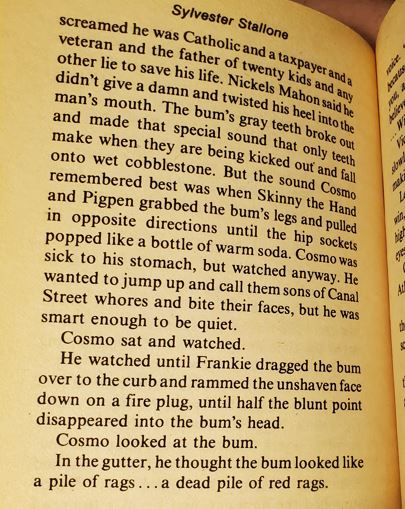
Cosmo is an oddball himself; there’s a weird bit early on where he and Victor visit Lenny in the funeral home and Cosmo starts making inappropriate comments about the “stiffs,” noting the stink. There’s a lot of death in this hot New York summer, and one guy who’s died was a street performer who had a pet monkey. Cosmo wants the monkey for one of his schemes, but one of the boys in Nickels Mahon’s gang has gotten hold of it. Nickels and his street toughs are straight out of that “nightmare,” roaming Hell’s Kitchen and preying on the weak, but still it has a juvenile vibe, with Nickels mostly trading insults with the Carboni brothers. However there is a dark quality at play; in an effective sequence Cosmo remembers the time when he saw Nickels and gang beat a bum to death: 


But now Cosmo wants that damn monkey. So at the neighborhood hangout Mickey’s Bar (surely an in-joke reference to Rocky’s trainer) Cosmo challenges Nickels: if Victor can beat Nickels’s hulking stooge Frankie the Thumper in an arm wrestling match, then the monkey is Cosmo’s. Otherwise Cosmo will owe Nickels a lot of money. This is where the brothers first learn the untamed power Victor has at his disposal, and also where they learn that he’ll only fight when his brothers believe in him. This will be the first pretense toward the main plot, but before that we’ll have more material with Cosmo’s schemes, like for example his plan to line up some drunks and tell them a dead hooker is really just “sleeping.” Tom Wright illustrates this scene, of Cosmo and Victor standing over the hooker’s corpse in the funeral parlor: 


But it’s not until around page 100 that we get to the wrestling setup, and it’s a spur of the moment thing, as Cosmo again eagerly volunteers Victor’s brawn. A “colored” fighter named Big Glory has remained undefeated in the ring at Paradise Alley, where people can bet on the fighters. Cosmo, apropos of nothing, dubs Victor “Kid Salami” and talks him into fighting Big Glory, which Lenny is opposed to. But Victor again proves his worth in the ring, which takes us into the main plot, of Victor becoming a famous Hell’s Kitchen wrestler, working his way up on the underground fight circuit. Here too Stallone reveals that Annie and Lenny were an item before the war, and Cosmo gets his heart broken when he sees the two back together. 

Also here as mentioned Lenny gets a personality overhaul; whereas the first half of the novel he’s taciturn and introverted, with Victor’s success in the ring Lenny turns into his aggressive manager, pushing Lenny further and further. This comes off as very awkward given that there’s not much setup for Lenny to suddenly become such a prick, but Stallone does sort of cover for it, as previous to this Cosmo gives Lenny a “what the hell happened to you?” speech, where he accuses Lenny of being a fool and rushing off to prove himself in the war…and coming home with nothing to show for it but a bum leg. (As I say, Cosmo is pretty unlikable at times.) Shortly after this Lenny’s not only rekindled his relationship with Anne, but he’s also become a new man, pushing Victor around like a proto-Don King. He also comes up with the schtick of hanging actual salamis on Victor before he enters the wring. But the implication is that Cosmo’s speech has spurred this change, serving as a moment of clarity for Lenny. 

Cosmo for his part becomes Victor’s trainer, leading to more goofball stuff, like Cosmo making Victor through radiators and such. Again, nothing on the par of running up the steps to the Philadelphia Museum of Art, but still entertaining in its own right. As for the wrestling matches, Stallone doesn’t dwell on them much. They’re for the most part rendered in a few sentences, and only occasionally does Stallone give blow-by-blow action description. There is though this phenomenal sentence when Victor knocks out one of his opponents: “Patty McLade dropped to the floor like a whore’s nightgown.” Again it comes down more to character, with Victor losing his lovable nature and becoming more of a “killer” in the ring. Unexpectedly here Stallone goes for the heart strings in a sequence that comes out of nowhere but leaves the longest impression on the reader: on Christmas Eve, a drunk Cosmo comes across Big Glory, the black fighter Victor defeated on his path to wrestling fame, and the two men carouse around Hell’s Kitchen, trading goofy dialog; a sequence that leads to a surprising, and touching, climax. 

The same can’t be said for the actual climax of the novel, though; Nickels Mahon, planning revenge on the Carboni brothers, gets Frankie the Thumper into his own wrestling career, leading to a final confrontation between the two giants in Paradise Alley. At this point the Carboni brothers are split asunder, with Victor a sadistic brawler, Lenny a heartless bastard, and Cosmo hating Lenny not only for taking Annie from him, but for being such a merciless controller of Victor. But the brothers reuinite during this climactic brawl, after which things get back to how they were at the start of the novel. Stallone goes for a circular approach, implying that the Carboni brothers can never leave Hells Kitchen, but by novel’s end it’s clear that there’s no place they’d rather be. 

So in closing I have to say I enjoyed Paradise Alley more than I thought I would. It’s a fast-moving tale for sure, and Stallone shows his screenwriting nature by sticking mostly to colorful dialog instead of scenery description. I did feel that the wrestling angle wasn’t properly exploited, but I’m assuming the movie goes into more depth in that regard. I’m also curious to see if Cosmo’s various schemes make their way into the film. Speaking of which, Stallone clearly intended to play Cosmo, as he’s the main protagonist of the novel, appearing more than either Lenny or Victor. But as mentioned Tom Wright must’ve been under the impression Stallone would play Lenny, as evidenced by this illustration of the cane-wielding Lenny looming behind Victor: