Wednesday, February 2, 2022

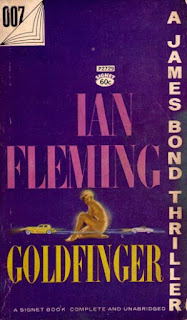
Goldfinger (James Bond #7)


Goldfinger, by Ian Fleming
No date stated (1965)  Signet Books
(Original UK edition 1959)

For some reason I never read this seventh James Bond novel as a preteen in the late ‘80s, even though Goldfinger was one of my favorite movies in the franchise. I had it on VHS and I recall watching the movie a lot in the summer of 1987. My assumption is I could never find the book back then, either in one of the new Charter editions or in an older edition at the local second-hand bookstore (the Paperback Exchange of Lavale, Maryland – I sure do have a lot of fond memories of that place!). Somehow I arrived at the idea that the book and film were pretty much alike, and now that I’ve actually read the novel all these years later I see that I was mostly accurate – while the film does appropriately hype up the action and the spectacle, it does at least follow the general setup of the novel. 

But one thing that’s changed over the years is my appreciation of the film. Today I’d judge Goldfinger as my least favorite of the original Connery films…yes, even lower than Diamonds Are Forever. I picked up all the movies on Blu Ray some years ago and watched them in succession, and Goldfinger I found to be a proto-Roger Moore spoofy romp. Also the finale really bugged me; as a kid I was somewhat able to suspend my disbelief at the climax, but as an “adult” I found it all ludicrous. And there was a lot of nonsensical stuff in the film, like Goldfinger patiently explaining his plot to rob Fort Knox to a bunch of hoods, and then killing them off. I guess if you were being lenient you could say he was getting rid of the competition, but it’s not like any of the hoods were planning to rob Fort Knox themselves. It was just a lazy way the producers doled out exposition for Bond and the audience. My favorite part – I think even when I was a kid – was actually the pre-credits sequence, of Bond in scuba suit (and then white tuxedo) raising some hell in South America. 

So going into the novel I had low expectations, which turned out to be fortunate. Goldfinger wasn’t as subpar as Casino Royale, and it wasn’t as boring as Moonraker, but still it just seemed like an “off” installment of the series. In fact it pretty much confirmed my suspicion that if you are a bestselling author, you can get away with anything: Goldfinger trades on coincidence (lazy coincidence at that), features a protagonist whose mood changes with the pages, takes forever to build up to anything, and climaxes in a finale that is preposterous at best. At least the movie included a little more sex and violence; Bond doesn’t even kill anyone in the novel until the very final pages. And once again he doesn’t even fire his Walther PPK, so heavily introduced in Doctor No; he didn’t fire it in that one, either. The pistol only appears early in the novel, when we learn that Bond conceals it in a “thick book” titled The Bible Designed To Be Read As Literature, a real-world book that was published in the 1930s. No mention is made if Bond’s actually reading this book; one would assume not, as it’s hollowed out to hide his gun. Which he doesn’t even use. Again. 

The novel opens with my favorite line in the series yet: “James Bond, with two double bourbons in him, sat in the final departure lounge of Miami Airport and thought about life and death.” This leads into a moody sequence in which Bond reflects on his just-completed assignment in Mexico, where he killed a heroin smuggler with his bare hands. Fleming effectively nails a depressive vibe as Bond, in flashback, muses over death after killing the man, how the man’s soul has so clearly left his body. The assignment has left Bond in a bit of a funk, and the character here is a far cry from the one who craved action in Doctor No. But then, Bond will go through several personality changes in Goldfinger, from a moody assassin in the opening to a bitchy boss at headquarters (where he snaps at a secretary for bringing him tea instead of coffee), before Fleming finally settles on making him, basically, the prefigure of Sean Connery’s take on the character, doling out sarcastic rejoinders to Goldfinger and his minions. 

In future Bond novelist Raymond Benson’s The James Bond Bedside Companion (1984), Benson too states that Goldfinger is a “weak” novel, but enthuses over its characterization. He also states that this book shows more of an inner view of Bond than the previous novels, in particular his tendency to daydream. This is certainly true; much of the narrative is comprised of Bond speculating how such and such things will occur, even stuff like how he might pick up a girl along the road. I guess this is one interesting element of the book, yet at the same time I would’ve preferred more pulpy action thrills along the lines of Doctor No. Benson also notes that in Goldfinger James Bond first begins “to take things less seriously,” and I guess he means mostly in regards to Bond’s sudden penchant for sarcasm and quips. I agree with him that this comedic element is “much needed” in the series, and I have a suspicion that much of this paved the way for the film take on the character as later devised by Sean Connery and director Terence Young. 

But man the plotting sure is lazy. After his two double bourbons Bond is approached by a Miami-based businessman who apparently sat beside Bond some years ago, during the big gambling match in Casino Royale. This is a guy named Du Pont, and he takes up a good portion of the first quarter, shuttling Bond around Miami and putting him up in a nice hotel, one Du Pont owns. Fleming was very much in an egalitarian mood when he wrote this one and thus it is filled with Bond wining and dining, with a host of French cuisine namedropped in the middle half. Here he feasts on crab with Du Pont, and Fleming’s culinary detail is enough to stir the reader’s appetite. But man you get the impression that Bond has to put on at least a few pounds in the course of Goldfinger, because it seems all he does is eat and drink booze, and smoke a ton of Chesterfields. And it’s not like he sees much in the way of physical action. 

While Du Pont was removed from the film, the producers captured the essence of this opening half. Only here in the novel it’s Du Pont who first alerts Bond to Auric Goldfinger, a man Du Pont suspects is cheating him at cards. Given Bond’s card-sharkery, Du Pont figures Bond will be able to help him out; he even mentions that he’s heard Bond is in the secret service! Gert Frobe was so memorable as Goldfinger in the film that I couldn’t imagine anyone but him as I read the novel. So far as Fleming is concerned, Goldfinger is big and round, with a moon-like face and red hair, using a sunburn to “camouflage” his ugliness. Despite being super rich he still finds the time to swindle Du Pont, all as in the film, with a lovely girl up in his room monitoring the action and telling Goldfinger Du Pont’s cards via a secret radio link in his ear. One thing different here is that when Bond barges into Goldfinger’s room and discovers the girl, Jill Masterton (Masterson in the film), she’s standing, so that she can see over the balcony. 

Jill is pretty much the typical Bond-girl, young and pretty with “firm breasts” that are clearly visible in her black lingerie; true to Bond-girl fashion, she makes her entrance mostly nude, which Kingsley Amis noted was required for most every Bond-girl in The James Bond Dossier. Fleming though has reigned in on his exploitation this time; “breasts” are only infrequently mentioned, and in fact for long stretches of Goldfinger there are no female characters at all. It’s as if Fleming realized he’d created such a vivid female character in Doctor No and didn’t even bother this time. For as it is Jill Masterton spends a few days on a deluxe train to New York, all courtesy Goldfinger as part of Bond’s “payment” for not turning him in to the cops, but Fleming gives no details – we flash forward a week and Bond’s back in London, only reflecting on the trip with the girl. Meanwhile he’s working the night duty, monitoring international Secret Service happenings…and, as mentioned, bossing around the staff. 

The novel is set up as three books: Happenstance, Coincidence, and Enemy Action. In this “literary” way Fleming attempts to gussy up what is just lazy plotting. For Bond is given his assigment by M – himself as bitchy as ever – and it is of course to track down Auric Goldfinger. The first section of the book has nothing to do with this; M is unaware Bond has already met Goldfinger. Instead it’s developed that Goldfinger hoards gold, and he’s got a lot of England’s gold, and the Bank wants it back. Bond is to track him down and bring him in. There follows a grueling part where Bond learns a lot about gold and Fleming is damned determined to let us know how much research he’s done on the topic. Bond gradually – and I do mean gradually – learns that Goldfinger’s vanity has undone him, as he’s put his own mark on his special bars. 

An interesting thing in the novel that’s not in the film is that Goldfinger is part of a larger plot. The film jettisoned the SPECTRE setup of the previous two movies, with Goldfinger just a random crook Bond went up against. But in the novel we learn that he might be the paymaster for SMERSH, the literary Bond’s archenemies in these early novels. I find it curious that the producers of the film didn’t stick to this and have Goldfinger act in a similar capacity for SPECTRE. As it is, Goldfinger is one of the more memorable characters yet. He doesn’t have the wild freakishness of Doctor No, but he’s more entertaining, a totally arrogant bastard who, despite cooking up the ultimate crime, still finds the time to swindle people at cards and cheat at golf. 

This was another part that bored me, though. I mean overlong card games, info-dumping about gold, and and overlong golf match…I have no interest in any of these things. But regardless Fleming’s very much into it as he writes a long match of golf between Goldfinger and Bond on the course that Bond frequented as a teenager. The egalitarian vibe is very thick in this section of the novel. While the match itself bored me, I enjoyed the presence of Oddjob, Goldfinger’s hulking Korean butler – more wonderful casting by the producers, as Harold Sakata was so memorable in the role that I could only imagine him in the novel. We learn that Oddjob is one of the “only three” people in the world to have a black belt in karate; as Benson said in The Bedside Bond, “surely there were more than three people in 1959.” Regardless, Oddjob’s karate skills, demonstrated for Bond at Goldfinger’s command, are presented as so superheroic that Bond offers his hand in congratulations. 

That is, when Bond isn’t making sarcastic comments as to the spectactle. In the latest personality overhaul, Bond here develops an acidic whit, very in line with the film version. My favorite part is after Oddjob does one of his karate masterstroke moves, devastating some piece of furniture or somesuch, and Bond quips, “Handy chap to have around.” If I’m not mistaken this line made it into the film. But a part that didn’t make it into the film follows, where Goldfinger caters to the Bond template and wines and dines Bond at his massive estate – this sequence has Bond at his most sarcastic, so it’s surprising it was left out of the film. There’s a part where Bond turns into a snoop, as Goldfinger and his Korean minions leave on some errand, and it’s clearly a setup to see how trustworthy Bond might be if left alone in Goldfinger’s house. This sequence features the unusual capoff of Oddjob being given a cat to eat! 

There’s a lot of what now would be termed “racial insensitivity” in Goldfinger; during the meal Goldfinger regales Bond with his thoughts on Koreans, speaking of them as less than human. This is expected of a villain, but more suprisingly Bond himself is revealed to share these sentiments: later in the novel Bond thinks to himself how he intends to put “Oddjob and any other Korean firmly in his place, which, in Bond’s estimation, was rather lower than apes in the mammalian hierarchy.” As Raymond Benson notes: “So Bond is revealed to be a bigot as well. This aspect of his character is not particularly evident elsewhere in the series, though one should notice that 95 percent of the villains in the novels are non-British. But this is the only instance in which Bond/Fleming actually derides a race.” For more insight into this particular aspect of the series, I once again suggest Ian Fleming’s Incredible Creation. But yes, there’s a lot here that might unsettle modern readers…but then I want to think overly-sensitive types wouldn’t be reading the Bond books in the first place. At any rate, I predict that someday soon these novels, if they’re still in print, will either be edited for content or, more likely, will come with warnings over “outdated racial and gender views.” 

And to be fair to Bond, perhaps by “Koreans” in the passage above he doesn’t mean Koreans in general, but these Goldfinger-servants in particular. Whatever, his suddenly-keen wit is on definite display in this sequence, especially his glib comments as Oddjob hops around smashing furniture and tossing his steel-rimmed hat. This was the first time in the literary series in which I could really see Sean Connery’s take on the character, mostly because there’s a macho bravado lurking behind Bond’s retorts. But the literary Bond lacks the physicality of Connery’s version, even if we learn that Bond’s working on a book about unarmed combat in his spare time. This from the guy whose chief move in Casino Royale was kicking people in the shins! None of the famous action scenes from the movie are in the book, however, nor is the tricked-out Aston-Martin with its machine guns and oil slicks. 

But again, this sequence does factor into the novel, just in less big-budget style. Bond gets his Aston Martin DB III from the shop – there’s no Q in the novels to show off fancy new gadgets – and “motors” through the French countryside as he tails Goldfinger. The car’s augmentations are a hidden compartment and a tracking device that allows him to stay within 100 miles of Goldfinger, a steady beep emitting from the dashboard. The egalitarian vibe is very thick here, with a plethora of French smattering the text as Bond thinks of this or that restaurant he wants to eat at as he drives along. There’s absolutely no suspense here and it’s as if Bond’s a decades-removed host of some Food Network show as he drives around the French countryside, thinking of places he’s eaten before. Things are spruced up by the appearance of a Triumph sportscar, driven by a beautiful young woman – which leads Bond into yet more daydreaming. 

All follows as in the film, though not as over the top; Bond realizes the girl is getting in his way, so manages to get her in a fender bender to stop her. This leads to her riding in the car with him, and there’s more humor here as the tracking device is still beeping in Bond’s car, and Bond comes up with some b.s. explanation for the sound. Everything is more subtle in the novel, and I had to give the producers credit because they delivered a better story in the film than Fleming did. Mostly because they wisely exploited the material that Fleming himself left vague. For example, the most memorable image of Goldfinger the film is the gold-painted body of Jill Masterson, which a horrified Bond discovers. In the novel, this never happens. The Triumph-driving babe turns out to be Tilly Masterton, Jill’s sister, and it is she who tells Bond that her sister was later murdered by Goldfinger, who totally painted her body gold. It’s all relayed via dialog, Fleming apparently never realizing that the moment would be so much more impactful if the reader were actually to see it. 

And the great action scene that occurs in the film isn’t in the novel, either; Bond discovers Tilly, who is about to kill Goldfinger, and in the movie version this leads to a big action sequence involving Bond’s tricked-out car. Tilly Masterson’s onscreen fate is also much different than Tilly Masterton’s in the novel. And the character is different, even in addition to the changing of her last name: the Tilly of the movie is another of Bond’s conquests, but in the book she’s a lesbian and has no interest in him. (And, once Bond’s learned Tilly’s proclivities, he displays no further sexual interest in her.) Again the novel plays out in more threadbare fashion; Bond and Tilly are merely captured, and next thing Bond knows he’s strapped to a table and Goldfinger is interrogating him. Here Goldfinger truly becomes a villain in the Bond mold, delivering some delightfully “evil” dialog, all while maintaining his pompous air. The novel’s more brutal in this respect: in the film, it’s a laser that threatens the bound Bond. In the novel, it’s a saw. 

But that’s another thing Fleming was constantly guilty of but which the filmmakers wisely fixed: the literary Bond is always being saved by someone else, whereas the film version more heroically saves himself. Bond in the film manages to bullshit Goldfinger and talks his way out of it; in the book, Bond tries to will himself to death and then passes out…only to wake up and find himself on an airplane. More daydreaming from Bond here, as he imagines he’s in heaven, with lots of ridiculous stuff about how he’ll need some time to set himself up in the afterworld! Goldfinger has decided to keep Bond and Tilly alive, for reasons that make no sense: he’s planning a big caper, and he needs to native English speakers (or somesuch) to handle the secretary work. Bond, who of course wants to live, takes the job. There follows super goofy stuff where Goldfinger, now in pure villain mode, assembles a host of American mobsters and tells them of his plan to rob Fort Knox. 

All this is very reminiscent of the hoods in Diamonds Are Forever, and in fact the new leader of that novel’s gang appears here, but Fleming does absolutely nothing to exploit it. Again, it’s another opportunity he misses to add more suspense and drama to the book. Instead much is given over to bald exposition as Goldfinger explains his plan, and meanwhile Bond obediently sits there and marks a list as to which of the mobsters he thinks Goldfinger shouldn’t trust! Here also we meet the most famously-named Bond-girl: Pussy Galore. She is much different than the film version: short black hair and “violet” eyes. It’s also established straightaway that she too is a lesbian, and in fact her all-girl gang, The Cement Mixers (of whom we see absolutely nothing of in the novel!), is also made up of lesbians. There’s no big “meet” between her and Bond in the book; she merely sees him when coming in for the meeting with the other mobsters, and there’s none of the Bond-girl template in effect for her, as there was for Jill Masterton. Indeed, Fleming hardly tells us anything about Pussy Galore, and her ample charms are not exploited at all; Bond clearly disregards her because he’s told she is a lesbian. 

However, Tilly Masterton does take a shine to Pussy Galore, and vice versa. What’s curious is that Pussy, in her very few dialog exchanges with Bond, refers to him as “Handsome.” This appears to be Fleming’s half-assed way of setting up the finale, but it rings hollow. So too does the playout of Goldfinger’s scheme. Bond, in Goldfinger’s plane, hides a message explaining the plot and begging that the note be taken to Felix Leiter at Pinkerton’s, offering a reward. He hides the note beneath the toilet seat in the restroom and then sits there as everyone in the plane goes back to use the can before landing, desperately hoping that none of them will raise the lid and discover the note(!!). I mean the idiot couldn’t even wait until closer to landing to hide it! From there to the same implausible finale as in the film, with the citizens of Fort Knox lying dead in the streets, thanks to the water Goldfinger has poisoned…only for it all to be revealed, so implausibly, as a massive city-wide sting on Goldfinger and the mobsters. 

Fleming goes all the way with his ludicrous concept, complete with Felix Leiter, a private investigator, dressed up in army fatigues and toting a bazooka, which he hands over to Bond...who takes a shot at Goldfinger’s departing train. Oh, it’s all so dumb. There follows some “bromance” between Bond and Leiter as they exchange manly put-downs on Leiter’s fast driving as Leiter takes Bond to the airport. But our hero is ensnared again, leading to the same post-climax as in the film; he’s Goldfinger’s prisoner, on Goldfinger’s plane. Here Fleming sees if he can pass off yet more implausibility, with Pussy Galore, who has had maybe a handful of dialog exchanges with Bond, suddenly announcing that she is “with him.” Here, at the very end of an overly-long novel, Bond finally kills: first he uses the blade hidden in his shoe heel to smash a window so one person is sucked out of the fuselage, and next he strangles someone with his bare hands – perhaps an allusion to the opening flashback in Mexico, in which Bond also killed with his bare hands. 

And here mercifully Goldfinger comes to a close; Pussy Galore snuggles up with Bond once they’re safely in a hotel. Bond says he thought Pussy didn’t like guys, to which she responds she’s never met a “real man.” This of course has truly bunched the panties of modern readers; even in Benson’s 1984 study the sequence is questioned, but not nearly as mockingly as it is today. And speaking of future Bond continuation novelists, Anthony Horowitz was so incensed by all this that in his 2015 novel Trigger Mortis, which was set immediately after Goldfinger, he went out of his way to correct this “deeply, deeply offensive” aspect of the novel. (Where would leftists be without their adverbs?) Indeed, in true “capri pants & soy latte” fashion Horowitz went even further in his novel, having Bond be chastised for his “homophobic” sentiments by an openly gay fellow secret agent (in 1959!!). I imagine reading Trigger Mortis immediately after Goldfinger would demonstrate how quickly society has changed in just a few decades, but I’ll never read it – this review tells me all I need to know. 

I guess in the end all I really liked about Goldfinger was the sudden gift for sarcasm Bond had, and also the big scenes from the movie that were here, only in somewhat muted form: the discovery of Jill Masterton in Goldfinger’s room, the Aston Martin, Oddjob and his deadly hat, the interrogation of Bond, and of course Pussy Galore. But I still feel the filmmakers took these elements and did so much more with them. And speaking of Pussy (couldn’t help myself), my issue isn’t so much her abrupt about-face on the whole gay situation, but that Fleming did so little to set it up. I mean she isn’t in the book enough to get worked up over; even in the assault on Fort Knox, when Pussy is dressed in an (apparently) form-fitting black leather outfit, Fleming does nothing to exploit her. She’s just another mobster in a final third that’s filled with mobsters. But then suddenly she’s not only willing to risk her life to aid Bond in the finale, but she’s also jumping into his bed. It isn’t so much insulting as it is half-assed. Raymond Benson also has insightful commentary on this, comparing and contrasting the fates of the two lesbians at the end of Goldfinger, how Tilly Masterton runs away from Bond and how Pussy Galore runs to him. 

Well anyway, I didn’t much like Goldfinger, but still it is a James Bond novel, so I recommend it – and, if you do decide to read it, be sure to listen to my Music To Read James Bond By compilation while doing so!

Thursday, January 27, 2022

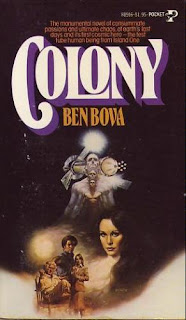
Colony


Colony, by Ben Bova
July, 1978  Pocket Books

As a science fiction-reading kid in the ‘80s, I knew Ben Bova’s name but never read any of his books; he was one of those wildly prolific authors and I had no idea where to start. Also it was my impression he was a “hard science” author, ie of the type who went more for technical minutiae than the world-building escapism I usually want from sci-fi. But then last year I came across this book on the clearance shelf of a Half Price Books store; the typically-awesome Boris Valejo cover grabbed my attention, and the back cover (below) only strengthened the hold. 

Indeed, here was sci-fi just as I love it: from the ‘70s, set in a future that is now in the past, filled with the space-faring, mind-expanding optimism of the era. I then checked the first-page preview, which proclaimed the novel “A bold, sweeping saga of one man against the world,” with the hero referred to as an “Adonis.” I thumbed through the book: thick as a doorstop, 470 pages of small, dense print. My quick appraisal was that it was along the lines of John Brunner’s Stand On Zanzibar, only with more of a “bestselling fiction” approach than an “experimental” one. In fact, I very much got the impression that what I had in my hands was what I had been long seeking: a science fiction novel told in that ‘70s “blockbuster” style I so love, with all the requisite sex and drugs the era demanded. And the suckers only wanted two bucks for it! This was another of those Cindy On Fire moments; I was on the way to the checkout line within two minutes of discovering the book. 

As usual though it took me a while to get around to actually reading it; despite my initial excitement I put the book aside and took almost a year to start it. But when on page 14 I came to a part where a British beauty with a “full, ripe kind of figure” was about to work herself over with a vibrator, on her first night on a massive space colony orbiting the Earth, I knew I’d found the “sci-fi meets trashy ‘70s popular fiction” novel I’d been seeking for years. Now to be clear, the vibrator in question was really a bathroom fixture that used “sonic vibrations” for cleaning, water conservation being important to the space colony, but why split hairs. I barrelled on through the novel and soon realized that it didn’t just capture that groovy ‘70s sci-fi vibe I so love (complete with jumpsuits and “contoured chairs” and all those other swank details), but that it was a great novel to boot, and that Ben Bova had clearly put his heart and soul into it. This was one of those instances like Boy Wonder, where I read the novel and couldn’t understand why it wasn’t a bestseller in its day, why it was consigned to oblivion. 

My only conclusion is that Colony was a paperback original, and this hampered its success. I personally prefer PBOs to hardcovers, but at the same I was puzzled why there was only a PBO for Colony. Bova has always seemed to me a “hardcover author,” and indeed it seems that the vast majority of his novels were published first in that format before getting paperback editions. And yet Colony was not. I can only assume that this was due to the energy crisis of the time; per Michael Newton in How To Write Action-Adventure Novels, publishers were very affected by the energy crisis, cancelling entire series and re-jiggering their publication schedules. I’m guessing, with absolutely no basis, that Colony would’ve come out in hardcover otherwise. And the hell of it is, without that hardcover edition and the ensuing industry coverage, Colony appears to have slipped through the cracks. Because as it turns out, Colony was one of the best books I’ve read in years, and certainly gave me everything I hoped for. 

That first page didn’t lie; this is indeed a sweeping saga, encompassing a huge cast of characters and occurring over several months of the “future year” of 2008. Now one thing the back cover didn’t mention, and which I only learned later, was that Colony was a sort-of sequel to an earlier Boval novel, Millennium (1976). Which itself was a sequel to Bova’s later Kinsman (1983, but comprised of short stories originally published in the ‘70s). I have not read either of those books, but at no point in Colony did I feel like I was missing out on anything. It appears that those two novels are more connected to each other than Colony is connected to either of them: Colony merely occurs in the same “world” as Millennium and Kinsman, with the only recurring characters being very minor ones in Colony. I wouldn’t even say that reading those two books would enrich the experience of reading Colony, as neither book is mentioned, and the only recurring bit here comes from Millennium, in that there’s a colony on the moon that’s now its own independent nation, and also that there’s a World Government that unites all the nations on the Earth. 

So yes, Colony takes place in a year that’s now 14 years past, but in no way does that detract from the reading experience. And besides, I’m not one who judges a sci-fi novel by what it got “right” or not. But to be clear, Colony is of a piece with other sci-fi novels of its day in that it is optimistic about the future of space exploration; wildly optimistic, in fact. I personally think it’s so cool that an author could publish a novel in 1978 that took place a mere thirty years in the future and fill it with moon colonies, space stations, orbiting colonies, and routine travel to and from all these places. Thirty years! But then, it only took ten years to get to the moon during the Space Race, so no doubt it only seemed logical at the time that expanded space travel would follow just as quickly. 

I’ve always looked at science fiction more as a reflection of the era in which it was written, and in that area too Colony is very ‘70s. Not just in its “bestselling fiction” approach, but also in the topics it focuses on. Overpopulation is a big one, as is weather control. But the space colony stuff is in-line with the speculations of the time. Many years ago I was really into the books of Robert Anton Wilson, and through him I learned about the “SMIILE” concept of Timothy Leary as well as the space colonies envisioned by Gerard O’Neil. In the mid to late ‘70s, it seemed to be commonly accepted among such visionairies that man would soon begin leaving the planet, to live in space. Leary’s stuff (for a project he never completed) in particular was about expanding consciousness as the next step on the path to outer space life. Back then the goal was leaving the Earth. Today it’s saving the Earth. 

So Bova, like a true sci-fi visionary of his day, projects a future that is really just the 1970s with a greatly expanded space program and a world government. The sentiments of the characters who live in this world are much more “1970s” than any people who lived in the actual 2008, and in this regard Colony is similar to another “future 70s” work, The Savage Report. But this isn’t a complaint. I much prefer these futures that didn’t happen to the one we actually got. I mean, if only the real 2008 had a space station where zero-g sex was one of the favorite activities of vacationers, not to mention an orbiting space colony filled with women in form-fitting jumpsuits. And Bova does get some stuff correct – he predicts video teleconferencing, which has become standard now in the era of Covid. Also the internet and quick digital transfers of money factor into the book, and are treated as commonly as such things are today. 

But Bova’s biggest miss is that in his projected future the left-leaning World Government is at odds with the multinational corporations. While the World Government wants global unification, a socialist utopia of equity in which world peace and harmony is maintained at the expense of independence, the multinationals want to practice pure capitalism, the poor and the planet itself be damned. This is pure Ayn Rand, of course, but how could Bova or Rand or any of the sci-fi visionaries of the day have predicted that in the real future the billionaires would be aligned with a leftist new world order? In the era of “get woke, go broke,” corporations no longer make a secret of their ideology. Even charity organizations have gone down the self-destructive path of wokeism. 

But this “World Government vs the multinationals” setup comprises the central plot of Colony. Certainly in Bova’s day it made sense; it would be easy to imagine the cigar-chomping billionaires of the 1970s united against the capital-diminishing aims of a socialist World Government. This though is just another indication of what I like about sci-fi; it takes contemporary reality and exposits on what the ensuing world might be like in a few years, decades, or centuries. And as mentioned Bova’s big concern is the growing population, per Stand On Zanzibar and so many other books of the era. Bova has the global population at near 8 billion in his 2008, which is pretty much where we are now. However he also has the black population of the US (or what was formerly the US) at 80%, just a tad off from the 13% of the actual 2008. 

I mention race because one of the many subplots Bova works into Colony is a race war, one that goes hand-in-hand with the people’s movement that is united against the World Government. That 80% figure is actually delivered by one of the black terrorists, a hulking mass of muscle named Leo who was once a pro footballer, but who now has carved out his own Escape From New York-esque fiefdom in Manhattan. Sadly, one of Bova’s biggest successes on the prediction front is that he envisions a 9/11 sort of attack on New York, late in the novel, but this one is carried out by an army of black terrorists who declare war on the “white asses.” One curious tidbit Bova introduces – one that would certainly trigger sensitive readers of today – is that the darker one’s skin is, the higher his authority is in the black resistance; Leo, we’re informed, regularly takes drugs to ensure his skin stays as dark as possible. He is in fact the only character who indulges in that ‘70s sci-fi mainstay: weird drugs. But Leo’s are some sort of super-steroids that affect his metabolism and keep him in hulking shape; without them, as we eventually learn, he’ll literally fall apart. 

But this too is more of a indication of Bova’s own time than our own; this 2008 is still run by men, however we are told that the US representative for the former US in the World Government is a black man, and obviously the World Government reps from the various former countries are not all white. But there are no women in positions of power, something that occurs to the otherwise-progressive head of the World Government, the 80-something year old De Paolo. One of the few characters returning from Millennium (which took place 9 years before this novel), De Paolo heads up the World Government from the HQ in Messina, Sicily(!), a loyal “Ethiopian” at his side. This bit, of the ancient leader of the world who confides solely in his Ethiopian aide, so mirrors the relationship of Premiere Vassily (the ancient ruler of his world) and Rahallah (Vassily’s Ethiopian aide) in the Doomsday Warrior series that I don’t think it could be a coincidence; I think Ryder Syvertsen certainly read Colony. 

So this is the world of Colony: The World Government controls the planet, while the independent nation of Selene is built beneath the surface of the moon (its formation chronicled in Millennium). Meanwhile there is Space Station Alpha, which acts as a waystation between the Earth and the moon, and most notably there is also Island One, a massive orbiting colony in which ten thousand people live. Bova clearly seems to be aligned with the World Government; his world is the one we seem to be lurching toward, in which gas-guzzling cars and other pollutants have been replaced, and all energy on the Earth is derived from solar energy beamed down by Island One. The colony is essential to the planet’s survival, but only the rich and the elite live up there in a green wonderland of open spaces with spectacular cosmic views from various massive windows; this much dismays the poor, starving people eking out a miserable existence on the overpopulated Earth. 

Things are becoming increasingly bad on Earth, with mass starvation and suffering and a huge disparity between the poor and the super-rich CEOs of the multinationals. Meanwhile the People’s Revolutionary Underground (PRU) is fighting against the World Government all across the globe; there’s also “El Liberator,” a Castro-esque revolutionary who is causing lots of trouble in Argentina. Curiously, all these revolutionary movements appear to be socialist, as is the World Government itself; I mean, socialists versus socialists – everyone’s a loser. Another interesting thing is that in Bova’s 2008 the Middle East has not been consumed by radical fundamentalism, and in fact Baghdad is what amounts to a tourist trap, where reps from the World Government work to recreate the wonders of the ancient world. The main terrorists of the PRU we meet in Colony are from the Middle East, however…and they’re a helluva lot less violent than the ones we got in reality. Several times Hamoud, or “Tiger,” the leader of the Iraqi section of the PRU, states that “suicide missions are stupid” and he and his fellow terrorists go out of their way not to get themselves killed…as well as not to kill any of their victims. 

Befitting the bestseller fiction approach, one man will be able to fix all the world’s problems: David Abrams, that “Adonis” mentioned on the first-page preview. David is a rather special character; apparently in his early to mid 20s, a good-looking blond-haired guy with a lean muscular build and etc. He is also the first “test tube baby,” grown and born on Island One, outside the legal domain of the Earth. This means that the Island One scientists, free to chase their every whim, made David a sort of super-being. He’s impervious to most all diseases, with an immune system that can quickly shake off viruses that would kill ordinary people. He’s also incredibly quick thinking and proficient at most forms of self-defense. In a bit that predicts cyberpunk, he also has a computer link wired into him, so that by tapping a molar with his tongue he can access computers and retrieve data which is “whispered” to him via “the microscopic receiver implanted behind his ear.” What I most appreciated though is that Bova shows us all this instead of just telling us about it; David’s gifts are demonstrated through his actions and quick thoughts, and Bova doesn’t beat us over the head reminding us that he was designed to be gifted. 

David Adams (note the Biblical connotations of the name) is the central character of Colony, and he’s a very memorable one. His origin is a bit of a mystery; his father is unknown, and his mother, one of the designers of Island One, died before David was born, and thus the fetus was removed and kept alive, those scientists going to work on all their genetic improvements. David has spent his entire life on Island One, and the crux of the novel concerns his learning of the plight of the Earth, and how Island One is central to the planet’s survival. I kept wondering why Bova titled the novel “Colony” instead of “Island One,” as the latter name is used much more often in the text. It is a massive space colony of the type envisioned by Gerard O’Neil in The High Frontier (1977), two “cylinders” that could easily hold at least a million people. But, as roving young British reporter Evelyn Hall soon learns, the second cylinder is completely empty: a flora-rich paradise that goes on as far as the eye can see, while people are running out of room down on Earth. 

The multinationals own Island One, though, in particular the few men who make up the Board. Chief among them is T. Hunter Garrison, Texas-based codger and all around old-fashioned billionaire type, of the kind seen in the trashy paperbacks of the day. Completely without conscience, devoted to money and power; Garrison is in his way one of the villains of the piece, particularly given how he is the main architect of the race war. As the novel progresses, we see that the Board intends to forment total civil war on the planet, secretly backing the PRU and other rebels in their war against the World Government. And while the planet is in flames, the Board will ride it out in that empty cylinder on Island One – which, of course, has been designed for them alone. Another of the board members is Sheihk Al-Hashimi of Iraq, who also secretly funds the PRU. 

What Al-Hashimi does not know (but the reader soon does) is that his beautiful daughter Bahjat is actually the infamous PRU leader Scheherazade. In fact, Bahjat is the true ruler of the Middle Eastern wing of the PRU, as Hamoud is devoted to her and does what she says, even though he pretends he alone is in power. Again though, we must not view Bahjat with modern eyes: she is not the suicidal and radical Islamic terrorist of the ISIS type. But then, neither is Hamoud and the others, though we are often told how “cruel” Hamoud is. These people rarely kill in their objectives, and Bahjat and Hamoud will carry out a few strikes in the course of Colony, either knocking out or merely holding their victims captive. In this regard they are much more comparable to the terrorists of Bova’s era than to the ones of today. The PRU indeed is presented as having a noble purpose; Bova is properly unbiased in his narrative, so that, when focusing on each group, he does not make them come off as good or bad. Even Garrison is given a bit of a heroic nature, late in the novel. Only Hamoud is presented as being truly evil, but again for the most part we are only told of this. 

This is a big novel, a sweeping epic, and like any epic there are many, many memorable sequences in it. What I really appreciated was how Bova had this large canvas of seemingly-unrelated characters, and then gradually brought them together. Being the star of the piece, David is usually the person who meets them, often in inventive ways. His meeting of Bahjat, for example – which we know is bound to happen given the first-page preview – is cleverly carried out in unexpected fashion. Through Beverly (whom David, per the trash fiction approach, beds early in the book) David learns of the dire plight of the Earth, and vows to get down there. However Dr. Cyrus Cobb, elderly founder and now head honcho of Island One (my assumption was he was based on Dr. Gerard O’Neil), refuses to let David go. After all, Cobb explains, David is technically owned by the Board of Directors. Cobb is another memorable character in a novel stuffed with them, a visionary in line with O’Neill and Leary and those other ‘70s visionaries, and he’s raised David as the son he never had. 

But as mentioned our hero is made of sterner stuff than common men, thus David concocts a scheme to get off Island One. This is a great sequence, involving David constructing a “womb” for himself to be placed on the hull of one of the ferries that go to the moon, with David in a self-induced sleep to conserve oxygen and heat. (The self-induced sleep is very ‘70s in vibe, involving a theta-level program David downloads via his comptuer linkup.) Bova doesn’t spend much time on the moon, but this part might be meaningful for those who read Millennium, at least in that we see how the colony of Selene has fared in the near-decade since that book. But ultimately David’s only on the moon for a few pages. There’s a sequence here that I found reminiscent of one in Moon Zero Two, where David commandeers a buggy and drives it solo across the harsh terrain, his oxygen levels running dangerously low. From the moon David heads to Space Station Alpha, where he awaits the next shuttle to Earth. Bova wonderfully caters to those ‘70s excesses when we are told – regretably without any detail – about the “zero-g orgy rooms” where David, off-friggin’ page, dallies with “several willing partners.” That’s right, folks: our virile hero does a bit of zero-g orgying and the author leaves it all off-page. 

Anyway, David excitedly boards the shuttle for Earth, and before entering the atmosphere the craft is hijacked – by Bahjat’s PRU cell. The way Bova combined these two plot threads really impressed me, and there are more instances throughout the novel. Bahjat’s people use a “knockout spray” on their victims, and in fact this is how Bahjat meets David. The PRU diverts the Shuttle to Argentina, where Bahjat hopes to win the confidence of El Liberator. Things will not go as she hopes for, though. We know, again per the first page, that David and Bahjat are destined for one another, but Bova also skillfully plays this out through the text, developing a very believable connection between the two. When meeting each other, both are in love with someone else: Bahjat still pining over a guy whose loss has set her on the terrorist path, and David here on Earth looking for Evelyn (who was most mysteriously spirited away from Island One; David is certain Cobb got rid of her). Instead David and Bahjat find each other, and this is almost a novel in itself. First David, who discovers that here on Earth he cannot access any computer linkups, abducts Bahjat so as to escape the PRU, and soon the two are stuck together in a cross-continent escape as they try to make their way to America, both of them on the run for separate reasons. 

A minor character nearly steals the novel here; David and Bahjat manage to get money from the PRU and pay for an illicit flight into Peru, as part of their escape plan to get into the US. The pilot of the small turbo-prop is a paunched, gray-haired local who gabs on about his days smuggling heroin in the ‘90s and how he’s been flying since he was a kid. He’s only in the book for a few pages but he’s the most colorful personality we meet. But then like any truly great novel, Colony has many such instances and characters that get stuck in your mind. Like The Right Stuff, this is a book I’d read in the morning while my kid was playing (the benefits of working from home!), and it took me so long to read that I almost felt as if I was experiencing something instead of just reading a book. I mean if you haven’t picked it up by now, I really enjoyed the novel. 

I especially dug how Bova gave us a piece of ‘70s blockbuster fiction with sci-fi trimmings; there are a lot of groovy details in the novel, with even the décor sounding at times like the swank interiors of Gerry and Sylvia Anderson’s UFO or Space: 1999. David Adams’s place on Island One is a literal space age bachelor’s pad, complete with a waterbed and “thick carpeting of reddish gold.” And in true ‘70s bestseller form, there’s a bit of sex in Colony. Nothing too egregious or explicit, but it’s certainly not tame in that regard. Befitting a ‘70s protagonist, David Abrams scores with both of the main female characters: Evelyn and Bahjat. Interestingly, so too does Hamoud, the villain. This is a curious subtext Bova leaves for the reader to notice, but in many ways Hamoud is presented as David’s dark reflection, and this is just another component of that. These sex scenes are usually over and done with in a few sentences, and Bova doesn’t much exploit the women. In other trashy touches there’s a part where T. Hunter Garrison dallies in a pool with a pair of Japanese girls who have been trained in underwater talents – talents which they also demonstrate for Garrison’s busty redheaded assistant-slash-bodyguard. The only “dirty” bit is the off-hand mention of Evelyn’s “anal” adventures with Hamoud. Good grief! 

While David proves to be instrumental not only in the solving of the novel’s central crisis but also the future of humanity itself, it’s to Bova’s credit that he gives full subplots for the majority of his characters, with storylines that pan out regardless of whether they’ve encountered David or not. What I mean to say is that these characters come off as very realized, with their own goals and plans. Colony features a large cast of characters, and Bova is for the most part pretty good in that he focuses on these characters individually, either via chapter breaks or white spaces. But at times he is guilty of terrible POV-hopping, by which I mean he’ll switch perspectives without warning the reader via a line or chapter break. Here is the worst example in the novel; note that this paragraph is part of a long sequence from the perspective of black terrorist Leo, but abruptly switches perspective to David – who Leo doesn’t even know yet at this point of the book! – without proper warning: 


Ironically Bova published a book titled The Craft Of Writing Fiction That Sells in 1994, in which he prided himself on how he handled perspective changes in Colony, even using similar excerpts as an example of how to do it! I was like, dude – no, it’s not! Give the reader a little white space or something before you switch perspective! But this is a minor quibble, and might not even bother most readers. I read Gary Provost’s Make Your Words Work (1990) a little over twenty years ago, and have never been able to ignore POV-hopping since. Otherwise Bova very skillfully juggles this large cast, and does such a good job of it that at no point was a I confused as to who was who. And the way he brought so many of them together really appealed to me. I’ve always been a fan of that sort of tesseract approach in fiction, where multiple storylines and characters converge in unexpected ways, and Colony featured a lot of that. 

The saga takes place over a few months, and David Adams certainly grows as a character, from the naïve young man on Island One to a visionary who orchestrates mankind’s next step in the stars. This journey encompasses so many memorable incidents, Bahjat at David’s side for many of them. There’s a great part where they get to Manhattan just as Leo and his soldiers start their war on “the white asses,” and Bahjat and David head underground to bypass the savagery above, navigating through rat-filled tunnels with a failing flashlight. Bova develops a sort of “enemies in love” setup; first David is Bahjat’s prisoner on the shuttle, and then he takes her prisoner when he escapes the PRU in Argentina. After this they become unlikely allies, Bahjat using her PRU contacts to fund their long travel by land up into the US, but once they get into PRU-controlled New York David is once again Bahjat’s prisoner. Not that this stops them, finally, from a bit of good lovin’, Bova delivering the long-awaited sequence more from a romantic perspective than a sleazy one. 

The various plot threads eventually tie around Island One, and Bova plays out the finale there. He brings the place to life; in particular I liked the bizarre aspect that, when looking up at the “sky,” you can actually see more houses and communities “above” you. This gives Evelyn the expected vertigo on her first night in Island One. David however is used to it, having grown up here, but there’s another nice character moment where, on his first night on the Earth later in the novel, he sits outside all night to watch the sun rise. Bova fills the novel with memorable sequences and touches. He also brings his various locales to life without the “hard science” technical detail I feared; Selene, Space Station Alpha, the World Government headquarters in Messina: all these places are captured with just a few effective sentences of word painting. And again I liked how we saw David’s superhuman makeup in action, rather than it being exposited to us; this superhuman makeup factors into David’s plot in the finale in a way that was very interesting in our Covid era. 

In fact, Bova strives for a sentimental finale along the lines of what Harold Robbins would regularly dole out for his characters, no matter how depraved they may be; even T. Hunter Garrison, who orchestrates a veritable holocaust in the US, is given a heroic makeover in the climax. I won’t spoil anything, but one issue I had with Colony was that there was little comeuppance for most of the villains in the finale. For example, Bahjat’s PRU cel manages to stop Island One’s solar energy from reaching the Earth, and we learn that over seven thousand people die as a result – areas that are in the midst of heavy snowstorms and such have no access to power, and many die. (On second thought these PRU terrorists are as bad as the real thing…) But the “love triumphs over all” finale Bova delivers undermines this atrocity. James Nicoll, in his review of Colony, scoffs not at this, but that Bahjat “becomes David’s reward at the end of the book, like a slave girl awarded to a victorious warrior.” He overlooks that Bahjat deserves much worse, given that she’s killed over seven thousand people. Modern reviewers are so hung up on identity politics that they ignore actual story elements.

This is indicative of the sea change that has occurred in Western society over just a few decades, and is another thing neither Bova nor any other sci-fi writer of his day could have predicted. And this is not intended as a slight against Nicoll, who is clearly knowledgeable about sci-fi. But his review title, “Soaked in 1970s-style sexism like a hopeful swinger reeking of Hai Karate,” is the epitome of what I’m talking about, as it gives a dismissive impression of a worthy book. (And also, you shouldn’t be surprised to know, his description sounds exactly like the type of novel I’d like to read!) Clearly readers of the actual era would not have seen things through the nauseating “woke” filter of today. I’ve only found one contemporary review of Colony: download Science Fiction Review #28 from November 1978, go to page 28, and there you will find a review of Colony by none other than Orson Scott Card. He raves about the novel and his only real complaint isn’t about the race or “women without agency” stuff, but that Bahjat falls in love after one night in the sack (with the man who sets her on the path to PRU activism). Card also sees that Bova was clearly going for the “science fiction meets bestseller” approach, and pointedly brings up Niven and Pournelle’s Lucifer’s Hammer, of the year before, as comparison. That book certainly did better than Colony, which seems to have been forgotten, so I’m curious if Bova attempted this blockbuster fiction approach in any further novels. 

The Stand On Zanzibar similarities I noticed when I first spotted Colony in the bookstore is that periodically the text is broken up with communiques, journal entries, or “tapes for an unauthorized biography” of Cyrus Cobb. This is Bova’s way of opening up his world while also advancing the narrative, but at the same time it occurred to me that it was another interesting comparison between Bova’s 2008 and the future we actually got. Because, despite the overbearing World Government, those news communiques are true, in that they reflect the actual “truth” of what is happening in the narrative. In other words, if there is rioting in Argentina or whatever, or people have been abucted on Island One, the communiques state that. What I mean to say is, there is no fake news in Colony, and it’s another indication of how Bova’s world is less complicated than ours.

As I mentioned above, Bova’s 2008 is basically the world we are lurching toward. In his projected future the carbon footprint has mostly been erased, with people driving electric bikes and etc. And all nations are united in a World Government which solely gets its power from solar energy. Bova, despite not playing sides in his fictional world, does clearly seem to think this is the way to go, yet he doesn’t seem to grasp that his novel makes the case that countries should not unite, and that it would be dangerous to put all your energy eggs in one basket, so to speak. I mean, those seven thousand who die when the Island One solar energy is stopped. Did the people in those countries no longer have access to gas-powered furnaces or the like? It seems ridiculous, but again it also seems like an indication of where we are going. Just over a year ago the United States was energy independent, gas was cheap and empty shelves at the grocery store wasn’t even a concern. Now, after a few policy changes by a new administration, gas prices have skyrocketed and global starvation looms on the horizon…all due to policies that are driven by a climate change agenda. Bova doesn’t dwell on the birth pangs his world would have gone through to become a solar energy-dependent new world order, but certainly we now in the present are going through something very similar to those birth pangs. 

This is a novel that took me on a journey, and it was the pure escapism that I wanted. And yet it clearly made me speculate about things in our own world, and I can think of no further indication of what makes for a great novel. Well, I can think of one other thing: I didn’t want Colony to end. I’m sure I will read it again someday. I’m also wondering if any of Bova’s other novels are along the same lines. Maybe someday I will read Kinsman or Millennium; Bova combined the two in 1988 as The Kinsman Saga, rewriting a portion of each novel so that they would flow more smoothly together as one story. But I’d more than likely read the originals, for fear that the ’88 edition might remove the swanky ‘70s details I demand. However so far as this sequence goes, Colony was the last novel; curiously though in 1985 Bova published Privateers, which concerns the mining of asteroids in our solar system. This is exactly what David Adams plans to do in the climax of Colony, however Privateers does not occur in the same world as Kinsman, Milennium, or Colony, featuring as it does a Soviet Union that’s still running in the early 21st century. 

So in conclusion I give Colony my highest recommendation, not just as a sci-fi novel but as a novel, and if any of you can suggest any other “sci-fi meets popular fiction” novels from the era I’d greatly appreciate it. Per above Orson Scott Card specifically compared Colony to Lucifer’s Hammer, but that one sounds like a post-nuke pulp with its apocalyptic setting – I’m looking for something more like mini-skirts on Mars or the like, with that “full ‘70s flavor” in space. Something that Colony delivers in spades. And finally here’s the back cover (the cover portrait of Bahjat is repeated on the spine of the book, by the way, and this was what initially captured my eye on the bookshelf when I first discovered the book):

Monday, January 24, 2022

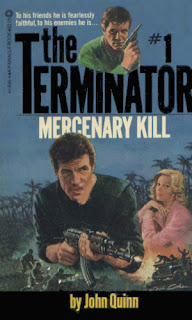
The Terminator #1: Mercenary Kill


The Terminator #1: Mercenary Kill, by John Quinn
September, 1982  Pinnacle Books

Here’s another latter-era Pinnacle offering, one that amounted to five volumes. It’s also another series Marty McKee hooked me up with some years ago, and I’m only just getting around to it. The Terminator is credited to John Quinn, but the copyright page outs Dennis Rodriguez as the real name of the author. Per Brad Mengel’s Serial Vigilantes Of Paperback Fiction, Rodriguez “was editor of pornographic magazines for Pendulum Press where he worked with Ed Wood Jr.” However, also per Brad, “While director Ed Wood Jr. also used the John Quinn pen name, there is no evidence that he wrote any of the books in this series.” And to be sure there is little in the way of Wood-esque weirdness in The Terminator, at least judging from this first volume, which sticks to a clear-eyed “realism” throughout. 

As I read Mercenary Kill I kept having flashbacks to another late-era Pinnacle offering: The Force. It’s been ten years since I read the first volume of that also short-lived series, and I haven’t read another volume since, but something about Mercenary Kill kept reminding me of it. Maybe it was the writing style, or the fact that the main protagonist of The Force was a cynical vet of the spy game, same as Rod Gavin, the main character in The Terminator. The Force was credited to “Jake Decker” and came out the same time as The Terminator, so maybe it too was the work of Dennis Rodriguez. Again per Brad Mengel in Serial Vigilantes, The Force was “the only credit for Jake Decker,” lending further impression that “Decker” was a pseudonym. Whatever the case, I did enjoy Mercenary Kill more than I enjoyed the first Force novel. 

Oh and just to address the series title – obviously this series came out before the Schwarzenegger movie. But in the world of this book, “Terminators” are a special section of the CIA, sort of like the “00” agents in the Secret Service in James Bond. Agents who are sent out on kill assignments. Per the deal it’s eight and done, and Gavin when we meet him is on his eighth assignment, after which he intends to retire. Curiously we’re not given a description of Gavin, so Gil Cohen’s cover will have to suffice. It is implied he is 34, though, and also a ‘Nam vet. Mercenary Kill is clearly an ‘80s offering because, unlike the majority of the men’s adventure novels of the ‘70s, it is focused on world-building and scene setting. In effect it comes off as a standalone novel, and doesn’t really even set up the potential for more action-heroing in future volumes. Gavin is not presented as an Executioner-esque crime or terrorism fighter, I mean to say, and his actions throughout Mercenary Kill are all made in the name of self-preservation, not to save anyone else. 

The novel opens on the action, though, with Gavin in Miami, where he takes out three commie agents. Here we see that Rodriguez will have a bit more of a “literary” vibe to his prose than the genre standard; again, another similarity with The Force. While the novel is not spectacularly gory, we do get memorable descriptions, like “pink spray” blowing out of a guy’s head when Gavin shoots him with his .45. It’s a cool and memorable description, but at the same time it gives the impression that Gavin’s just shot a cartoon character. Rodriguez maintains a crisp style throughout, with lines like “[Gavin] brought his blood pressure to boil with a couple quickly-smoked cigarettes.” Oh and as a random note, I found it interesting that “flight attendant” was used in the novel instead of “stewardess,” so it must’ve been the late ‘70s or very early ‘80s when that earlier term, so championed in trashy paperbacks of the day, had fallen out of favor. 

Another thing unusual about Mercenary Kill is that there are a slew of minor characters to keep track of. And Rodriguez keeps hopping around them with little introduction or setup, leaving the reader out of sorts. Things move a lot more smoothly when he just focuses on Gavin, though. Our hero, who is pretty taciturn and cipher-like, has carved out an off-the-grid life for himself in Colorado, living in a rented apartment with no phone. He’s so off the grid that he doesn’t use banks; when he goes on a job he takes a big envelope of money to one of his few friends to safeguard while he’s gone. Gavin’s also in love with Kendall, the owner of the bookstore across from his apartment. While she doesn’t factor into the novel much, Kendall is often on Gavin’s mind, which also gives the novel a different vibe from the average; Rod Gavin is one of the few men’s adventure heroes who is in love. Not that this stops him from having a little extracurricular fun on the job. 

One of the many supporting characters in the novel is Barnes, Gavin’s boss at the Agency. The two have an antoginistic relationship that really reminded me of the one Butler had with his CIA boss in the Butler series by Len Levinson. But again this series is more serious in tone, thus Barnes comes off as more nefarious than satiric. He questions Gavin’s lack of commitment to the Agency, telling him he is “not a believer.” Regardless he gives Gavin his latest – and final – mission: go to the country of Costa Bella in Central America and terminate a soldier named De Leon. In one of those many subplots we’ve seen De Leon get in trouble: he’s inadvertently massacred a car load of nuns, at the order of sadistic commanding officer Rojas. This has set off an international incident, with De Leon, clearly framed, thrown in a Costa Bellan jail. They’re all involved with the US to some extent, with De Leon being working undercover for a State Dept guy named Duffy. 

My assumption is Duffy will factor into future volumes of The Terminator, as he becomes Gavin’s main accomplice in Mecenary Kill. In this volume the two meet; Gavin’s been sent to kill De Leon, and Duffy heads to Costa Bella because he’s heard the CIA is getting involved. Meanwhile other agents are afoot, including one minor character who is run down in Costa Bella; Rodriguez’s description of this guy’s death is an example of the dark sort of humor that runs throughout the narrative: “…a painless impact that he actually thought was kind of funny.” What’s weird though is Rodriguez throws in the curveball, one that’s barely explored, that Gavin knows De Leon. The two attended some sort of training a decade before. Rodriguez does little too exploit this, and just has Gavin (rather easily) carry out his job, after which the main plot kicks in – Gavin realizes that he himself has been framed, as Rojas, the man Barnes told him to connect with down here, now chases after him for the murder of De Leon. 

Throughout Rodriguez sticks to more of a realistic vibe, save for a bit midway through where Gavin runs into a group of Costa Bella guerrillas. Of course, their leader is a sexy chick named Maria Angela, and of course she ends up going to bed with Gavin. Rodriguez leaves it off-page, but at least we know that our hero isn’t too devoted on his girlfriend in Colorado. Maria also hooks Gavin up with a gun: a P-38, which he uses for the rest of the novel. Judging from Cohen’s portrait of Gavin that runs on each volume of The Terminator, I’m assuming this P-38 will become his trademark gun. Hopefully Bucher doesn’t mind! Maria isn’t the only helper Quinn encounters; as mentioned Duffy also meets up with him, and after a shaky start the two develop a sort of friendship, with Duffy providing Gavin a place to stay once Gavin’s made it back into the country. (Curiously, Rodriguez leaves Gavin’s escape from Costa Bella off-page; one would think it would almost be a story in itself.) 

There is more of a modern hardboiled vibe to The Mercenary Kill than the cover of Rod Gavin blasting an AK-47 would have you believe. And in fact, he doesn’t even blast away with an AK-47 in the novel, or at least he doesn’t that I can recall. Instead of a slam-bang finale, we have something more befitting a Gold Medal paperback as Gavin traces Rojas and Barnes to California, where the two are involved in a heroin ring. Barnes has been using his CIA role to run drugs, his biggest deal coming through and etc. He of course was behind the frame of Gavin, as well as of De Leon; we’ve also learned almost casually that Barnes is gay and has a fondness for young men. Ah, the days when being gay was just another “villain attribute” in pulp fiction. Simpler times. 

I have repeatedly mentioned that Rodriguez goes for realism, but this is not to say we have a totally believable situation. The finale features Gavin locking himself in the trunk of Rojas’s car, fortifying himself with a couple sandwhiches and a bottle of J&B scotch. He drinks half the bottle as he waits for Rojas to drive into the remote area where the drug-dealing’s going down. By this point Gavin is a little buzzed; we’re told he “feels good” and “relaxed.” He gets out of the trunk, does a few stretches – and then proceeds to do some quick shooting with his P-38. I just thought it was funny our hero got drunk for the finale, but Rodriguez doesn’t imply that this might slow him down at all. That being said, one guy does get eaten by a dog here, though it happens off-page. 

As also mentioned Mercenary Kill comes off a lot like a standalone novel. By the end Gavin’s gotten his revenge and he’s headed back to Colorado to reconnect with his beloved Kendall. There’s no indication that he’ll return in a future volume to see any action; indeed, we get the impression he’s done with the action and killing business. This makes me wonder if, a la The Revenger and other series openers that came off like standalones, Rodriguez wrote Mercenary Kill as a self-contained story, and then either he or Pinnacle decided to farm it out into a series. Overall I enjoyed Mercenary Kill, and eventually will get to the next ones. And once again a big thanks to Marty for hooking me up with the series.

Thursday, January 20, 2022

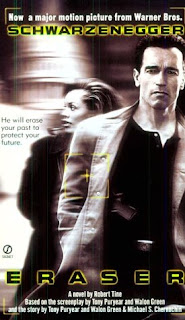
Eraser


Eraser, by Robert Tine
June, 1996  Signet Books

I was always under the impression that Eraser was an unofficial sequel to Arnold Schwarzenegger’s earlier movie Commando (1985). And this was an immediate reaction; I saw Eraser in the theater on its opening night, with the Arnold-obsessed friend I mentioned in my Total Recall review. This guy was so obsessed that, every July 30th (ie Schwarzenegger’s birthday), he’d call people up and tell them, “Happy Arnold Day.” I think Eraser came out around this time, or maybe a little before – all I remember is I’d just graduated from college and was spending the summer in Myrtle Beach, South Carolina, which is where I saw the movie. 

But it seemed clear that Eraser, which is likely considered a lesser movie in Schwarzenegger’s canon now, was at least somewhat of a tribute to Commando. It had the same sort of “comedy meets action” vibe, with Schwarzenegger playing a stone-cold badass who, despite his stone-cold badassery, had a gift for goofy one-liners. Also, Schwarzenegger played a “John” in both films: John Matrix in Commando and John Krueger in Eraser. Both films featured a black lead actress: Rae Dawn Chong in Commando and Vanessa Williams in Eraser. Schwarzenegger jumped out of an airplane in both films: before takeoff in Commando and before landing in Eraser. There was also a total callout to Commando in Eraser, with Schwarzenegger at one point wearing a jacket with “Let’s party!” written on it, this being one of his lines at the climax of Commando. 

What really set my friend and I to theorizing was that the end credits didn’t bill Schwarzenegger as having played “John Krueger;” instead, he was credited merely as “Eraser.” This gave the impression that Krueger wasn’t even the guy’s real name. And most importantly, “Eraser’s” job was creating new identities for people. It didn’t require a huge leap in deduction to figure that John Matrix could’ve changed his own name to John Krueger. Of course, all this is pointless, as the two films are clearly unrelated, but it was fun to think of Eraser as the Commando sequel we never got. But then, many years later I managed to get a copy of the never-produced Commando II script, dated February 1989 and written by Steven E. de Souza with revisions by Frank Darabont, and in it John Matrix goes up against a nefarious defense contractor…so similar to the plot of Eraser that I wondered if this was yet another connection between the two films. 

I recall at the time that I thought Eraser was fine, if fairly generic; it was clear even then that there was a huge difference between Schwarzenegger’s 80s films and his ‘90s films. His star power was still sufficient enough to make Eraser a hit, and it might’ve been his last non-franchise hit, I’m not sure. It was certainly better than the movies he made over the next few years, but I only saw it that one time in the theater. Then about a decade ago I got it on Blu Ray, and enjoyed it more than I thought I would. Still thought it was a bit generic, though, with none of the violence of those ‘80s movies and more of an attempt at being a “real” movie, with James Caan and James Coburn in supporting roles. Also, you knew for sure it was the ‘90s because suddenly Schwarzenegger was pecking away on a computer keyboard. And using a handgun – notice that in the ‘80s the action stars used machine guns, but they reverted to handguns in the ‘90s. Just kinder, gentler times overall. 

Well anyway, this tie-in novel courtesy prolific novelization author Robert Tine hews very closely to the film itself. And despite being 233 pages it’s a quick read; you could probably read it in the time it would take to watch the movie itself. It’s got some seriously big print, and looks very much like the average Gold Eagle paperback of the day. Tine also drops in the occasional weaponry detail, which gives it even more of a Gold Eagle vibe. There are no major differences from the film – this isn’t a Rambo III type novelization, that’s for sure – or at least none that jumped out at me. About the most I noticed was a bit more backstory for Krueger, who reveals that he got into witness protection years ago because a woman he knew was raped and he pushed her to testify, and she ended up getting killed because no one protected her. But then, this dialog might be in the film too, I can’t remember. 

Tine’s novel somewhat aids my “Commando sequel” theory: Krueger is referred to as “Eraser” in the narrative, same as Schwarzenegger was in the credits. He’s only called “Krueger” once or twice, and his WITSEC colleague Robert Deguerin (James Caan) refers to him as “John.” But then Deguerin himself is referred to as “Samaritan” in the novel. They are all US Marshals, part of an “elite Shadow Operation” by the name of WITSEC, and these are their code names. It lends the story more of a comic book vibe than the film actually had. This is somewhat present in the opening action scene, which sees Eraser, masked head to toe in black like a ninja, taking out several mobsters as they’re about to torture-kill an informant named Johnny C. This was another part my Arnold-obsessed friend and I got a kick out of, as Schwarzenegger first appears while hiding behind an opened refrigerator door. My “eccentric” friend liked to do the exact same thing; he was fond of “sneak attacking” people, usually appearing out of the shadows to throw a kick at your head or whatever. Hiding behind an opened fridge door was one of his favorites, and there his friggin’ hero was doing the very same thing on the big screen! 

This opening eventually paves the way for the main plot, which has Eraser taking on a defense contractor which is planning to sell off its high-tech experimental weaponry to the highest bidder. Ultimately the Russian mafia is involved, but this isn’t really elaborated on. Eraser’s main enemies are his fellow agents, rogue ones from WITSEC and the CIA. One of the problems with Eraser is that Samaritan is played by James Caan, and thus the producers give him a bit more personality and memorable lines. This movie’s over 25 years old and I’m sure the majority of you have seen it, so no spoiler alert but Samaritan turns out to be the bad guy. The thing is, because the producers gave him a personality he lacks the batshit craziness of previous villains in Schwarzenegger films – like the guy in Commando, or even Richter in Total Recall. Guys you spend the entire movie waiting to see get killed. 

And honestly, if you have seen the movie, you’re not going to get much new stuff out of Tine’s tie-in, or perhaps we should refer to it as a Tine-in? No, that would be stupid. But really, the book is almost a straight take on what’s seen in the film, and for the most part Tine doesn’t even add much inner stuff for the characters, to give perspective or depth. This actually could’ve helped the book in a major way. For example, the plot concerns Lee Cullen (Vanessa Williams), an executive at defense contractor Cyrex, who wants to turn in evidence on some illegal and traitorous actions involving newly-developed rail gun technology. While Tine displays some of Lee’s concerns and fears early in the novel, in later action scenes he skips all that and just tells us what she’s doing. Like the big action scene in the zoo; it’s all Lee aiming guns and firing, or even later in the book bashing some guy in the head and escaping, and it all just happens, with no internal turmoil from Lee, someone entirely new to this world of violence, as she prepares herself to attack someone. 

Otherwise the action follows almost identically to the film. The airplane sequence also plays out the same, with Eraser drugged by Samaritan and then managing to jump out of the plane after he wakes up. I recall the part where he parachuted into the auto junkard – asking the kids “Where is this?” and the kids replying “Earth – welcome!” – got a big laugh in the theater, probably the biggest laugh of the movie. But then, Schwarzenegger’s one-liners suffered too in the ‘90s; his “You’re luggage!” to a CGI-rendered alligator he shoots at the zoo was lame even then. Actually Caan is the one who gets the most comedic lines, his Samaritan almost having a grand old time of it as he goes bad. Also the violence has been toned down; Tine’s novelization might be more violent than the film, with occasional mentions of heads being blown off. I also appreciated his description of how the rail guns worked, in particular the “eerie glow” of the “X-ray scope” on the guns. 

Toward the climax Eraser and Lee infiltrate the Cyrex HQ, a scene which plays as much on comedy as action, featuring as it does Johnny C feigning a heart attack in what could almost be a skit from a comedy movie. From there we get into the action, with Eraser again blasting away with a sidearm as Samaritan and the CIA goons try to hunt him down. But it’s so far removed from the action spectacles of the ‘80s, with those damn computers once again central to the action as Lee hurriedly types away on a keyboard. I seem to recall the Commando II script also featured John Matrix infiltrating the high-tech HQ of a defense contractor (it’s been several years since I read it); Frank Darabont, who revised that unproduced script, also did some uncredited rewrites on Eraser, so this entire sequence could be yet another tangent in the “unofficial Commando sequel” theory. 

One area in which Tine’s novelization veers from the movie is the ending. I remember reading a magazine article years and years ago where Vanessa Williams stated that she and Schwarzenegger had originally kissed at the end of Eraser, but this “romantic” ending was changed because it “didn’t work.” Tine actually has that ending here in the novel. We see Eraser and Lee at an airport, deciding on where to go. He returns her St. George necklace, which he took from her earlier in the book as part of her “identity erasing.” The idea being that he is now her protector. They kiss and that’s that. I can’t even remember how the actual movie ended right now. Maybe I should get the Blu Ray out and watch it again. Really though, Tine’s novelization just reinforced the idea that Eraser is a bit generic, like one level above a direct-to-video release. Which makes it all the more sad that it was one of Schwarzenegger’s better ‘90s movies!

Monday, January 17, 2022

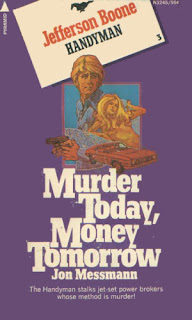
Jefferson Boone, Handyman #3: Murder Today, Money Tomorrow


Jefferson Boone, Handyman #3: Murder Today, Money Tomorrow, by Jon Messmann
August, 1973  Pyramid Books

The third volume of Jefferson Boone, Handyman is a little better than the previous two, because Jon Messmann backs off on the “international terrorist” angle and delivers a mystery plot that’s more in-line with his cerebral protagonist. It was kind of hard to buy the whole Jefferson “Handyman” Boone concept in the earlier books; as I wrote, he just came off a bit too much like “James Bond meets Frasier Crane” to be believable. Messmann also slightly tones down on the introspective musings, which is a help, but he also turns way up on the casual misogyny. 

Again, I don’t virtue-signal lightly (or ever, really), but in this case there’s no other word for it but misogyny. Messmann is kind of a creep in how he typically treats his female characters, as has been noted in reviews of his other novels (as well as in the comments sections). And I’m not talking about how he objectifies them, how he always mentions their breasts – I mean I encourage stuff like that from my men’s adventure authors; these books should come straight from the male id. What I mean is how many of his male protagonists are just total assholes to women. Constantly putting them down, snipping at them, mocking them, etc. Murder Today, Money Tomorrow goes further in this regard than any previous Messmann novel I’ve read, with the ultimate effect that Boone (or “Jeff,” as Messmann most often refers to him in the narrative) comes off as a dick, and the “taming of the shrew” angle ultimately makes no sense in the context of the book. 

There’s no pickup from previous volumes, and in fact Messmann gives a bit more background on Jeff this time. Not too much, but in dialog Jeff relates how he decided to become an international “handyman” after the murder of his diplomat father. In fact we’re told his dad was “killed right in front” of Jeff. This volume overall really ties into Jeff’s past; when we meet him he’s waiting in the dark in rural Virginia for a childhood friend named Roger Van Court, an eccentric guy Jeff never really liked. Jeff’s dad and Roger’s mom were apparently having a bit of a fling when the two boys were kids, and Jeff would spend every Christmas at the Van Court estate. And we’re really in the upper-crust world of the filthy rich; this series has always traded on the jet-set world, and Murder Today, Money Tomorrow makes it clear that Jefferson Boone grew up in the lap of luxury. This of course makes his current role as a total bad-ass a bit hard to buy, but whatever. 

That bad-assery is displayed posthaste, though; first Boone is approached by a “truculent” young blonde with an “elfin” build who appears to be with Roger. Jeff immediately dislikes her, for reasons Messmann never really makes believable. She’s protective of Roger, clearly, but Jeff suspects her of foul play or somesuch. Roger does appear, but only momentarily, as some guys with guns show up and start blasting at him. In the pitch dark Jeff manages to turn the tables, killing off the thugs with his pistol. Here Messmann introduces a new gimmick to the series: Jeff drops a “little gold toolbox” onto one of the corpses. In other words, the calling card of the “Handyman.” Meanwhile, both Roger and the girl have fled. Jeff goes back to DC for some good lovin’ with a chick he’s been checking out at cocktail parties over the past few years; Messmann develops this curious subplot where the girl, Fran, she of the “full-bosomed, long-legged loveliness,” wants to be Jeff’s steady, but the relationship is broken off within a few pages, due to jealousy. Fran calls Jeff up next morning and discovers another girl on the line. This is Cassie, the “elfin blonde” who was with Roger the night before; she’s lost Roger as well, and will hang out with Jeff for the duration to find him again. 

The funny thing about Money Today, Murder Tomorrow is that the back cover makes it clear that Roger Van Court, a geologist, has made a discovery that could lead to a new form of power. However, Jefferson Boone spends the entire novel not knowing what it is Roger’s discovered, nor why so many people are trying to kill him. Even more ridiculously, Cassie herself has no idea what Roger was up to, even though she’s spent the past year as his companion. The two had an “understanding,” one that Messmann plays out as a lame mystery for almost the entire novel. But it’s clear that she and Roger were close, and a recurring bit is that Jeff is just unable to see Roger being with this cute blonde with an elfin build…however, when Cassie comes over to Jeff’s pad and takes off her coat, Jeff sees that “the little elf had magnificently high, full breasts.” 

Poor Cassie can’t catch a break from Jeff or Roger. She goes around the world with Jeff, who treats her like shit the entire time. Putting her down, mocking her, disparaging her relationship with Roger. He’s constantly on the attack, too; I lost count of the number of times Messmann used the dialog modifier “tossed off” when Jeff spoke to Cassie. But then Roger was a dick to her, too, a condescending one at that. She’s from backwoods Tennessee (or maybe it’s West Virginia; Messmann can’t seem to make up his mind), and Roger met her while on one of his research trips. He took a cotton to her, took her under his wing; it was a podunk town and everyone always took Cassie for granted until Roger Van Court came along. But, we learn, he tried to give her culture, giving her books to read, teaching her how to act in “polite society,” etc, etc. Now that’s “mansplaining” folks. And of course done without any apology; indeed, Jeff is quite pleased with the progress Roger made on the otherwise rednecked Cassie! 

But see that’s the thing. Nowhere does Cassie act like a dumb hick, or do anything stupid, or do anything that would make Jeff dislike her. And yet Jeff does dislike or at least distrust her, and goes out of his way to attack her at all times. It makes him seem like a total asshole, and what’s weird is that you get the impression that Messman doesn’t think he is an asshole. I mean we aren’t talking like an anti-hero sort of deal here. Jeff is the hero, no questions asked. So he takes Cassie under his own wing and they follow the vague leads on where Roger could be holed up, and why. Given this, Cassie has a greater part in the narrative than previous female characters. But it’s a strange relationship for sure, and Jeff’s attitude toward Cassie would certainly get him canceled in today’s “believe all women” world. 

It soon becomes clear that Roger is into something deep and is hiding for a reason. Jeff is constantly followed; even when going to pick Cassie up, driving back into Virginia, he’s tailed by some goons, managing to lose them in some salt flats. It gets to be annoying, though, because every time Jeff gets close to Roger, the guy will either run away or send an emissary in his place, to the extent that it almost takes on the tone of a Monty Python skit. Roger’s sought out Jeff, though, because Jeff’s “Handyman” status has become legedary, and also even as a kid Jefferson Boone was known for his fortitude. The action is infrequent, but always handled in a realistic matter when it happens, however as usual Messmann never dwells on the gory details. After encountering a few random thugs, Jeff deduces that Portugal had something to do with whatever Roger was into, so he and Cassie head there. 

The jet-setting Eurotrash stuff is pretty thick, here; as I mentioned before, Jefferson Boone, Handyman is more akin to the trash fiction bestsellers of the day, a la Burt Hirschfeld and the like. Messmann shows restraint, though, in that Jeff does not conjugate with the ultra-hot, ultra-stacked beauty Maria De Vasquez, whom he first sees getting into a fancy vintage car outside of a restaurant. Through various plot developments, Jeff has settled on Maria’s wealthy uncle as someone who might know what Roger was up to. De Vasquez seems to have walked out of a Bond novel, a man of such wealth that he retains his own retinue of enforcers and who has a garage filled with priceless vintage cars. Even here though the battle of wills with Cassie is played out; De Vasquez invites Jeff and Cassie to a party at his villa, and Jeff keeps imploring Cassie not to go, telling her she’ll be “out of her league” and “make a fool of herself” in front of all the jet-setting Euroscum. Seriously, the guy’s a dick. 

But the “Pygmallion” stuff is only reinforced when Cassie, wouldja believe, comes out of her room ready for the party…and it’s as if she’s become an entirely different woman. She has just one dress – bought for her by Roger, of course, for when he took her to socialite parties! – and she’s gotten her hair done, and she of course manages to hold her own at the party. Indeed she holds it so well that Jeff finds himself ignoring super-stacked Maria to keep checking on Cassie! Now all along Cassie’s been telling Jeff there was “more to the story” so far as her relationship with Roger went, and that night she finally tells Jeff it all: due to a “childhood incident,” Roger was no longer able to, uh, rise to the occasion, thus he and Cassie had a sort of “student-teacher” relationship and nothing more. And folks you better believe she’s ready for some good lovin’. She and Jeff go at it in a fairly explicit scene that for once doesn’t play out with the Hirschfeld-esque metaphors and analogies of previous such scenes. 

And meanwhile, Jeff still ponders this unfathomable case, this “increasingly multifaceted rigadoon with death.” Yes, that’s actually a line in the book. I don’t think even prime-era William Shatner could’ve delivered that with a straight face. (Orson Welles probably could’ve…and then he’d take a thoughtful puff on his ever-present cigar.) Finally, on page 147, Jeff learns that Roger was in-line to a breakthrough in “thermal energy.” This he learns from his State Dept. contact Charley Hopkins. And, of course, De Vasquez and his minions are out for it. This leads to a nice action scene where Cassie gets in on it; a country girl, she’s more than familiar with handling a rifle, and uses one to blast apart some thugs they chase while Jeff handles the car. As I say, she’s a likable character, making Jeff’s treatment of her seem even worse…though of course by this point they’ve been to bed a few times together, so at least he’s nicer to her. 

This proves to be the action highlight of the novel. As befitting the mystery thriller Murder Today, Money Tomorrow really is, the actual climax plays out more on a suspense vibe. Jeff and Cassie return to Roger’s home, where they learn exactly why thugs were constantly popping out of the woodwork to tail them. In other words there was a traitor in Roger’s life, and this character is dealt with in an entertaining – if predictable – finale. And it’s also worth noting that Jeff pitchforks a guy in this climactic sequence. It’s also interesting that Cassie knows her fling with Jeff has a limited lifespan; at novel’s end she wants one more roll in the hay, then she’s off to live her life. 

But man, there’s a lot of stuff I didn’t even cover here…like the bit where Jeff and Cassie go back to Cassie’s home town and run into some rednecks there. And other stuff on Jeff’s highfalutin childhood and jet-setting life in DC. As ever Messmann packs a lot of prose into the small, dense print of the book, clearly trying to write a “real” novel instead of the third installment of an action series. And I have to say, I think he succeeded this time. It won’t float everyone’s boat, but Murder Today, Money Tomorrow was pretty entertaining…if you can put aside the main character’s rampant misogyny, that is.